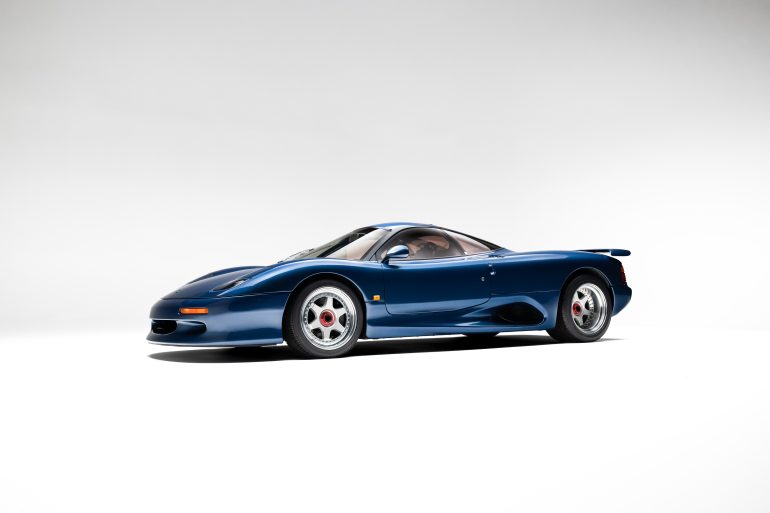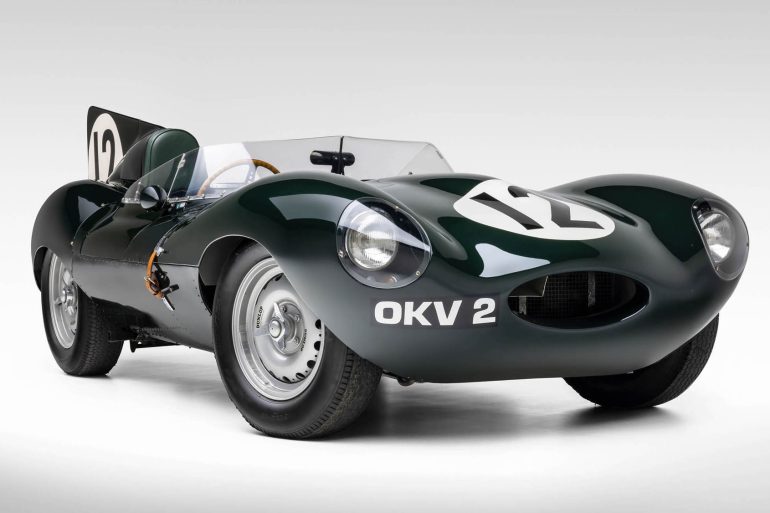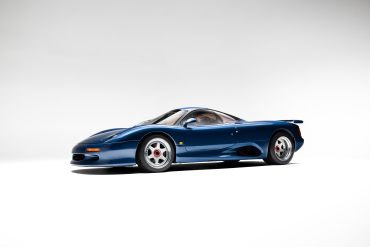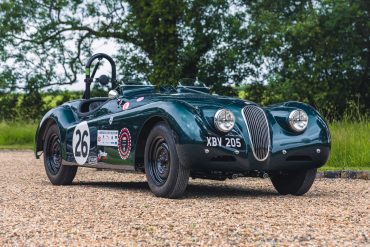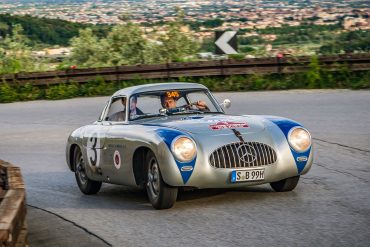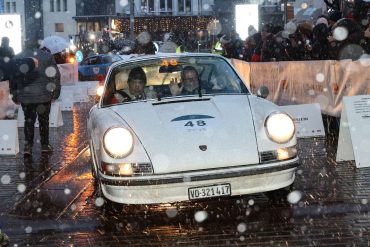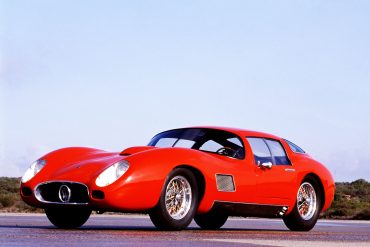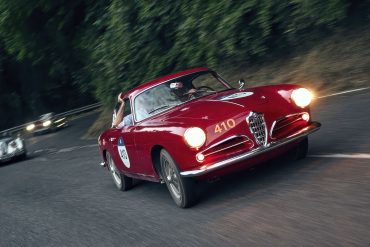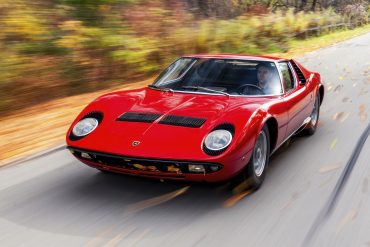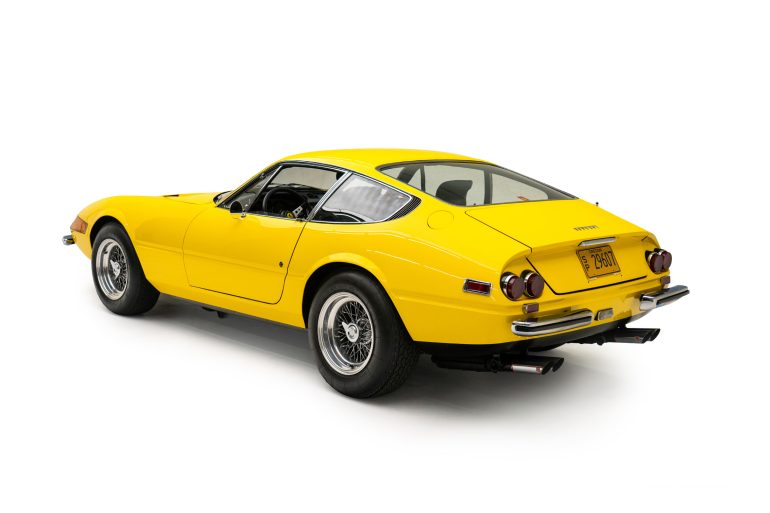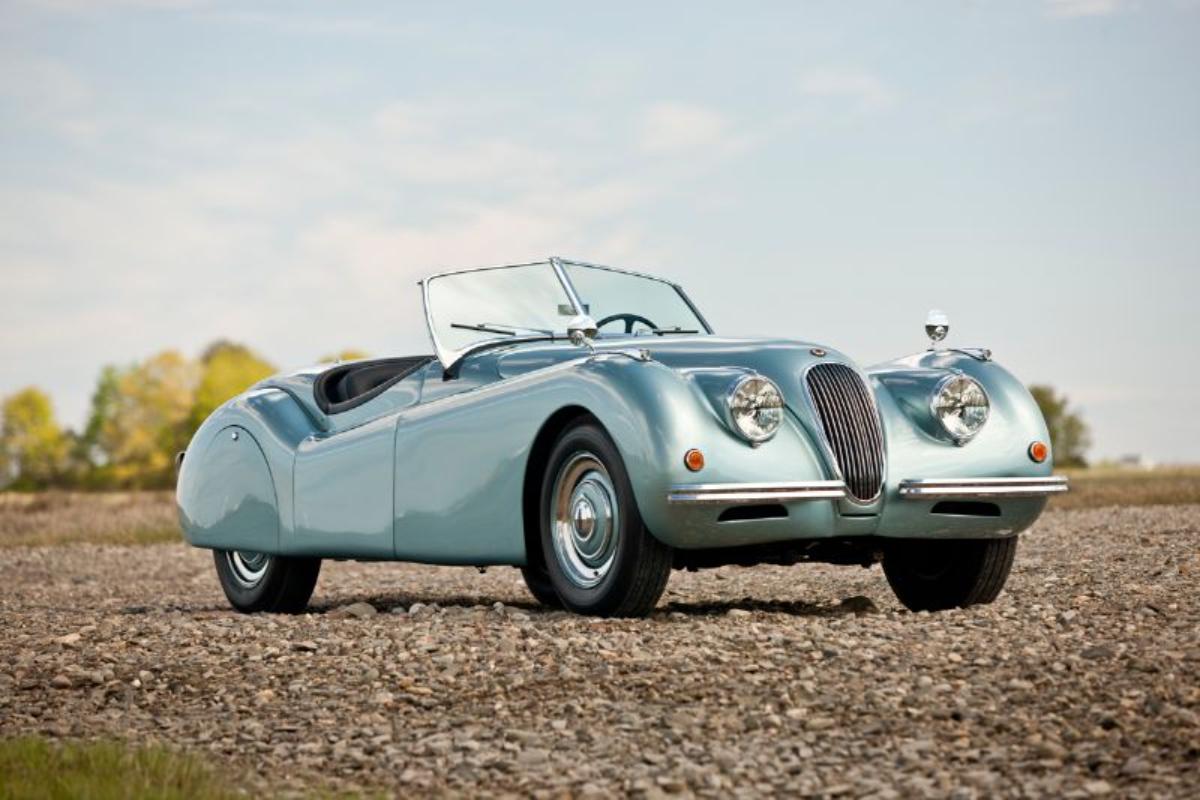
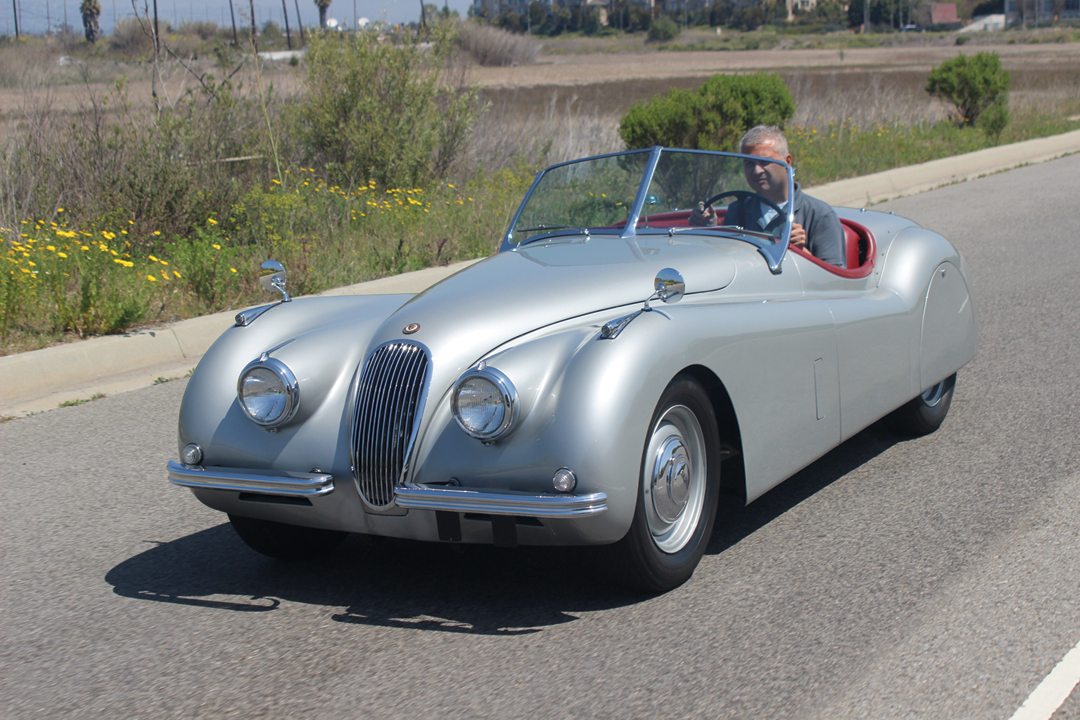
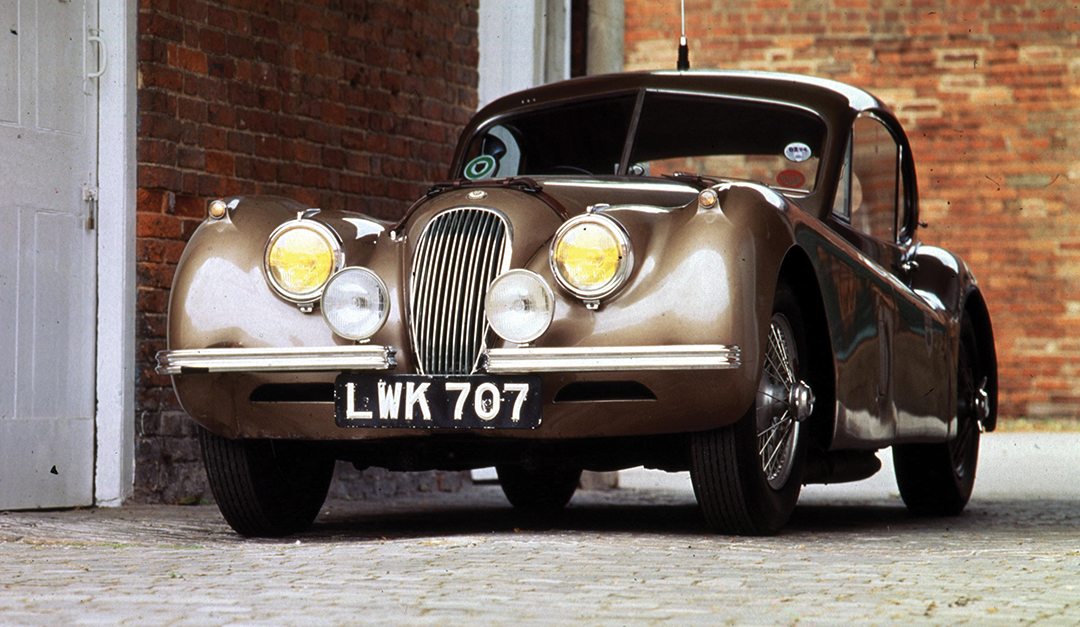
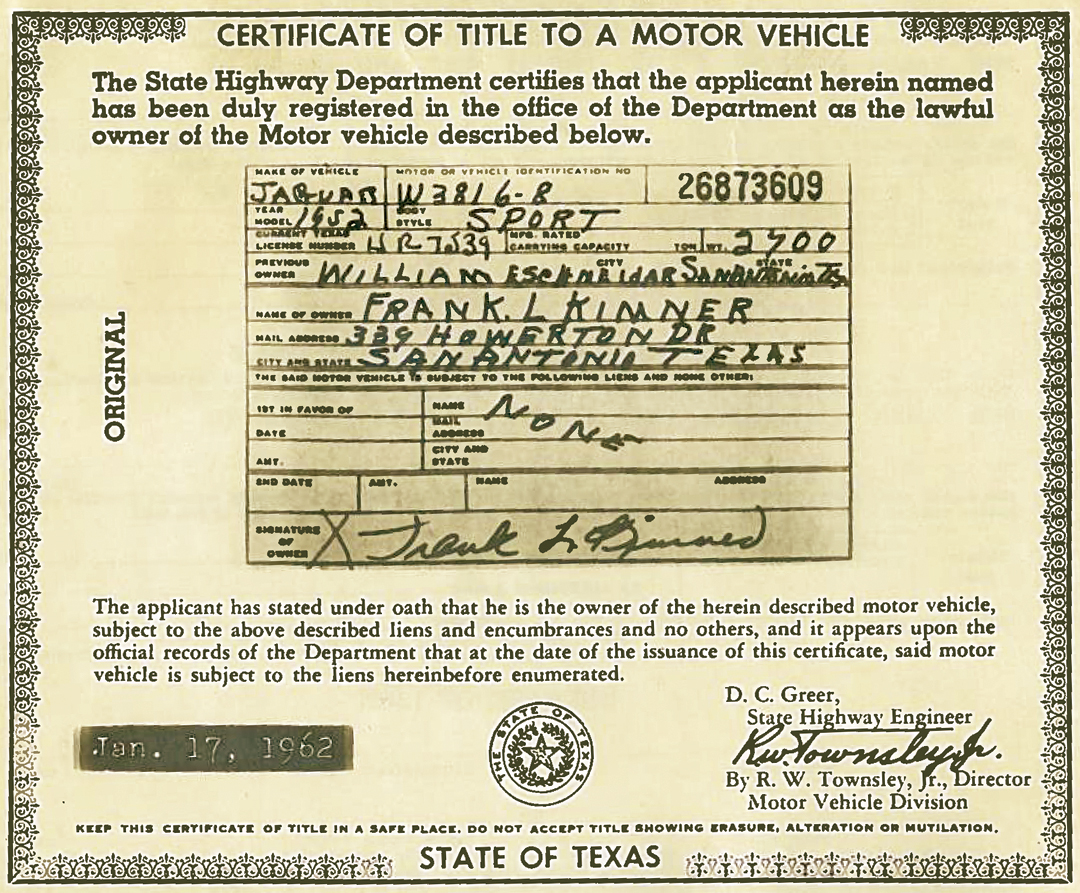
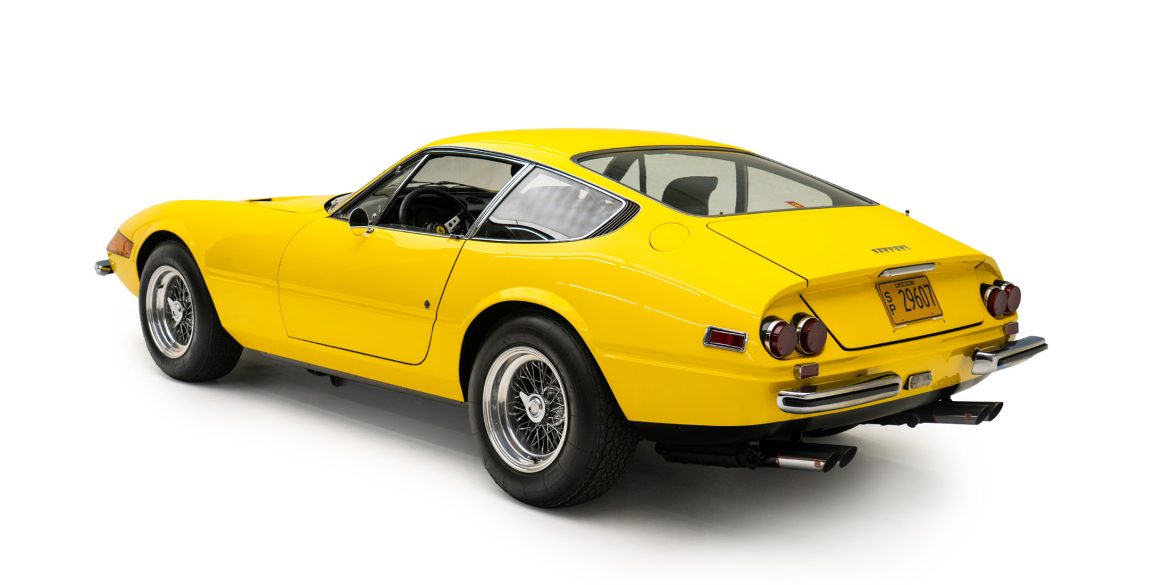
Eleven holders of the production top-speed title at the Petersen from July 18: the 120 mph Jaguar XK120 of 1949, the first over 150 (Mercedes 300 SL) and 200 (RUF CTR Yellowbird), through to the 282 mph SSC Tuatara.


The car William Lyons built to show off an engine and had to put into production because the crowd at Earls Court would not let him do otherwise: a 3.4-litre twin-cam six in a body shaped in a fortnight, 120 mph when a family car did 70, £998 before tax, and 132.6 mph on the Jabbeke road in May 1949 to prove the name was not a boast. The alloy roadsters that Clark Gable and Phil Hill drove, the steel cars that followed, the fixed-head and the drophead, the Silverstone win of 1949, Le Mans and the Mille Miglia of 1950, Moss's first great win at Dundrod, Appleyard's three Coupes des Alpes in NUB 120, Les Taylor's Darwin-to-Alice Springs record, Norman Dewis at 172 mph in 1953, and the C-type that grew out of it and won Le Mans in 1951. 12,055 built before the XK140 took over in 1954. 97 Jaguar XK120 stories in the archive, in order.
The pieces to start with
Eight pieces on the car: the staff history of the fastest production car of its day, Vintage Racecar's 1952 roadster, Raffi Minasian's seventy years, Patrick Quinn's Darwin-to-Alice Springs record, Art Evans racing his Jaguars, Mike Lawrence on the Swallows and the lost four-cylinder, the Hansgen Special and Mark Brinker's drag-racing XK120.
Jaguar planned 200 XK120s and built more than 12,000, many for export dollars. The 3.4-liter twin-cam six with its alloy head made 160 bhp; the engine was planned by Lyons, Heynes, Hassan and Baily on wartime fire-watching duty.
Jaguar’s new 3.4-liter twin-cam six was ready in 1948 but the saloon meant to take it was not, so William Lyons drew an alloy-bodied two-seater on a modified Mark V chassis and planned 200. Driven, in 1952 form.
A nine-year-old at the 1971 L.A. show walked past muscle cars to a “Classic Cars” corner and met his first XK120, 23 years after Britain did. By Design on the 1948 car that dropped the upright grille and buckboard seating.
Les Taylor deserted in wartime, married under a false name and in 1950s Australia set a world record in an XK120 that stood until Moss and Jenkinson’s 1955 Mille Miglia average of 98 mph. Patrick Quinn on a scoundrel’s record.
Phil Hill won the 1950 Pebble Beach Cup in one of the first aluminium-bodied XK120s. Art Evans raced his own: 160 bhp from the 3.4 twin-cam, synchromesh on three gears, side curtains behind the seats and 12-inch drums that faded.
Swallow Sidecars’ body added 15 percent to an Austin Seven’s price and more to its standing; one appears in Mary Poppins Returns. Mike Lawrence on “Wardour Street Bentleys”, fire-watching on the Coventry roof and a lost engine.
Watkins Glen, 19 September 1953: Walter Hansgen’s homebuilt Jaguar special ran short of fuel on lap 19, lost the lead to George Harris’s Chrysler-Allard and swapped it back five times on the final lap to win by two car lengths.
San Antonio gave an elderly woman notice to remove the Jaguar XK120 her absent son had left in the driveway since the early 1970s, or pay $400. Word reached David Duthu through a church group. Mark Brinker on what he found.
The newest writing on the Jaguar XK120, as it is published.
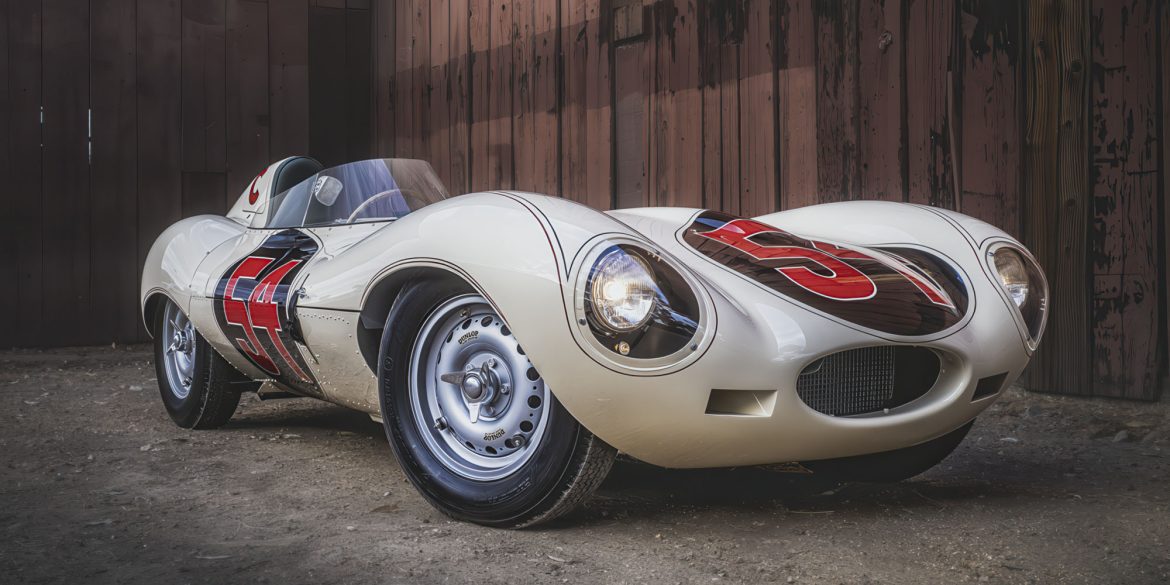
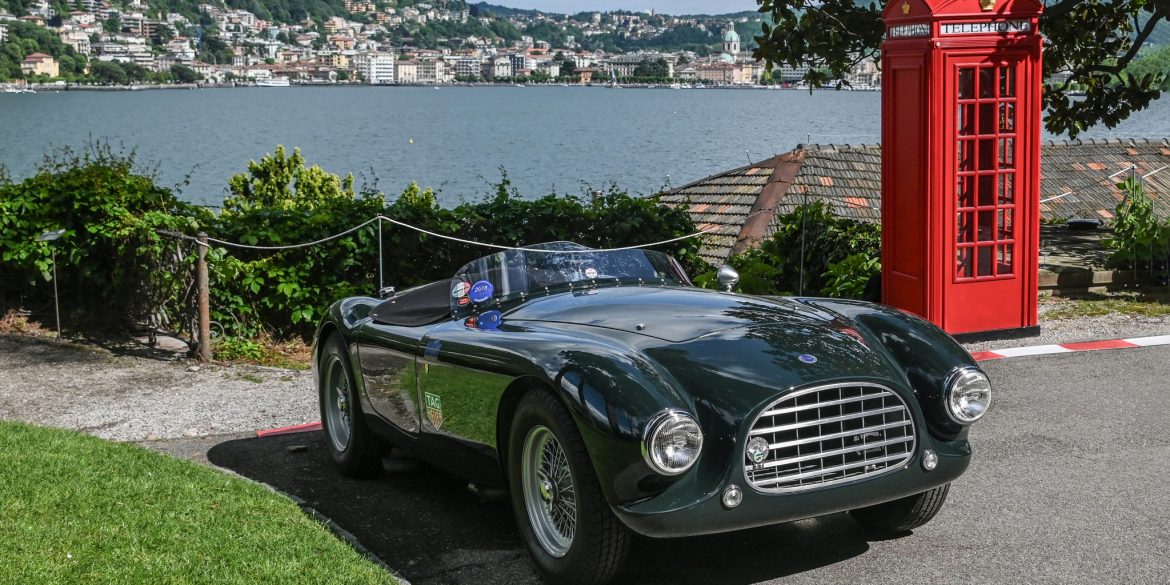
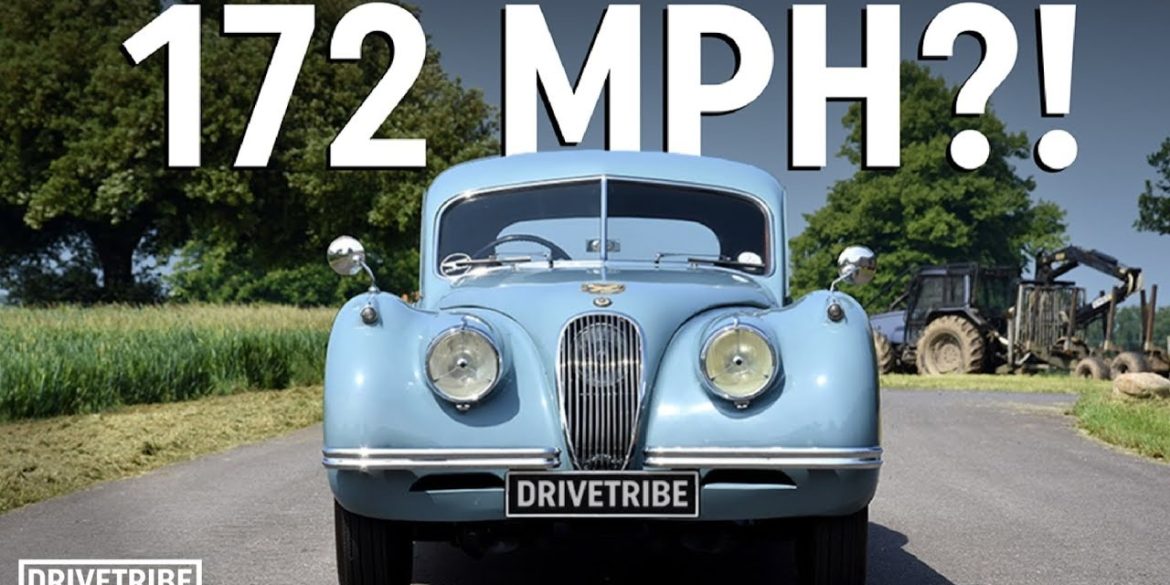
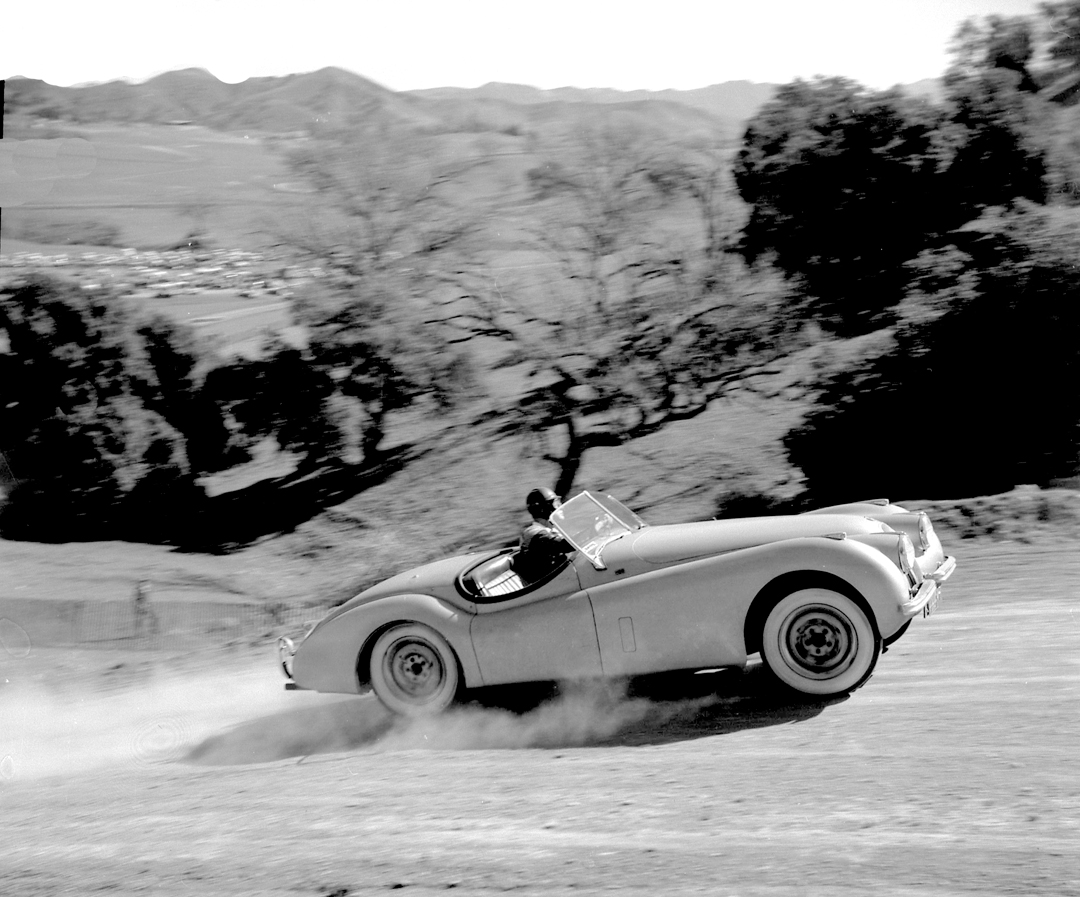
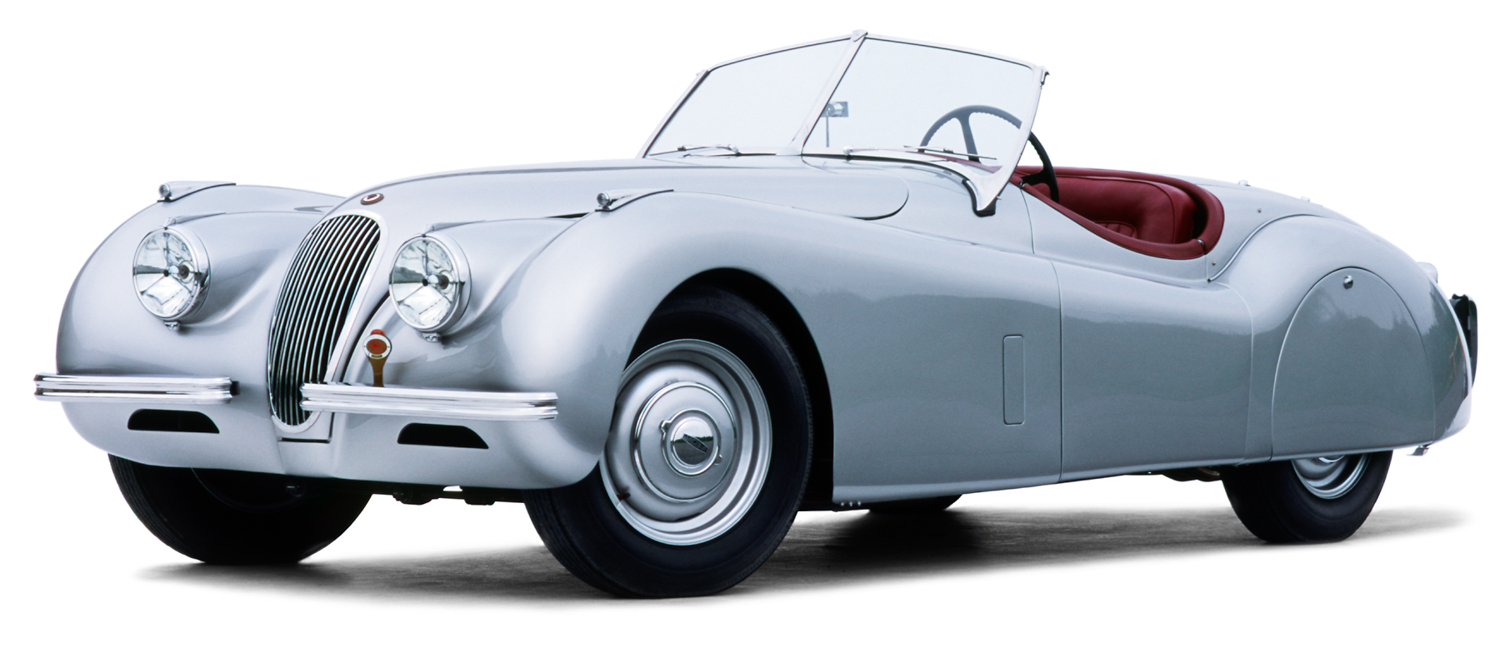
The Jaguar XK120 is the two-seat sports car Jaguar showed at the London Motor Show at Earls Court in October 1948 and built from 1949 to 1954, the first car to carry the XK engine that powered every Jaguar for the next four decades, and the car that made Jaguar an international name. The number is its top speed in miles per hour: 120, at a time when the fastest production cars in the world struggled past 100, and Jaguar proved it in May 1949 on the closed autoroute at Jabbeke in Belgium, where the works test driver Ron Sutton took a standard car with its hood and screen removed to 132.6 mph and, with the windscreen up, past 126. The engine was the point. William Heynes, Walter Hassan and Claude Baily had designed the twin-overhead-camshaft, seven-bearing, 3,442 cc straight-six during the war, on fire-watching nights at the Coventry works, for the big saloon that became the Mark VII; the XK120 was meant to be a show car and a short run of perhaps 200 to advertise it, and the orders that followed the show turned it into a model. Its 160 horsepower in a car weighing a little over 1,300 kg gave it the performance of a racing car with the manners of a saloon, which is why the archive's own history calls it the world's fastest production car of the early 1950s, and why Lyons priced it at £998 before purchase tax in Britain and $3,945 in New York, less than half a Ferrari.
The first 242 were bodied in aluminium over an ash frame, by hand, because nobody expected to build many; from the spring of 1950 the body was pressed in steel, with aluminium doors, bonnet and boot lid, and those alloy cars are now the most valuable XK120s of all. The open two-seater, the roadster, was joined by the fixed-head coupé in 1951 and the drophead coupé in 1953, and by the Special Equipment car, the SE or M in America, with 180 horsepower, stiffer springs, wire wheels and twin exhausts. Most went abroad, four in five of them to the United States, where Max Hoffman and Charles Hornburg sold them to film stars and to the young men who founded the sports car clubs of California and the East, and raced them at Palm Springs, Pebble Beach, Watkins Glen and Elkhart Lake. The XK120 won the first race it entered, the Production Car race at Silverstone in August 1949, ran at Le Mans and in the Mille Miglia in 1950, gave Stirling Moss his first major victory at the Tourist Trophy that September, won the Alpine Rally's Coupe des Alpes three years running in Ian Appleyard's NUB 120, and fathered the XK120C, the C-type, that won Le Mans at its first attempt in 1951. Production ended in 1954 at 12,055 cars, 7,631 roadsters, 2,678 fixed-heads and 1,769 dropheads, and the XK140 and XK150 carried the shape to 1961, when the E-type replaced it. The archive has 97 Jaguar XK120 stories: the staff history of the fastest production car of its day, Vintage Racecar's 1952 roadster, Raffi Minasian on seventy years of the design, Patrick Quinn's Darwin-to-Alice Springs record, Art Evans racing his Jaguars in California, Mike Lawrence on the Swallows and the four-cylinder XK that never was, the Hansgen Special built from a wrecked XK120, Mark Brinker's drag-racing Jaguar, Carl Goodwin's Watkins Glen and Callicoon, Pete Lyons's cats, the Pinin Farina one-off, Clark Gable's car winning at Pebble Beach, Norman Dewis's Jabbeke car and the XK120s at auction.
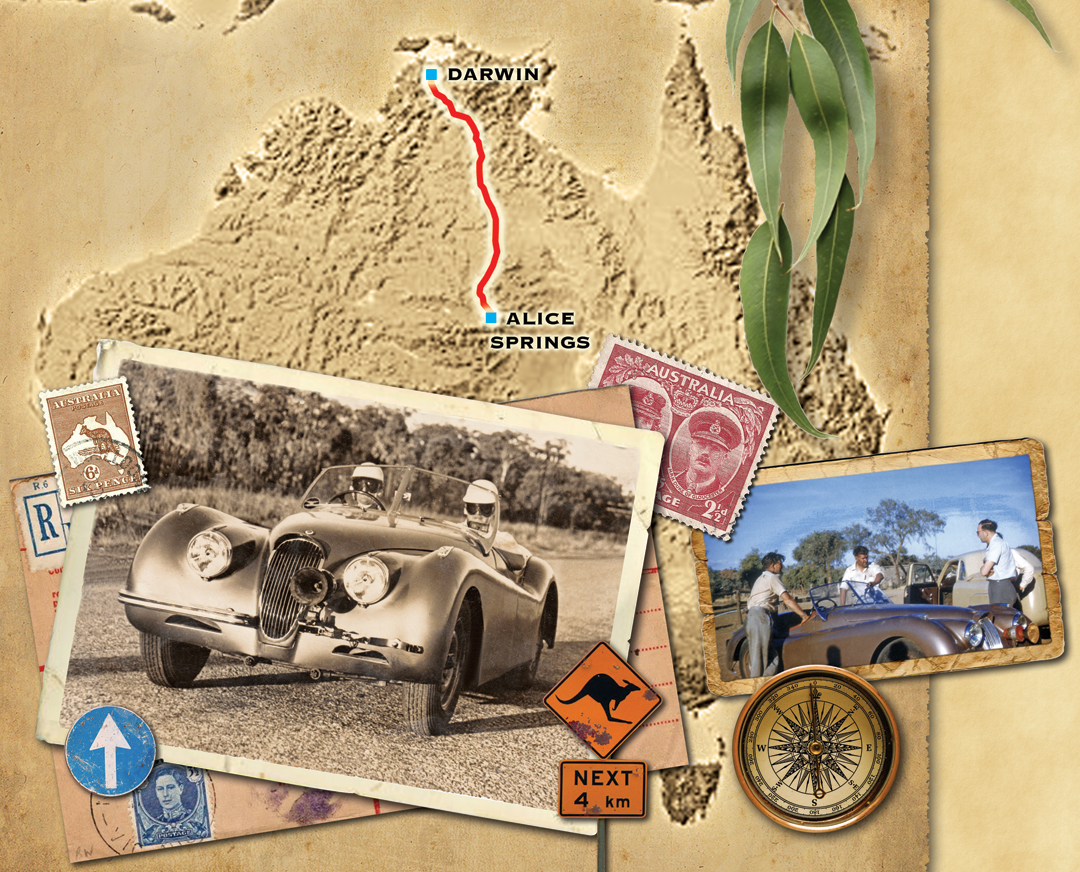
Jaguar's story before the XK120 is Swallow Sidecars, the Austin Seven Swallow, the SS1 and the SS100 of 1936, the pre-war 100 mph sports car that Sean Smith's and Patrick Quinn's archive pieces cover; Mike Lawrence's "Of Jaguars, Swallows and the Lost 4-Cylinder" tells how the company became Jaguar in 1945, the initials SS having acquired a different meaning, and how the new engine was planned as a family: a four-cylinder XK100 of 2 litres for a small sports car and the six-cylinder XK120 above it, the number in each case the car's intended top speed. The four was built and tested and quietly abandoned; the six went into production. Lyons wanted it in the big Mark VII saloon, which was not ready, so for Earls Court in 1948 he had a sports car body made to carry it, drawing the shape himself, as he drew all his cars, on a shortened Mark V chassis with torsion-bar independent front suspension by Heynes, and with the bodywork hand-beaten in aluminium. The car on the stand was called the XK120 Super Sports, in bronze, and it stole the show; the orders, mostly from America, were more than a hand-built car could meet, and Lyons committed to tooling for steel while the Coventry works built the first cars in aluminium through 1949 and into 1950. The press doubted the 120 mph claim, so on 30 May 1949 Jaguar closed the Jabbeke-Aeltre autoroute in Belgium with the Royal Automobile Club of Belgium timing, and Ron "Soapy" Sutton ran a white roadster, HKV 500, at 126.448 mph with the screen up and 132.596 mph with the screen and hood off and a metal tonneau over the passenger seat. Jaguar went back to Jabbeke in 2013 with an F-type, as the archive reports, to mark the sixtieth anniversary of the second record there; the 1949 run is where the XK120's name was earned. Raffi Minasian's "70 Years of Spectacular" is the archive's essay on the shape, and the 1949 roadster in the Car of the Day pages is one of the first.
The first production cars went to the people who could sell them: Clark Gable had chassis 670003, one of the earliest, and was photographed with it in Hollywood, which did more for Jaguar in America than any advertisement, and the archive's 2012 Pebble Beach report records that car winning its class there sixty-three years later. Phil Hill bought an alloy XK120 in California and won the Pebble Beach Cup with it in November 1950, the first of the Pebble Beach road races, which Art Evans's history in the archive describes; Art Evans himself raced two XK120s in the 1950s and his "Racing My Jaguars" and "Jaguars and Jim Peterson" are the archive's view from the cockpit of the West Coast club racing the car created. In Britain Jaguar entered three cars, prepared by the works and lent to private drivers, in the Daily Express Production Car race at Silverstone on 20 August 1949, and Leslie Johnson won it with Peter Walker second; the same approach took six works-supported cars to the 1950 season. Johnson finished fifth in the Mille Miglia in April 1950, the best a British car had done; at Le Mans in June, three XK120s ran, Johnson and Bert Hadley lying third at twenty-one hours before the clutch failed, Peter Clark and Nick Haines twelfth and Peter Whitehead and John Marshall fifteenth, and Jaguar learned that the car was fast enough and heavy enough to need a racing version. In September Stirling Moss, twenty years old, drove Tommy Wisdom's XK120 to win the RAC Tourist Trophy at Dundrod in the rain, his first major win, and Lyons offered him a works drive on the spot; Robert Newman's piece on "Lofty" England, the service manager who became the team manager, is the archive's account of how the works team was put together. Ian Appleyard, Lyons's son-in-law, won the Alpine Rally's Coupe des Alpes in NUB 120 in 1950, 1951 and 1952, the first Coupe d'Or for three unpenalised runs, and the Tulip and RAC rallies besides. In Australia in August 1951 Les Taylor and Dick Rendle drove a month-old bronze XK120, chassis 660569, the 954 miles from Darwin to Alice Springs in 10 hours 32 minutes, a shade over 90 mph on a military road with spoon drains and wild horses, the open-road record that stood until Moss and Jenkinson's Mille Miglia of 1955; Patrick Quinn's "Jaguar Outback Record" is the archive's telling. At Montlhéry in October 1950 Johnson and Moss ran a car for 24 hours at 107.46 mph, and in August 1952 Johnson, Moss, Jack Fairman and Hadley ran a fixed-head coupé there for seven days and nights, 16,851 miles at 100.31 mph. The archive's for-sale profile of an XK120 and the 2008 profile of the C-type lay out the running gear the two shared.
Every story on the site about the man whose first wins came in an alloy XK120, newest first.
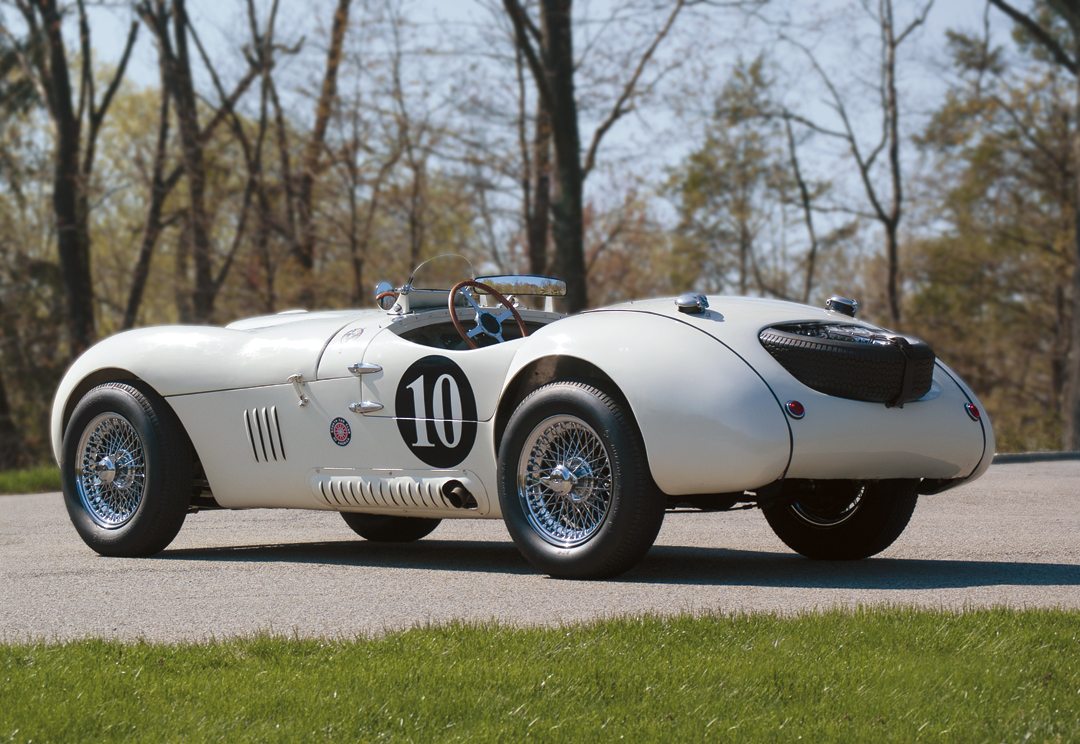
The steel-bodied roadster came in the spring of 1950, slightly heavier and visibly the same, and with it the production that the alloy shops could never have managed: Vintage Racecar's "1952 Jaguar XK120" in the archive is the model's close study, Lyons's halo car explained from its engine outward. The fixed-head coupé of March 1951 added a roof with the Mark VII's walnut and wind-up windows and was the car Jaguar used for the Montlhéry week; the drophead coupé of April 1953 put a proper padded hood and the coupé's interior on the open car; and the Special Equipment package, from 1951, gave 180 horsepower with high-lift cams and a lightened flywheel, wire wheels, twin pipes and stiffer torsion bars, which is the car the archive's 1954 SE roadster at Auburn and the Pinin Farina one-off are. The XK120C, the C-type, was announced in 1951: the XK120's engine and gearbox at 200 and then 220 horsepower in Bob Knight's tubular frame under Malcolm Sayer's aerodynamic aluminium body, some 300 kg lighter, with rack-and-pinion steering, and it won Le Mans in June 1951 in the hands of Peter Walker and Peter Whitehead at its first appearance, and again in 1953 with Tony Rolt and Duncan Hamilton and disc brakes; Pete Lyons's "In the Beginning... there was the C-type", Ed McDonough's "Cat's Cradle" on the Rolt/Hamilton car and Matthew Stevens's 2008 C-type profile are the archive's, and the C-type has a page of its own on this site. Norman Dewis, who had joined as chief test driver in 1952, took a modified XK120 roadster with a bubble canopy, an undertray and a 1.5-inch-lower screen back to Jabbeke on 20 October 1953 and ran the flying mile at 172.412 mph, a record for a production-based car that stood for years; the car's restoration and its 2013 reunion with Dewis at the Quail are in the archive, and the Jabbeke recreation story has the detail. The Hansgen Special of 1953, the subject of the archive's "American Special" piece, was Walt Hansgen's answer to the C-type he could not buy: a wrecked XK120 rebuilt as a cycle-winged special that won the Watkins Glen Grand Prix in September 1953, the race Carl Goodwin's "1953 Watkins Glen" describes, and Goodwin's "Callicoon Sports Car Races" is the same summer's forgotten road race with the Jaguars in it. Mark Brinker's "Incarcerated Drag Jag" is a 1952 roadster that spent its American life on the drag strip. By 1953 the XK120 was outclassed on the circuit by the C-type, the Allard J2s with Cadillac engines and the Ferraris, and it became what it had always really been, the fast road car of its age.
Every story on the site about the racing car the XK120 became, newest first.
Every story on the site about Jaguar's test driver and the 172 mph man, newest first.
Production of the XK120 ended in 1954 after 12,055 cars, and the XK140 of October 1954 was the same car civilised: the engine moved three inches forward for legroom, rack-and-pinion steering from the C-type, 190 horsepower standard and 210 in the SE with the C-type head, heavier bumpers for America and, in the coupés, a token rear seat; Casey Annis's archive study of the 61 Sports Purpose XK140s, the 9S cars, and the ex-Cunningham, ex-Denise McCluggage XK140 that went to the Motorsports Hall of Fame are the model's archive thread, and Brooklyn Beckham's Lunaz-electrified XK140 is its strangest. The XK150 of 1957, Sean Smith's 1958 coupé and Vintage Racecar's 1958 fixed-head in the archive, widened the body, raised the wing line, added a one-piece curved screen and, at last, Dunlop disc brakes on all four wheels, with the 3.8-litre and the triple-carburettor S engines of 1959 taking it to 265 horsepower; it lasted until 1961 and the E-type, which took the XK engine, the discs and the independent rear of the D-type into the next decade, and has its own page here. The XK120 itself was by then simply a used sports car, cheap through the 1960s, raced in the SCCA's production classes and the early vintage meetings, and Pete Lyons's "My Cats" is the archive's memory of what a Jaguar meant to a boy at Bridgehampton in those years. Jaguar's own count of the XK family is 30,000 cars in thirteen years; the XK120's 12,055 were the ones that mattered.
Every story on the site about the XK120's successor, newest first.
Every story on the site about the last of the XKs, newest first.
A table of the car, the racing and the company from the Swallow years and the SS100 to the "World's Fastest" exhibition of 2026, with the archive's story of each year linked, follows this chapter. The model and people names link to every story on the site; the C-type, D-type and E-type have pages of their own.
The six model years and the seventy since: the car, the racing and the archive's story of each. Model and people names link to every story on the site.
| Year | The car | The racing and the company | In the archive |
|---|---|---|---|
| 1935–45 | SS100 · Jaguar · Coventry | Swallow becomes SS Cars, the SS100 of 1936 is the first 100 mph Jaguar; the XK engine designed on fire-watching nights; SS becomes Jaguar Cars in 1945 | Of Jaguars, Swallows and the Lost 4-Cylinder · Jaguar SS100 · South by SS100 |
| 1948 | XK120 · William Lyons | The XK120 Super Sports shown at Earls Court in October on a shortened Mark V chassis, drawn by Lyons; the orders turn a show car into a model | Jaguar XK120: World's Fastest Production Car of the Early 50s · Jaguar XK120: 70 Years of Spectacular |
| 1949 | XK120 · Silverstone | Jabbeke, 30 May: Ron Sutton at 126.4 and 132.6 mph in HKV 500; the alloy roadsters delivered; Leslie Johnson wins the Silverstone Production Car race in August, Walker second; Clark Gable's 670003 | Car of the Day: 1949 Jaguar XK120 Roadster · Jaguar recreates the Jabbeke sprint test |
| 1950 | XK120 · Mille Miglia · Le Mans · Tourist Trophy · Stirling Moss · Phil Hill | Steel bodies from spring; Johnson fifth in the Mille Miglia; three cars at Le Mans, 12th and 15th; Moss wins the Dundrod TT in September; Appleyard's first Coupe des Alpes; Montlhéry 24 hours at 107 mph; Phil Hill wins the Pebble Beach Cup in an alloy car | Racing My Jaguars · History of the Pebble Beach Road Races · Lofty England |
| 1951 | XK120 · C-type · Le Mans | The fixed-head coupé in March; the SE package; the XK120C wins Le Mans in June, Walker and Whitehead; Taylor and Rendle's Darwin-to-Alice Springs record in August; Appleyard's second Coupe des Alpes and the RAC and Tulip rallies | Jaguar Outback Record · In the Beginning... there was the C-type · Jaguar C-Type |
| 1952 | XK120 · C-type · Mille Miglia · Norman Dewis | Dewis joins as chief test driver and runs the Mille Miglia with Moss in the disc-braked C-type; the Montlhéry seven days at 100.31 mph in the fixed-head; Appleyard's Coupe d'Or; the SCCA season from Palm Springs to Elkhart Lake | 1952 Jaguar XK120 · 1952 Incarcerated Drag Jag XK120 · Jaguars and Jim Peterson |
| 1953 | XK120 · C-type · Watkins Glen · Norman Dewis | The drophead coupé in April; the C-type wins Le Mans again, Rolt and Hamilton; the Hansgen Special wins at Watkins Glen in September; Dewis at 172.4 mph at Jabbeke on 20 October | 1953 Hansgen Special · 1953 Watkins Glen · Callicoon Sports Car Races · Hamilton/Rolt C-Type: The Cat's Cradle |
| 1954 | XK120 · XK140 · Pininfarina | The last XK120s, 12,055 in all; the Pinin Farina coupé on an SE chassis; the XK140 announced in October with the engine moved forward and rack-and-pinion steering | One-Off Jaguar XK120 Pinin Farina · Auburn: unrestored 1954 XK120 SE Roadster · Cruising in a 1954 XK120 Roadster |
| 1955–57 | XK140 · D-type · Cunningham | The XK140 and its 61 Sports Purpose cars; the D-type's Le Mans wins; Cunningham's XK140 for Denise McCluggage | Jaguar's 61 Sports Purpose XK140s, the 9S cars · McCluggage's XK140 at the Motorsports Hall of Fame |
| 1957–61 | XK150 · XKSS · E-type | The XK150 with disc brakes and the curved screen; the 3.8 and the S; the XK family ends at about 30,000 cars when the E-type arrives in March 1961 | 1958 Jaguar XK150 Fixed Head Coupe · 1958 Jaguar XK150 Coupe · Jaguar E-Type: The Coolest Cat in Town |
| 1960s–2000s | XK120 · Pete Lyons · Bridgehampton | The XK120 as a used sports car, then a vintage racer; Taylor's record car restored at 400,000 miles and re-run in 2001; Pete Lyons's cats; the first XK120s in the for-sale pages | My Cats · FOR SALE: Jaguar XK120 · FOR SALE: Jaguar C-Type XKC 029 |
| 2010 | XK120 · Mille Miglia · Art Evans | Jaguar's 75th: the works team at the Mille Miglia; Vintage Racecar's Jaguar issue with Evans, Quinn, Newman and Lyons | Of Swallows and Cats · Jaguar works team at the 2010 Mille Miglia |
| 2012–13 | XK120 · Pebble Beach Concours · Norman Dewis · JD Classics | Clark Gable's 670003 wins its class at Pebble Beach; Dewis's Jabbeke car restored and reunited with him at the Quail; Jaguar back at Jabbeke with the F-type | Jaguar XK120 Wins at Pebble Concours 2012 · Jabbeke Jaguar XK120 |
| 2014–16 | XK120 · Auctions (Jaguar) · Mille Miglia | The Jaguars sold at auction, year by year; Dewis's OBE; the XK120s in the Mille Miglia galleries | Jaguars Sold at Auction in 2014 · Jaguars Sold at Auction in 2016 · Norman Dewis honored with OBE |
| 2017–19 | XK120 · Pebble Beach Concours · Amelia Island · Norman Dewis | The Pinin Farina one-off unveiled at Pebble Beach after 6,725 hours; Amelia Island's XK120 class for the seventieth anniversary; Norman Dewis dies at 98 | Amelia Island to salute the XK120 · Famed Jaguar test driver Norman Dewis passes away |
| 2020–21 | XK120 · C-type · William Lyons | The staff history; Dewis's centenary; the C-type continuations from Jaguar Classic and Ecurie Ecosse; the Silverstone Auctions Jaguars | Tribute to Norman Dewis on his 100th birthday · Jaguar to build its own continuation C-types · Classic and competition Jaguars at Silverstone Auctions |
| 2022–23 | XK120 · XK140 · Worldwide · William Lyons | The unrestored SE roadster and the McCluggage XK140 at Auburn; the Lyons digital exhibition; the Car of the Day and the driving guide | Auction: McCluggage's former XK140 · Sir William Lyons: the man who made Jaguar · Tips for driving the fastest car of the 1950s |
| 2024–26 | XK120 · C-type · D-type | A race-winning 1952 C-type for sale; the Fuori Concorso cars; the World's Fastest exhibition of 2026 with the Jabbeke Jaguars | FOR SALE: race-winning 1952 Jaguar C-Type · World's Fastest exhibit opens · CAT-A-LIST: one very special D-Type |
The C-type, D-type and E-type have pages of their own; the XK140, XK150 and SS100 have threads below.
Nine cards follow for the cars the archive has most to say about: the SS100 the XK120 replaced, the alloy roadster, the steel open two-seater, the fixed-head coupé, the drophead and the Special Equipment car, the XK120C that became the C-type, the Pinin Farina one-off, the XK140 and the XK150. Each links to every story on the site about that car or to the archive's closest study of it.
Nine cars from the archive, from the SS100 the XK120 replaced to the XK150 that closed the line; each links to every story on the site.
Every story on the site about the pre-war Jaguar the XK120 replaced, newest first.
William Lyons, Sir William from 1956, drew the car and ran the company until 1972, and the Jaguar Daimler Heritage Trust's 2023 digital exhibition on him is in the archive; William Heynes was the chief engineer who designed the XK engine with Walter Hassan and Claude Baily and the chassis the car sat on; Malcolm Sayer, the aerodynamicist from Bristol, shaped the C-type and D-type from it. Norman Dewis joined in 1952 as chief test driver, took the 172 mph record at Jabbeke in 1953, drove a C-type in the 1952 Mille Miglia with Moss and developed every Jaguar to the XJ-S; he died in 2019 at 98 and the archive has his OBE, his passing and his centenary. F.R.W. "Lofty" England, the service manager who ran the racing team through the five Le Mans wins and later became chairman, is Robert Newman's subject. The drivers were the first generation of British post-war professionals, Leslie Johnson, Peter Walker, Peter Whitehead, Tommy Wisdom, Bert Hadley, and the twenty-year-old Stirling Moss, whom the Dundrod win of 1950 made; Ian Appleyard, the rally driver and Lyons's son-in-law, made NUB 120 the most famous registration in rallying. In America the car's people were Clark Gable and the Hollywood owners, Phil Hill, whose first wins were in an alloy XK120 before Ferrari, Walt Hansgen, who built his special out of one and became Briggs Cunningham's lead driver, Jim Peterson and Art Evans in California, Sherwood Johnston, John Fitch and Masten Gregory in the East, all of whom appear in the archive's Watkins Glen, Pebble Beach and Palm Springs stories; and Max Hoffman and Chuck Hornburg, who sold the cars.
Every story on the site about the man who drew the car, newest first.
The XK120 is the affordable end of the great Jaguars and the expensive end of the British sports car, and the archive's "Jaguars Sold at Auction" reports for 2014, 2015 and 2016 and the Bonhams, Gooding and Mecum reports have dozens of them. The alloy-bodied roadsters of 1949–50, 242 built, are the collector's car, at $300,000 to $500,000 and more for one with an early chassis number or a history, and a Gable or Hill provenance puts a car beyond the ordinary market. A steel roadster is $80,000 to $180,000 depending on condition and whether it is an SE, a drophead coupé $90,000 to $175,000, and a fixed-head coupé, the least loved and arguably the prettiest, $60,000 to $120,000; the unrestored 1954 SE roadster at Auburn in 2022 is the archive's example of what an original car brings. The one-off Pinin Farina coupé of 1954, found and restored by Classic Motor Cars over 6,725 hours and shown at Pebble Beach in 2017, stands alone. What to check is what any XK buyer checks: the matching numbers in the Heritage certificate, the state of the ash framing on an alloy car and the sills and floors on a steel one, the wire wheels and SE equipment that may have been added later, and whether a roadster began life as one, because dropheads and fixed-heads have been converted. The XK140 and XK150 cost less for more car, the C-type costs millions, and the XK120 sits where it always did, between them.
Auction previews and results, the XK120s among them, newest first.
XK120s and other Jaguars offered by dealers and collectors, newest first.
The XK120 has been a concours car since Clark Gable's roadster won its class at Pebble Beach in 2012; Amelia Island made it a featured class in 2019 for the seventieth anniversary of Jabbeke and Silverstone, as the archive's two stories record; it runs in the Mille Miglia every May in numbers, the archive's 2014 gallery and the Jaguar works team's 2010 entry among them; and it is the backbone of the Jaguar classes at Goodwood and the Monterey Motorsports Reunion. Jaguar Classic built continuation C-types in 2021 and Ecurie Ecosse built its own, both in the archive, and the "World's Fastest" exhibition of 2026 put the Jabbeke cars on show. Norman Dewis's record car was restored and shown at the Quail in 2013; Les Taylor's bronze roadster was restored at 400,000 miles and re-ran the Darwin road in 2001. The XK120 remains the easiest great Jaguar to own and drive: parts are made new, the engine is the one every Jaguar specialist knows, and a well-sorted car will still do what its name says.
Where the XK120s run every May, newest first.
- Shown London Motor Show, Earls Court, October 1948; the XK120 Super Sports, in bronze, on a shortened Mark V chassis
- Engine XK 3,442 cc twin-overhead-camshaft straight-six, seven main bearings, 160 hp at 5,000 rpm; 180 hp in Special Equipment (SE/M) form; designed by Heynes, Hassan and Baily during the war
- Jabbeke, 30 May 1949 Ron Sutton, HKV 500: 126.448 mph with screen up, 132.596 mph screen and hood removed
- Jabbeke, 20 October 1953 Norman Dewis, modified roadster with bubble canopy: 172.412 mph flying mile
- Alloy cars 242 aluminium-bodied roadsters, 1949–50; steel bodies with aluminium bonnet, doors and boot from spring 1950
- Body styles open two-seater 1949–54, fixed-head coupé 1951–54, drophead coupé 1953–54
- First race Silverstone Production Car race, 20 August 1949: Leslie Johnson first, Peter Walker second
- Mille Miglia 1950 Leslie Johnson and John Lea fifth
- Le Mans 1950 three cars: Johnson/Hadley third at 21 hours, retired (clutch); Clark/Haines 12th; Whitehead/Marshall 15th
- Tourist Trophy, Dundrod, 16 September 1950 Stirling Moss wins in Tommy Wisdom's XK120, his first major victory
- Pebble Beach Cup, November 1950 Phil Hill, alloy XK120
- Alpine Rally Ian Appleyard, NUB 120: Coupe des Alpes 1950, 1951, 1952; the first Coupe d'Or
- Montlhéry 24 hours at 107.46 mph, October 1950; 7 days and nights, 16,851 miles at 100.31 mph, August 1952 (fixed-head)
- Darwin to Alice Springs, August 1951 Les Taylor and Dick Rendle, chassis 660569: 954 miles in 10 h 32 min, the open-road record until the 1955 Mille Miglia
- C-type XK120C announced 1951; Le Mans wins 1951 (Walker/Whitehead) and 1953 (Rolt/Hamilton)
- Price £998 before purchase tax in Britain (£1,263 with it), $3,945 in New York, 1949
- Built 12,055: 7,631 open two-seaters, 2,678 fixed-head coupés, 1,769 drophead coupés; about four in five exported
- Successors XK140 1954–57 (8,937), XK150 1957–61 (about 9,400), E-type 1961
- Market alloy roadster $300,000–500,000+; steel roadster $80,000–180,000; drophead $90,000–175,000; fixed-head $60,000–120,000
- Archive 97 stories tagged Jaguar XK120; first in 2001, Ed McDonough's "Cat's Cradle"
Short answers, with the long ones above.
XK was the name of Jaguar's new twin-cam engine family, X for experimental and K for the final development series; 120 was the car's top speed in miles per hour, which Jaguar demonstrated at Jabbeke in May 1949 by running a standard car at 132.6 mph with the screen removed.
When it was launched, yes: no series-built road car of 1948–49 could match 120 mph, let alone the 132.6 Jaguar timed at Jabbeke. Ferrari's and Aston Martin's cars of the early 1950s caught up, and the 300SL of 1954 passed it.
One of the first 242 roadsters, built in 1949 and early 1950 with hand-formed aluminium bodies on ash frames before the steel tooling was ready. They are lighter, rarer and worth several times a steel car.
William Lyons drew the body himself; William Heynes engineered the chassis and led the design of the XK engine with Walter Hassan and Claude Baily. Malcolm Sayer, who shaped the C- and D-types, joined Jaguar after the XK120 was done.
Three works-supported cars ran in 1950, finishing 12th and 15th with the third retiring from third place with three hours to go. The lesson produced the C-type, which won Le Mans in 1951 and 1953.
He won the 1950 RAC Tourist Trophy at Dundrod in Tommy Wisdom's XK120 in pouring rain, aged twenty, his first major win, and Jaguar signed him to the works team the same evening.
The XK140 of 1954 moved the engine forward, added rack-and-pinion steering and heavier bumpers and gave the coupés a small rear seat; the XK150 of 1957 widened the body, added a curved one-piece screen, four-wheel disc brakes and eventually the 3.8-litre engine. The XK120 is the lightest and purest of the three.
12,055 between 1949 and 1954: 7,631 open two-seaters, 2,678 fixed-head coupés and 1,769 drophead coupés, of which about 240 were the early alloy roadsters.
From about $60,000 for a fixed-head coupé through $80,000–180,000 for a steel roadster to $300,000–500,000 and up for an alloy car; the one-offs and the cars with Gable, Hill or works history are beyond the market.
The XK140 in 1954, the XK150 in 1957 and then the E-type in 1961, which used the same engine's 3.8-litre form and the disc brakes and independent rear suspension the racing programme had developed.
The whole archive on one thread, newest first.