
More than a thousand world championship Grands Prix have been run since 1950, and most of them were settled by the first corner. These are thirty that were not.
What counts
A single race in the Formula One world championship, from 1950 onwards. Earlier Grands Prix, such as Nuvolari's win at the Nürburgring in 1935, will be found in our list of the greatest moments in motorsport.
We were looking for races, not drives. A Grand Prix in which one man was untouchable from start to finish is a great performance and often a dull afternoon. To be here, a race needed a contest: a chase, a fight for position, a result in doubt near the end. A few entries stretch that rule, and we say so where they do.
How we ranked them
On three things. The racing: how much overtaking, how close, how long the result was open. The stakes: whether a championship turned on it. And the finish: how it ended, and whether people still talk about it.
A race with all three is near the top. The best pure racing on the list, at Monza in 1971, is third because nothing but the race depended on it.
The calls we expect to be argued with
The 1957 German Grand Prix first. It is close to being one man's drive. We have kept it at the top because Fangio had to catch and pass two cars to win, and did it on the second-last lap. The 2011 Canadian Grand Prix is second, and is the choice for anyone who thinks a great race needs more than one protagonist.
The 2021 Abu Dhabi Grand Prix tenth. Many readers think its result was wrong and that it should not be celebrated. It is here because no finish in thirty years carried more or is argued about more. The entry sets out what happened and what was decided afterwards, and does not take a side.
No Senna and Prost at Suzuka. The collisions of 1989 and 1990 decided two championships and are among the best-known moments in the sport. The races around them were not good ones. They belong on our lists of moments and rivalries.
Five races at Monaco. We have said elsewhere that Monaco produces poor racing, and in the dry it does. All five of these were wet, or chaotic, or both.
Seven races since 2011. Some will say that is too many and that recent races always look better than they were. We have left out everything from the last two seasons for that reason.
How to read this list
The top ten get the longest entries, the next ten a shorter one, and the last ten a paragraph. Each ends with a one-line verdict. Which races are lower or higher than you might expect, and which are missing, is set out at the end.
See the full ranking, 1 to 30
30 to 21
30. Monza 2020 Italian Grand Prix
6 September 2020 · Pierre Gasly · AlphaTauri AT01
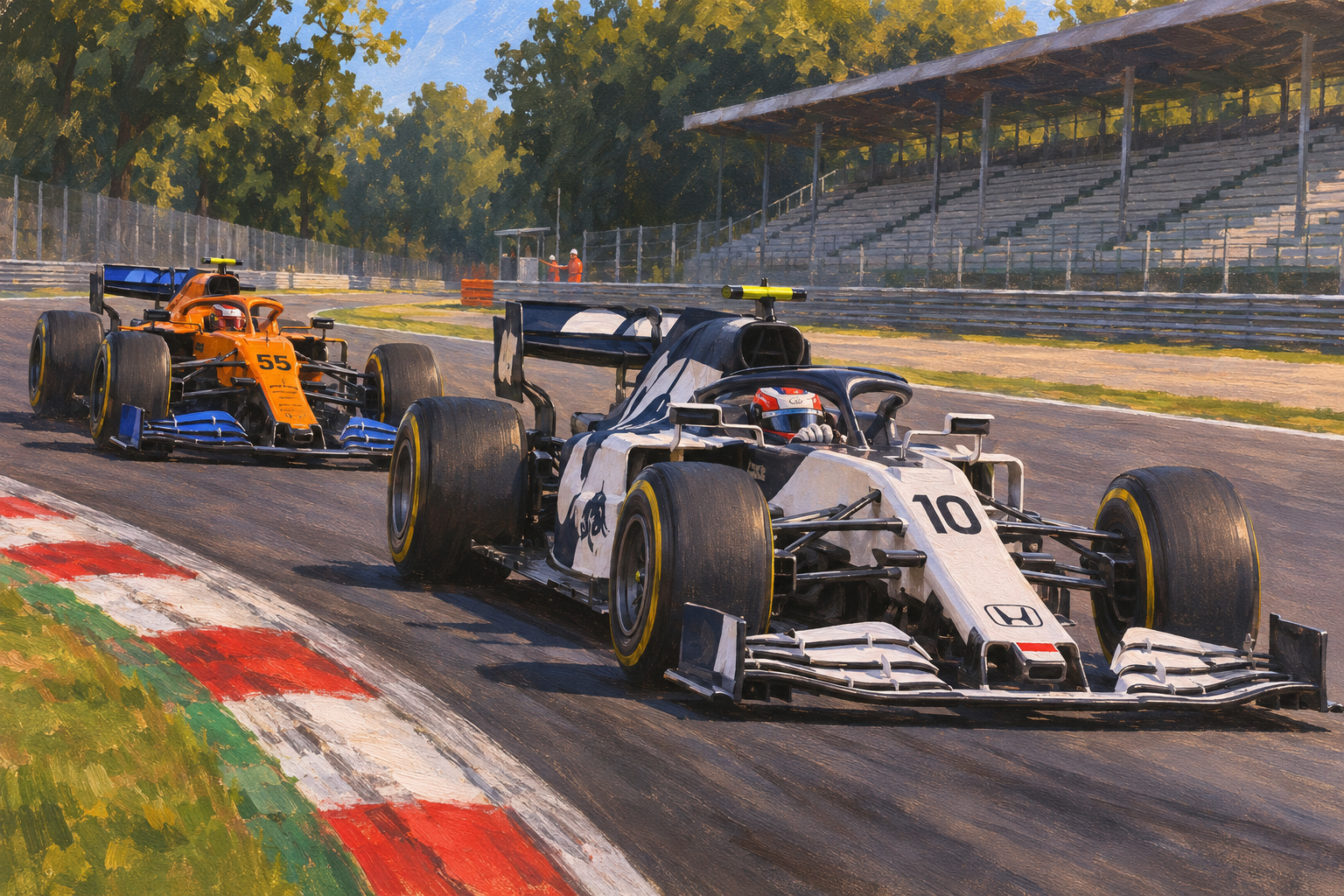
Lewis Hamilton was running away with it when he stopped in a closed pit lane and was given a penalty. A red flag bunched the field. At the restart Pierre Gasly, in an AlphaTauri, found himself leading, with Carlos Sainz closing in a McLaren. Gasly held on by four tenths. He had been dropped by the senior Red Bull team a year earlier.
Verdict The fastest car was penalised, and a midfield team won its home race by four tenths.
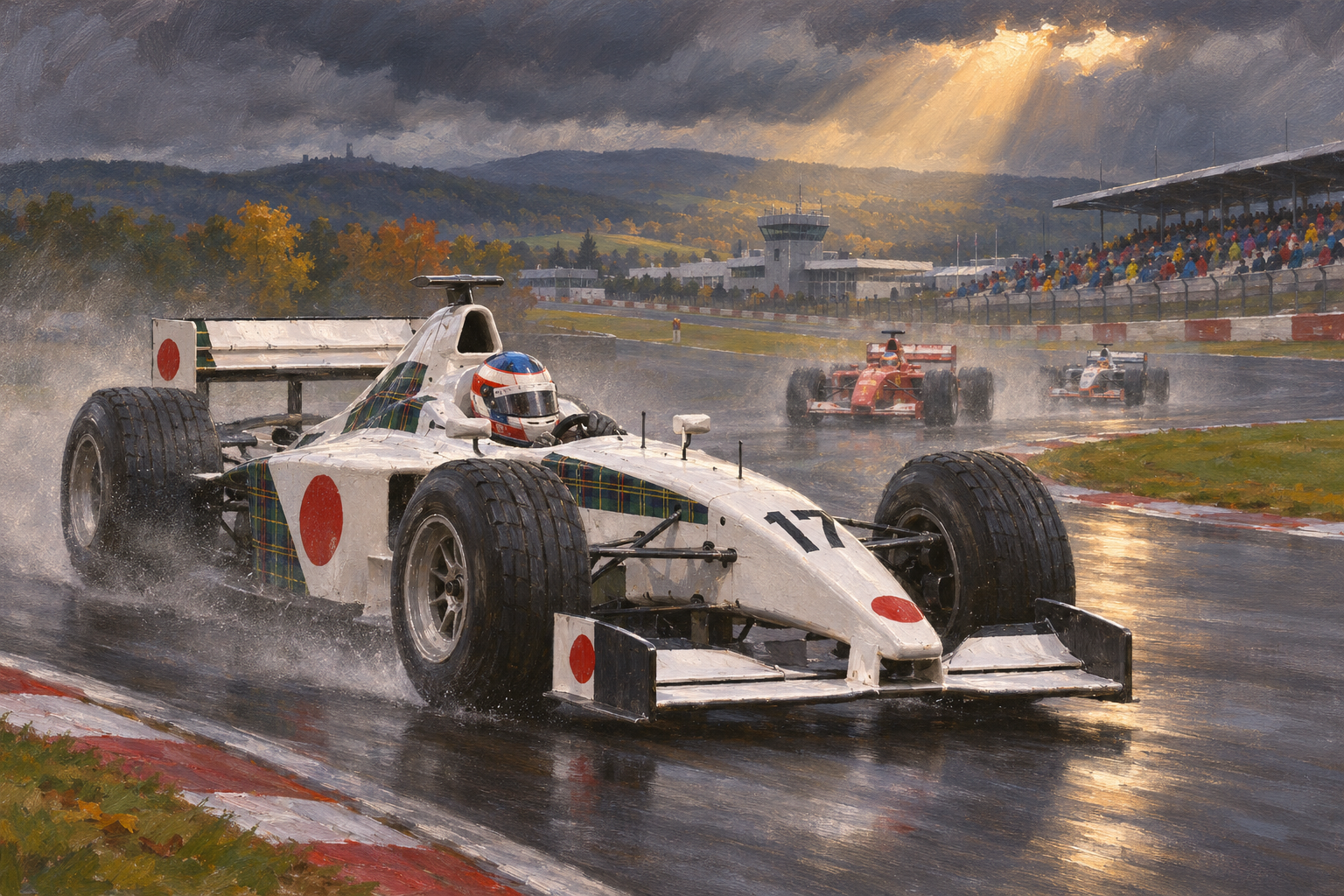
29. Nürburgring 1999 European Grand Prix
26 September 1999 · Johnny Herbert · Stewart SF3
The weather changed four times and every leader fell out. Heinz-Harald Frentzen's car died leaving the pits. David Coulthard slid off. Ralf Schumacher had a puncture and Giancarlo Fisichella spun. Johnny Herbert, who had started fourteenth and chosen the right tyres each time, won for Stewart Grand Prix. It was the team's only victory.
Verdict Four leaders lost it one after another, and the man who guessed the weather won.
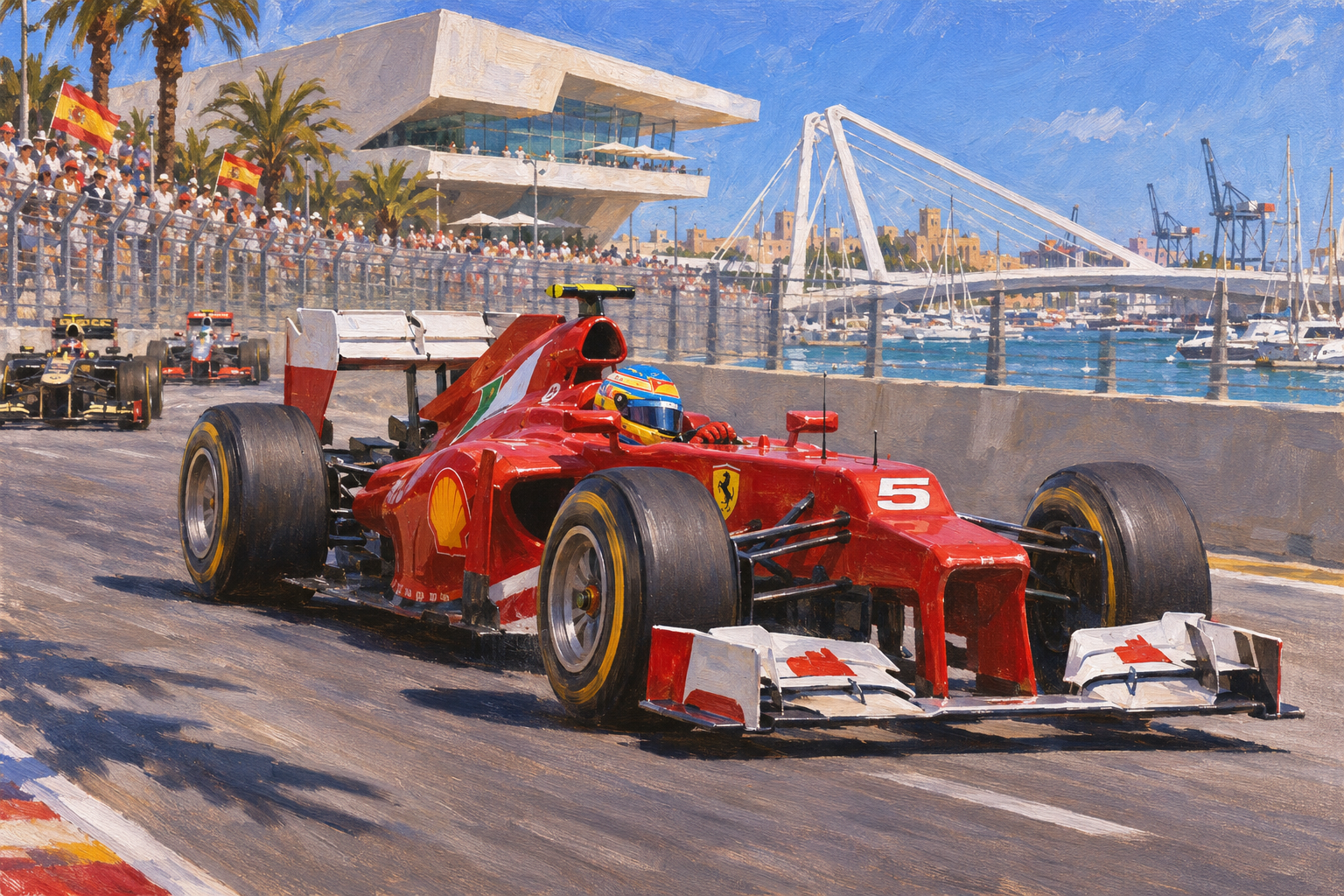
28. Valencia street circuit 2012 European Grand Prix
24 June 2012 · Fernando Alonso · Ferrari F2012
Valencia's street circuit had produced only dull races. Fernando Alonso started eleventh and overtook his way to third. Then a safety car wiped out Sebastian Vettel's lead, and Vettel's engine stopped. So did Romain Grosjean's. Alonso won in front of a home crowd and wept on the podium, beside Kimi Räikkönen and Michael Schumacher.
Verdict A dull circuit, a home winner from eleventh, and three champions on the podium.
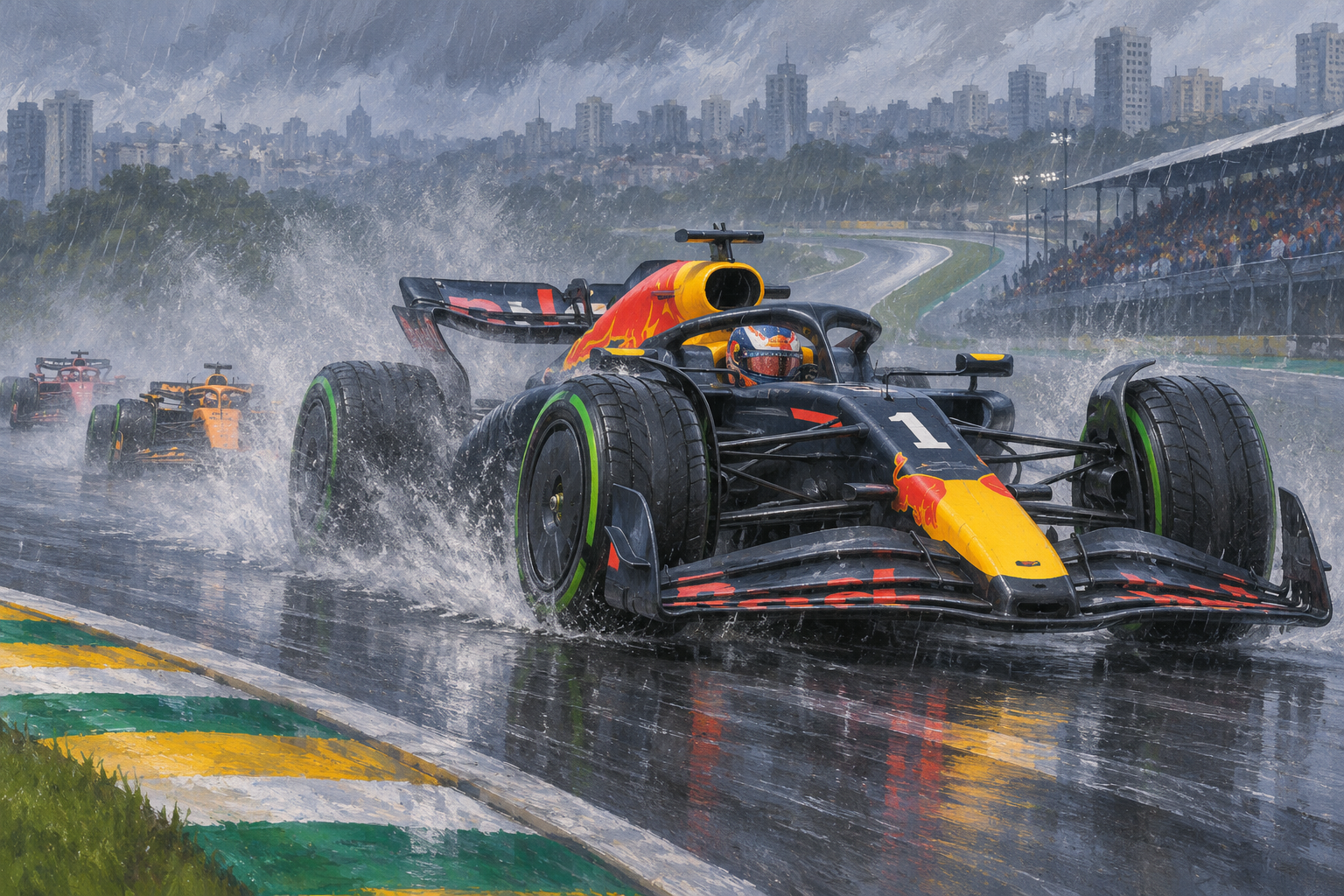
27. Interlagos 2024 São Paulo Grand Prix
3 November 2024 · Max Verstappen · Red Bull RB20
Qualifying was washed out and held on Sunday morning. Max Verstappen, without a win in ten races and with his title lead shrinking, started seventeenth after a penalty. In heavy rain he made up six places on the first lap and took the lead after the race was stopped and restarted. He won by nineteen seconds. Lando Norris, his rival, started on pole and finished sixth.
Verdict Seventeenth on the grid in the rain, first by nineteen seconds, and the title settled.
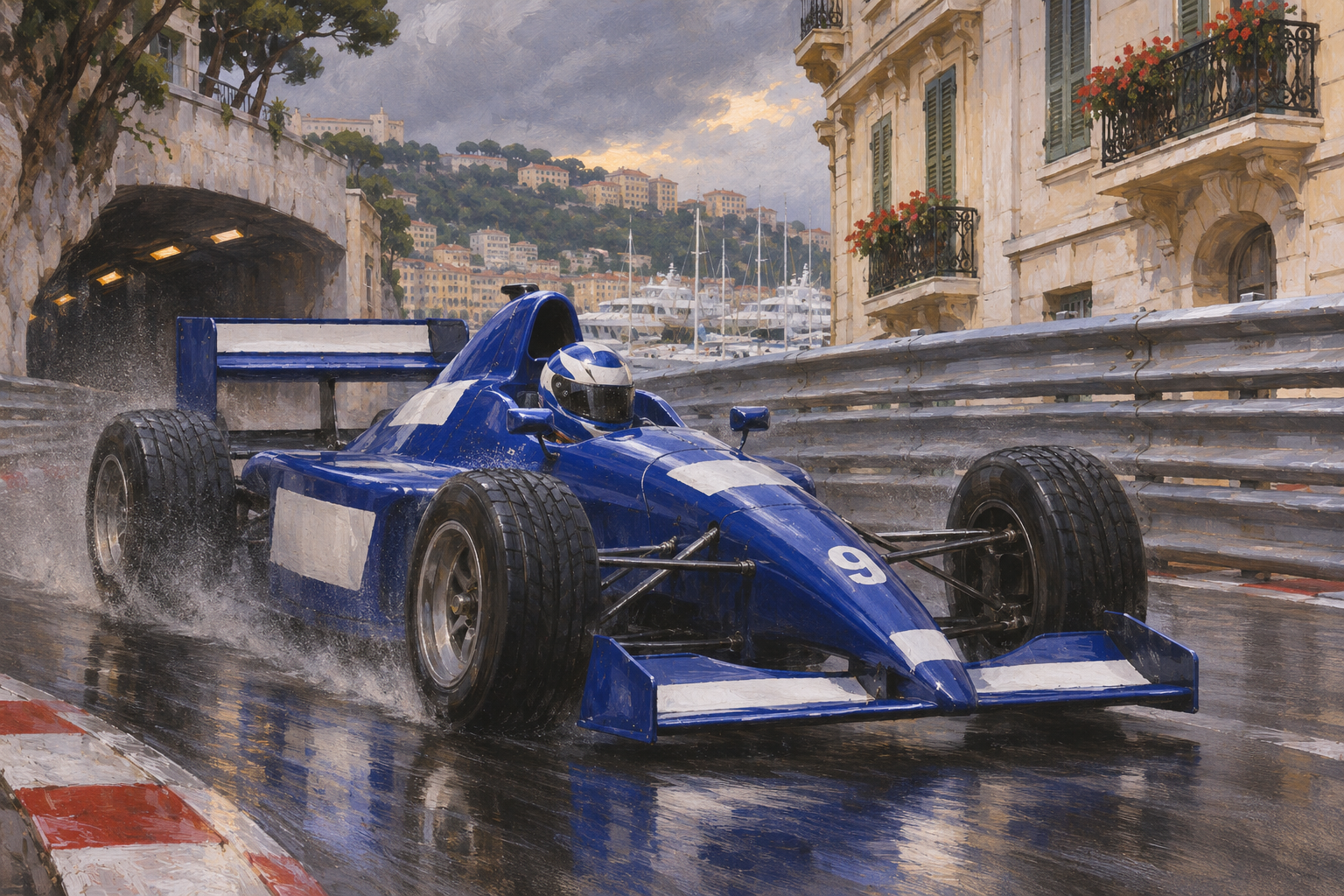
26. Circuit de Monaco 1996 Monaco Grand Prix
19 May 1996 · Olivier Panis · Ligier JS43
Twenty-one cars started on a wet track and three were running at the end. Michael Schumacher crashed on the first lap. Damon Hill's engine failed while he led, and Jean Alesi's suspension broke soon after. Olivier Panis, who had started fourteenth in a Ligier, passed people where passing is not possible and found himself in front. It was his only win.
Verdict Three cars finished. The one in front had started fourteenth.
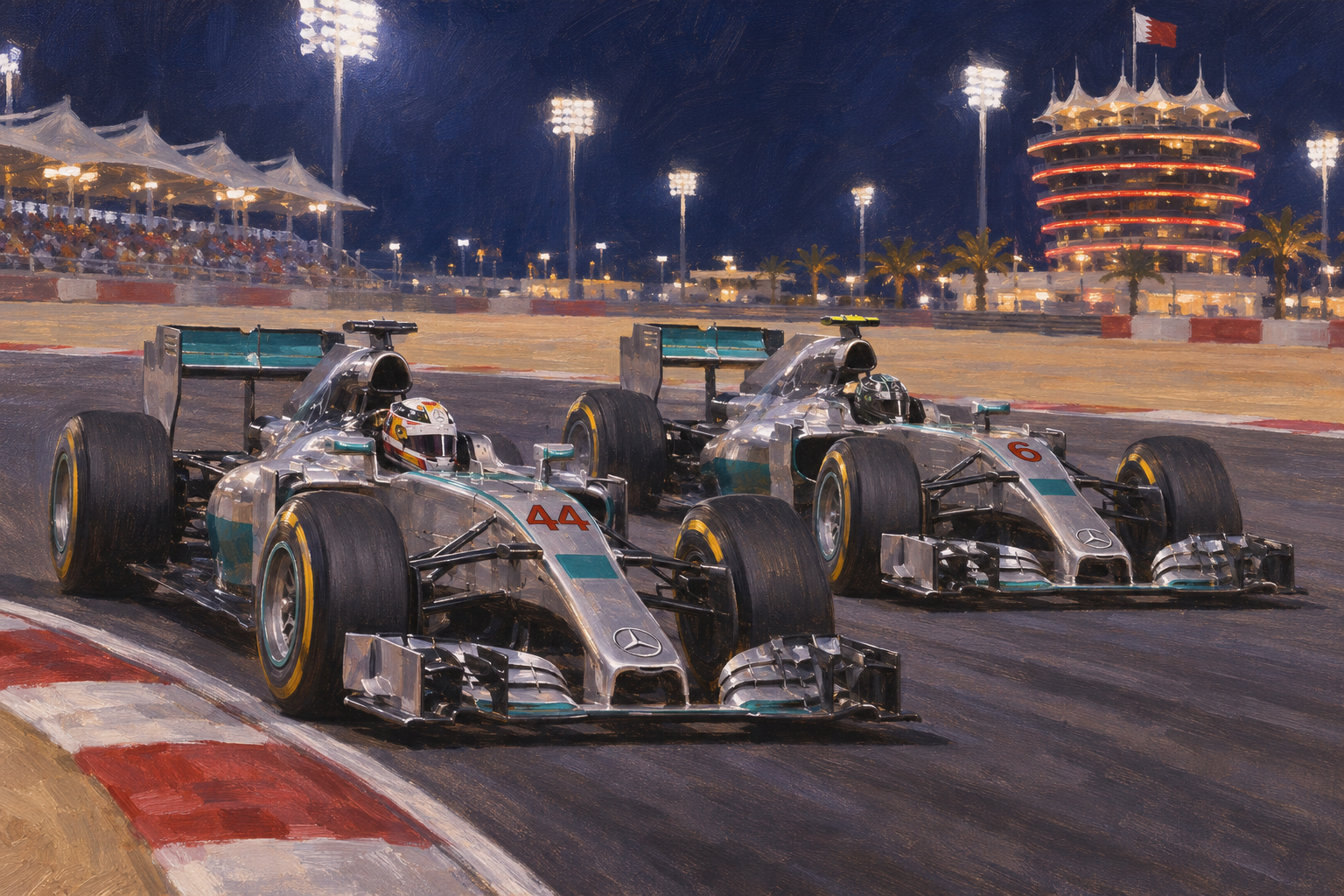
25. Bahrain International Circuit 2014 Bahrain Grand Prix
6 April 2014 · Lewis Hamilton · Mercedes W05
The two Mercedes were far faster than anything else, and the team let its drivers race. After a late safety car Nico Rosberg had ten laps on the quicker tyre to pass Lewis Hamilton. He tried at the first corner and the fourth, lap after lap, got ahead more than once and was repassed each time. Hamilton won by a second, under floodlights.
Verdict Two team-mates, the same car, ten laps of clean fighting, and nobody told them to stop.
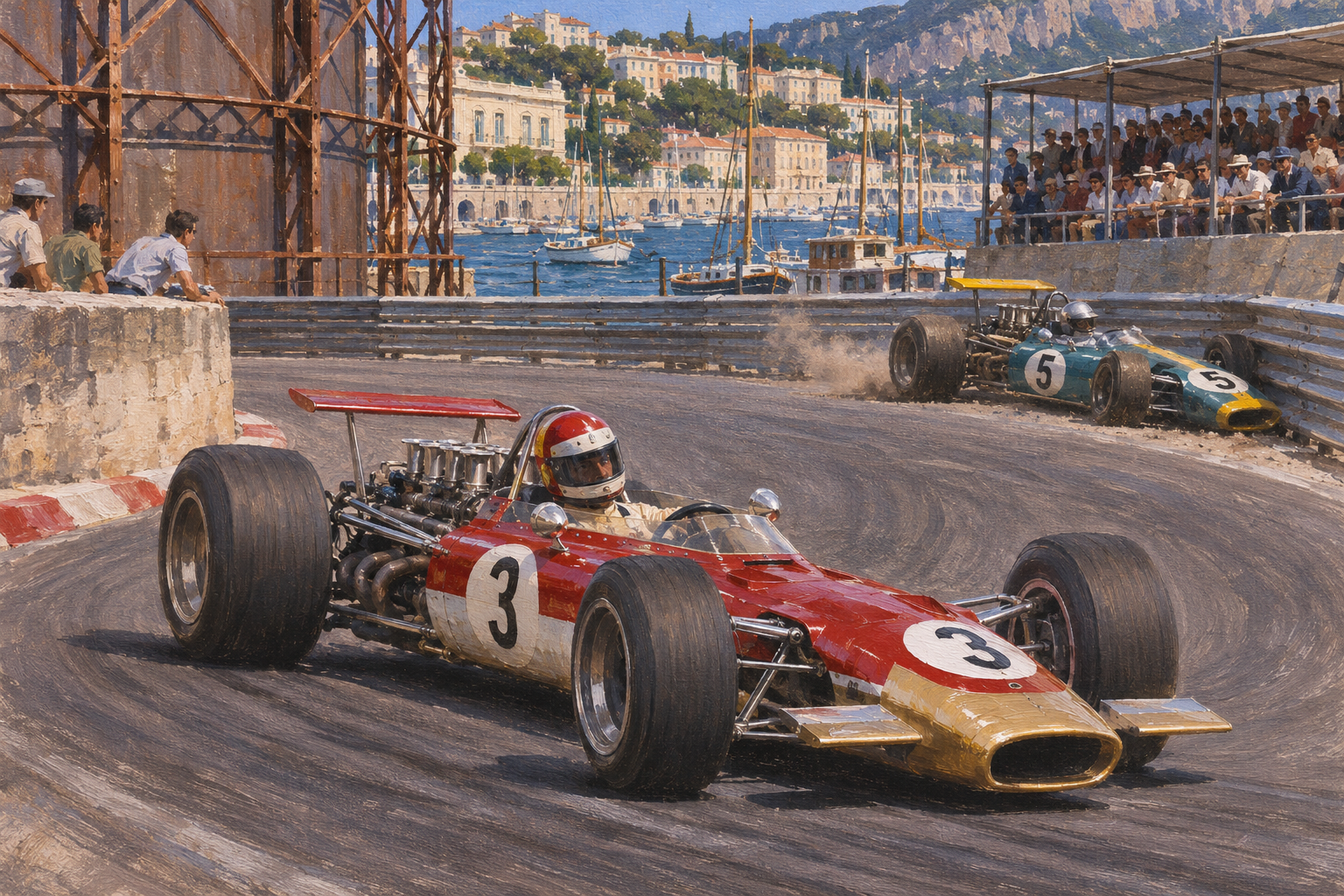
24. Circuit de Monaco 1970 Monaco Grand Prix
10 May 1970 · Jochen Rindt · Lotus 49C
Jack Brabham, aged 44, led into the last corner of the last lap. Jochen Rindt, in an old Lotus, had cut a fifteen-second gap to almost nothing with a string of record laps. Brabham, off line to pass a backmarker and watching his mirrors, braked too late and slid into the barrier. Rindt drove past and won. He had led for about two hundred yards.
Verdict Brabham led every yard but the last two hundred.
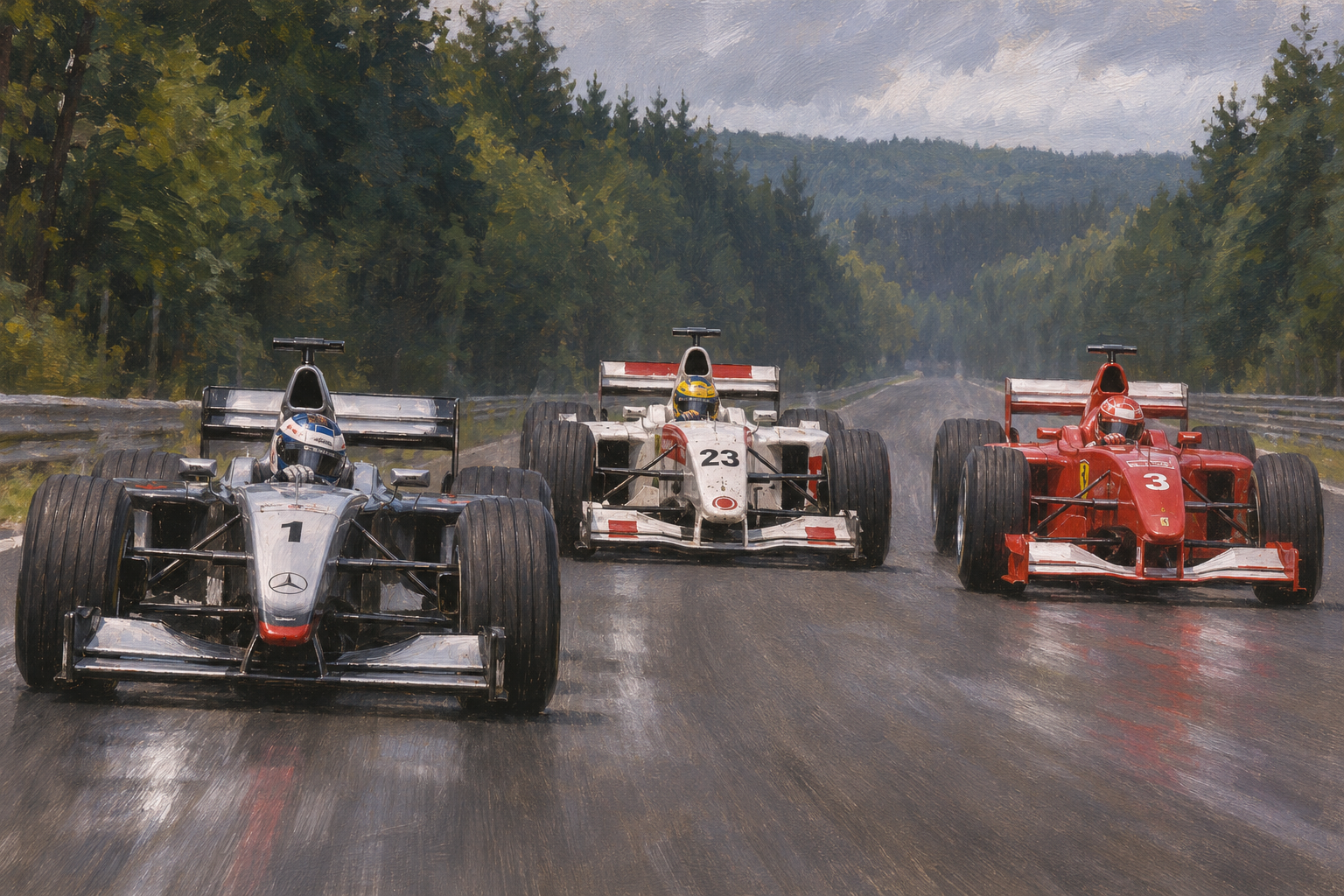
23. Spa-Francorchamps 2000 Belgian Grand Prix
27 August 2000 · Mika Häkkinen · McLaren MP4/15
Mika Häkkinen spun away the lead and spent the race catching Michael Schumacher. With four laps left he tried to pass at 200 mph and was squeezed towards the grass. A lap later they came up behind a backmarker on the same straight. Schumacher went left of him. Häkkinen went right, passed them both, and won.
Verdict One lapped car, two leaders, one either side. The pass of the decade.
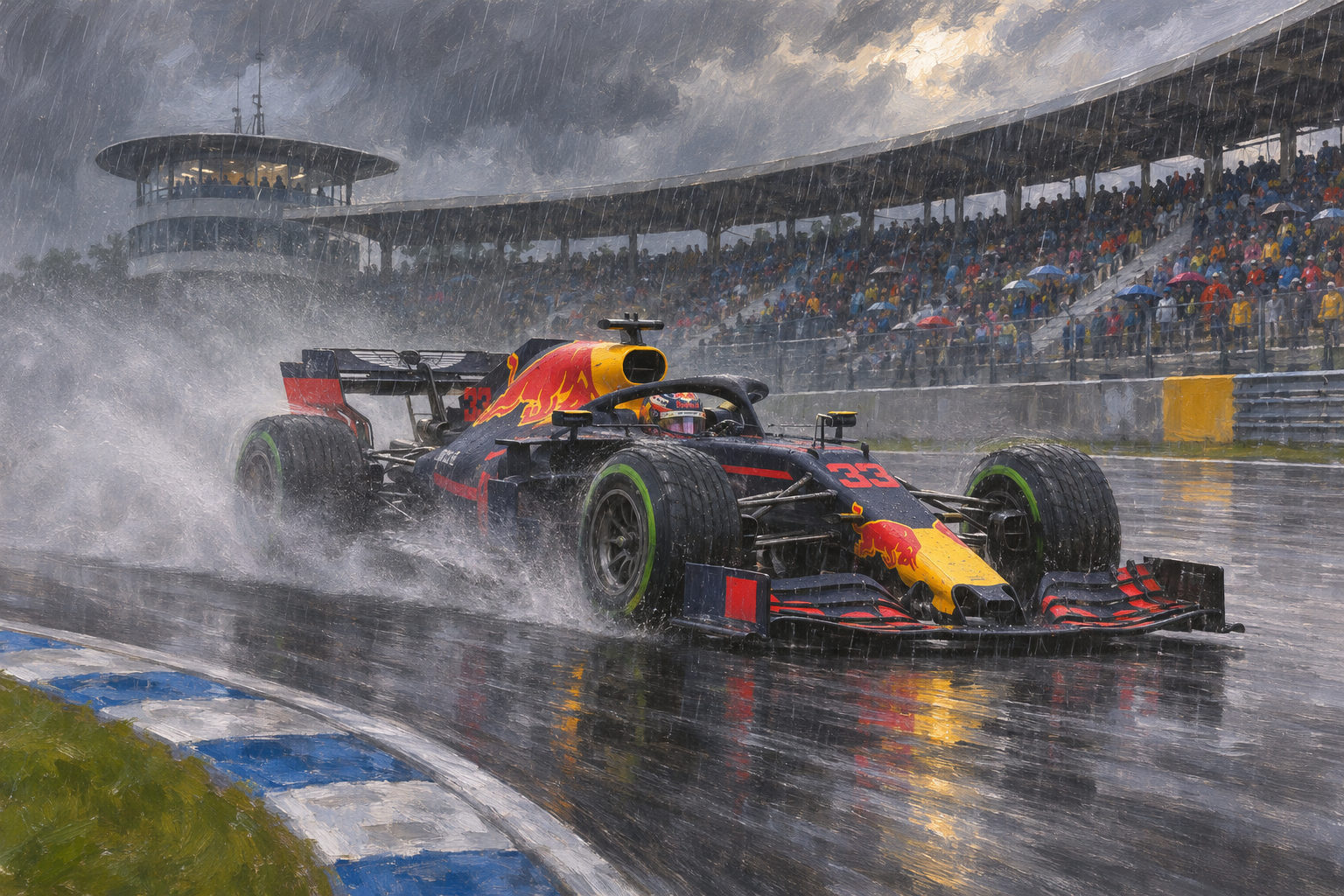
22. Hockenheim 2019 German Grand Prix
28 July 2019 · Max Verstappen · Red Bull RB15
Rain turned Hockenheim into a lottery. Mercedes, celebrating an anniversary in period costume, had Lewis Hamilton crash from the lead and take 50 seconds over a pit stop. Charles Leclerc went off at the same corner, and Valtteri Bottas crashed later. Max Verstappen spun through a full circle, stopped five times and won. Sebastian Vettel finished second from last on the grid.
Verdict The winner spun and pitted five times. Everyone else had a worse day.
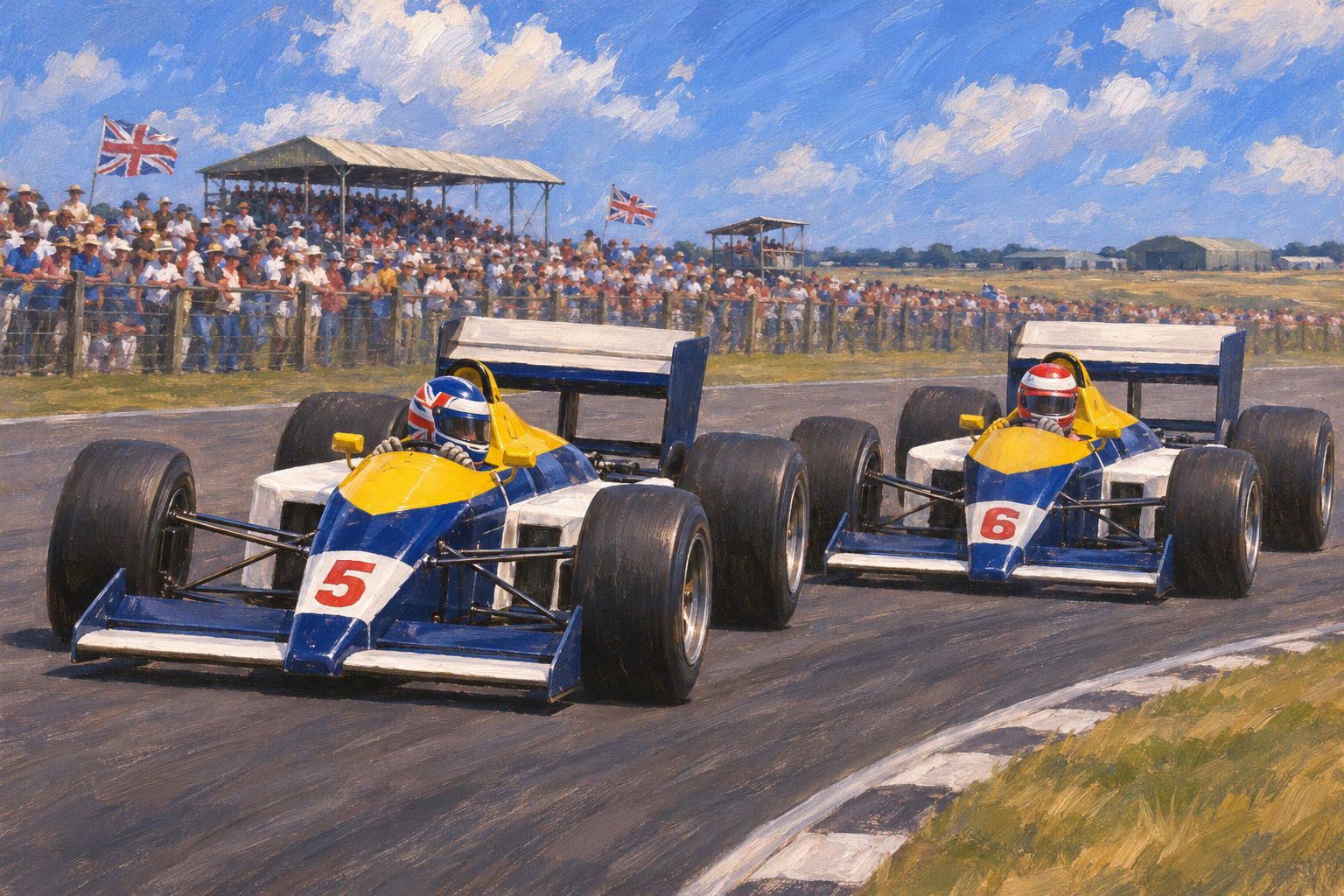
21. Silverstone 1987 British Grand Prix
12 July 1987 · Nigel Mansell · Williams FW11B
Nigel Mansell stopped for tyres with 30 laps left and came out 28 seconds behind his team-mate Nelson Piquet. He broke the lap record eleven times, caught him with three laps to go, feinted left on the Hangar Straight and went through on the right into Stowe. He ran out of fuel on the slowing-down lap, and the crowd carried him home.
Verdict Twenty-eight seconds made up in 27 laps, and one dummy at 180 mph.
20 to 11
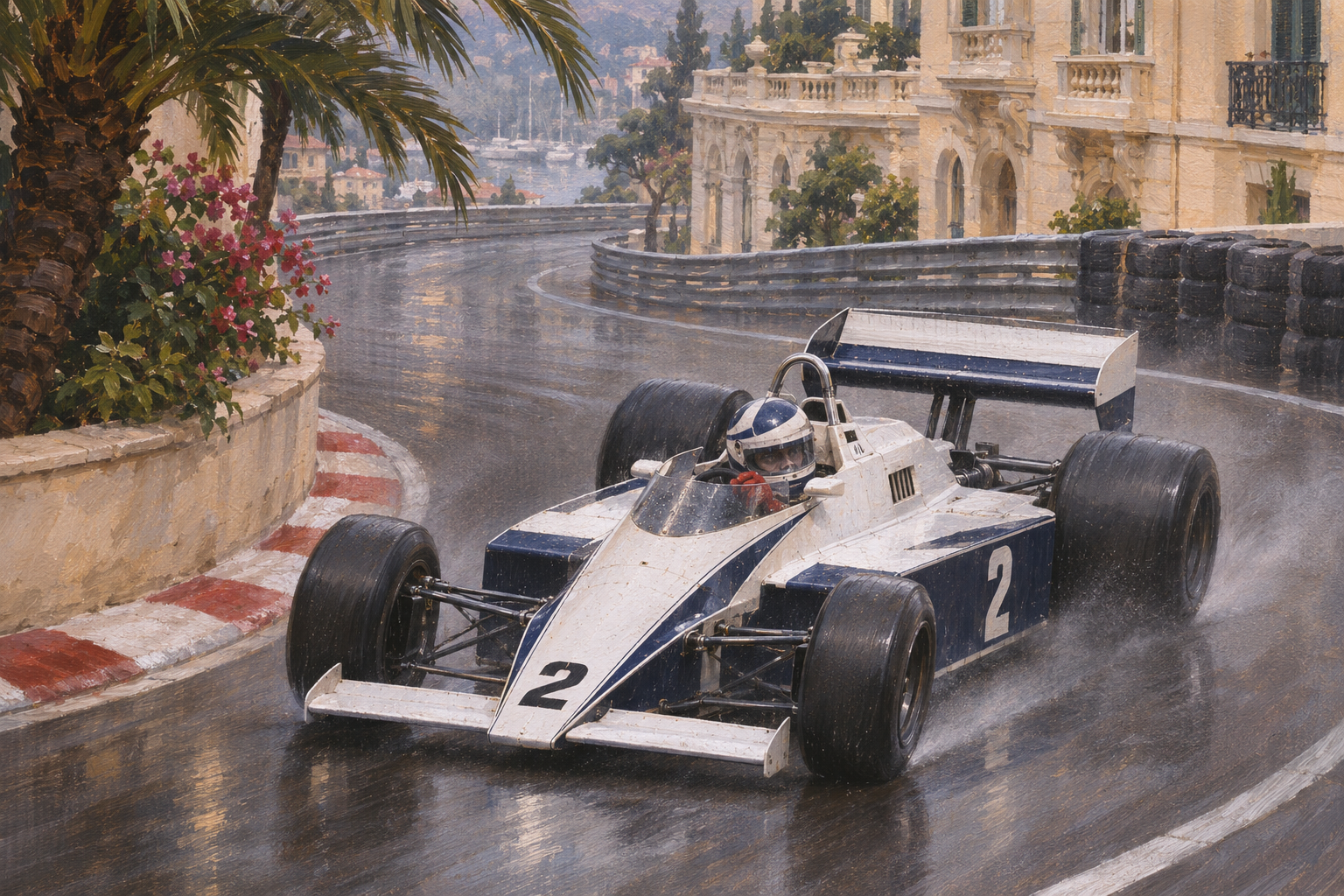
20. Circuit de Monaco 1982 Monaco Grand Prix
23 May 1982 · Riccardo Patrese · Brabham BT49D
For 73 laps this was a dull race that Alain Prost was going to win. Then it started to drizzle. Prost crashed with three laps left. Riccardo Patrese took the lead and spun at the hairpin. Didier Pironi took over and stopped in the tunnel on the last lap with a dead engine. Andrea de Cesaris, next up, ran out of fuel before he reached him. Derek Daly would have led, but his gearbox had just failed. Patrese, who had got going again by rolling down the hill, came round and won his first Grand Prix. He had no idea until someone told him.
Verdict Five leaders in three laps, four of them stopped, and a winner who did not know.
Did you know: Patrese did not know he had won until he was told on the slowing-down lap.
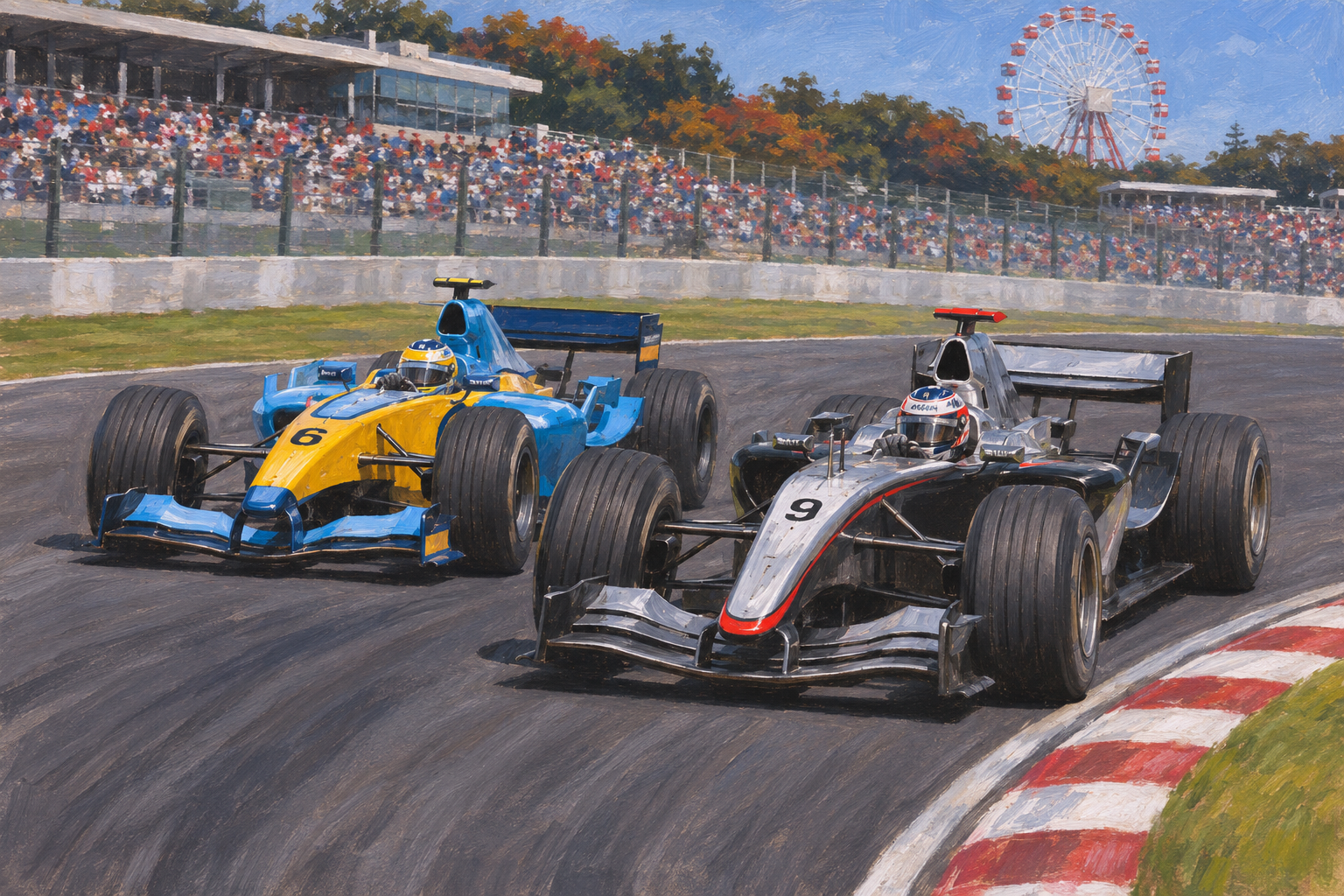
19. Suzuka 2005 Japanese Grand Prix
9 October 2005 · Kimi Räikkönen · McLaren MP4-20
Rain in qualifying put the fastest cars at the back. Kimi Räikkönen started seventeenth, Fernando Alonso sixteenth and Michael Schumacher fourteenth, on a circuit where overtaking is supposed to be difficult. Alonso passed Schumacher round the outside of 130R at 190 mph. Räikkönen worked his way to second and spent the closing laps hunting Giancarlo Fisichella's Renault. He drew alongside on the pit straight at the start of the last lap and went round the outside into the first corner. The race was dry throughout, and every place was made on the track.
Verdict Seventeenth to first, with the lead taken round the outside on the last lap.
Did you know: The winner started seventeenth and took the lead on the last lap.
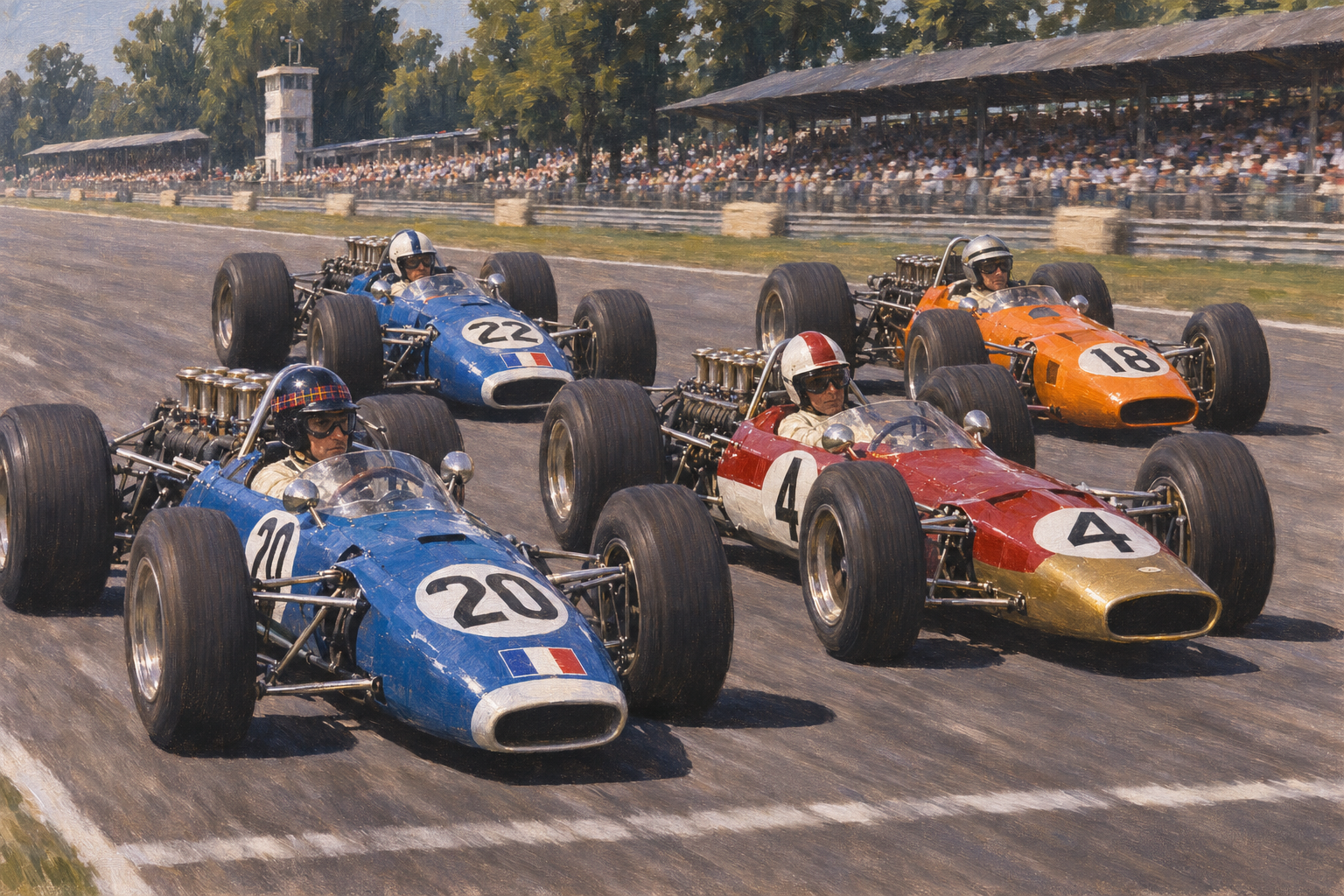
18. Monza 1969 Italian Grand Prix
7 September 1969 · Jackie Stewart · Matra MS80
Two years before the closest finish of all, Monza produced one nearly as tight with more at stake. Jackie Stewart, Jochen Rindt, Jean-Pierre Beltoise and Bruce McLaren ran together for the whole race and came out of the last corner four abreast. Stewart had fitted a long fourth gear so that he would not need to change up before the line. It was worth a few feet, and he won by eight hundredths of a second. The four were covered by less than two tenths. The win made him world champion for the first time, with three races still to run.
Verdict Four cars across the line together, and a championship decided by a gear ratio.
Did you know: Stewart chose a gear ratio that let him reach the line without changing gear out of the last corner.
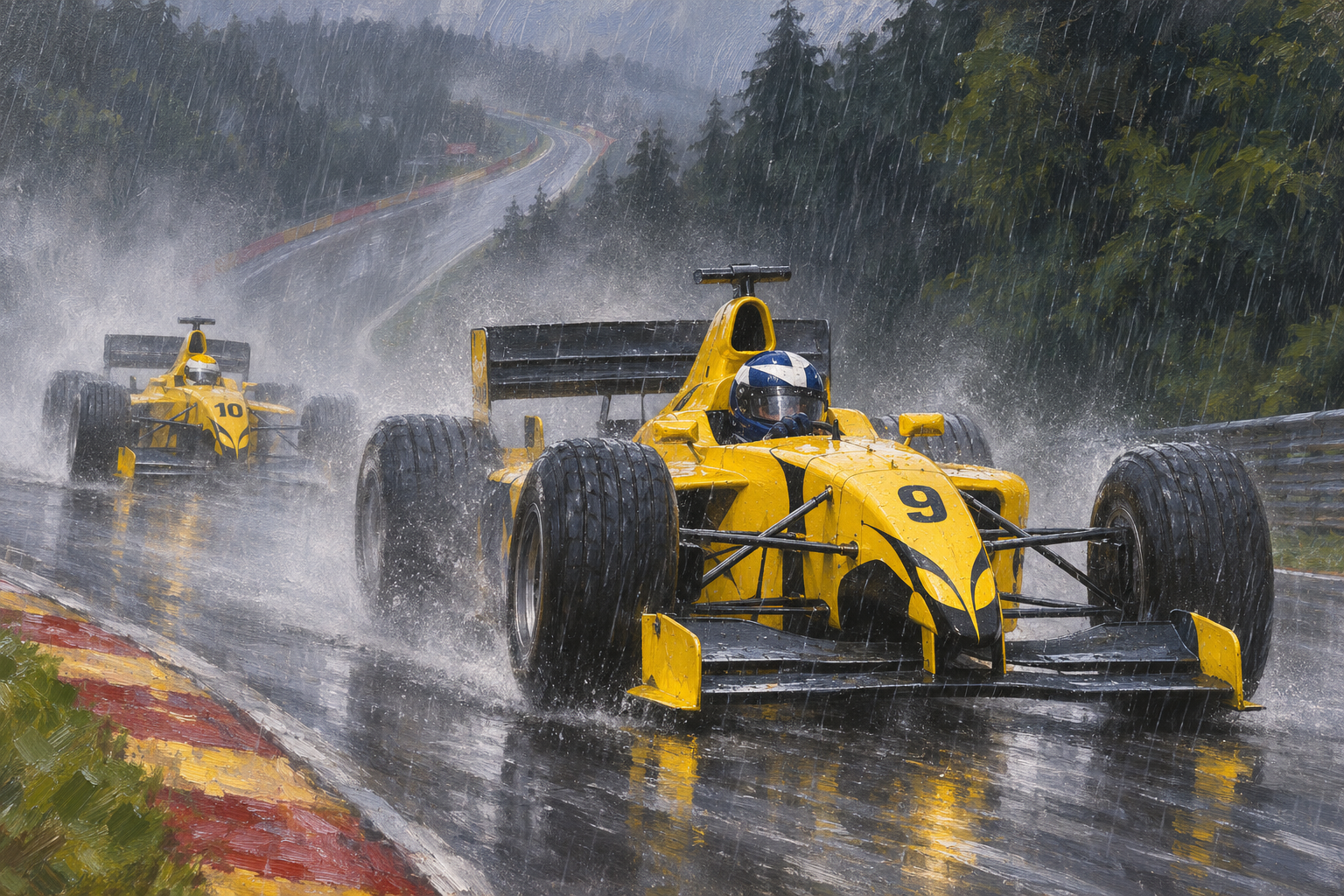
17. Spa-Francorchamps 1998 Belgian Grand Prix
30 August 1998 · Damon Hill · Jordan 198
It began with the biggest accident the championship has seen: thirteen cars, in spray, on the run down from the first corner. At the restart Mika Häkkinen spun out. Michael Schumacher took the lead from Damon Hill and pulled away at three seconds a lap, until he came up to lap David Coulthard in the mist and ran into the back of him. The Ferrari returned to the pits on three wheels, and Schumacher walked to the McLaren garage to find Coulthard. That left Hill leading his team-mate Ralf Schumacher. Eddie Jordan told them to hold position, and his team won for the first time, in its 127th race.
Verdict A thirteen-car pile-up, the leader out on three wheels, and Jordan's first win.
Did you know: It was Jordan's first win, in the team's 127th Grand Prix.
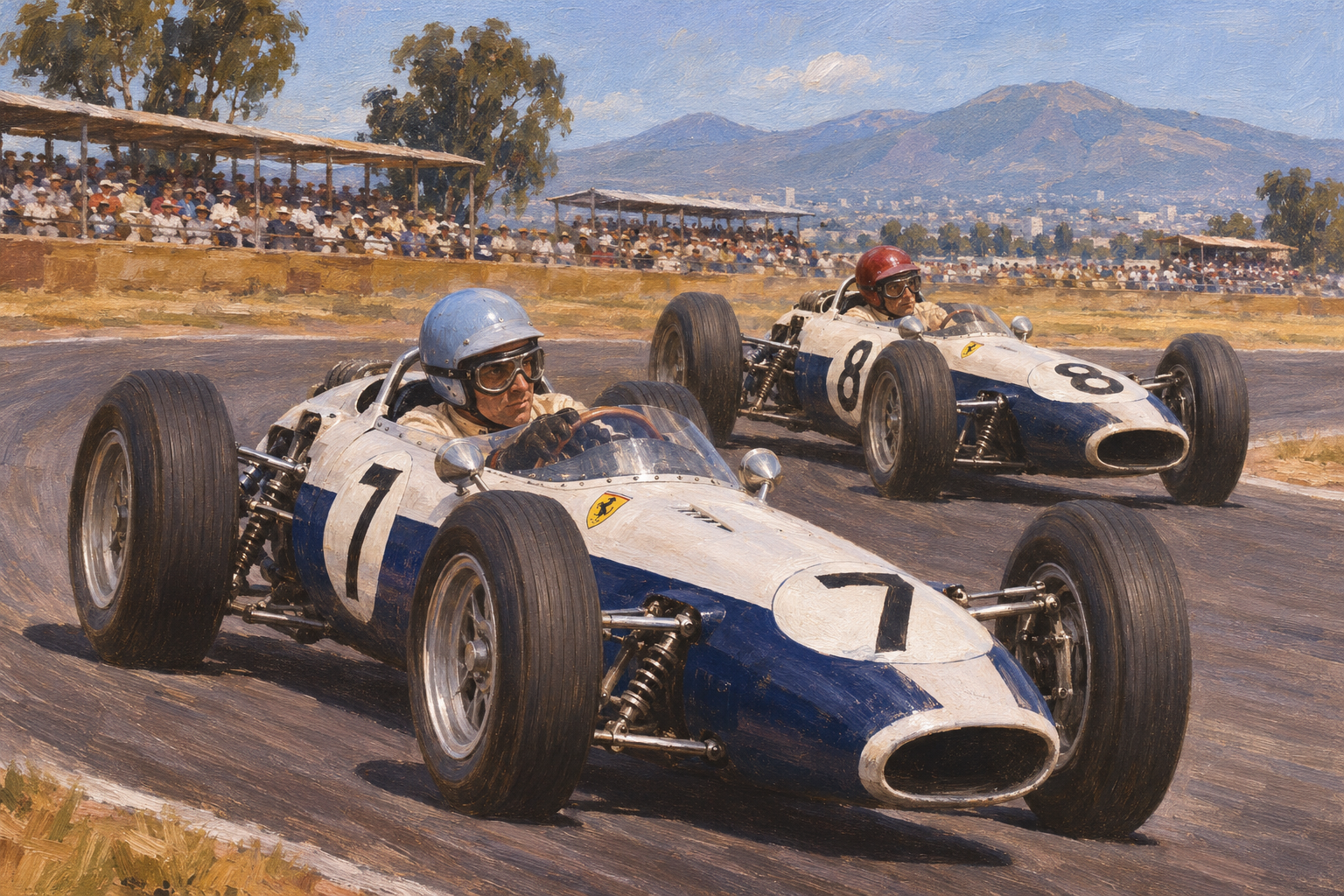
16. Mexico City 1964 Mexican Grand Prix
25 October 1964 · Dan Gurney · Brabham BT7
Three British drivers could win the title in the last race, and each of them held it at some point in the afternoon. Jim Clark led from the start and had it won until his engine lost its oil on the second-last lap. That handed it to Graham Hill, who had been pushed off earlier by a Ferrari and was out of the points with a damaged car, but was ahead on the count. Then the Ferrari pit signalled Lorenzo Bandini to let John Surtees past into second place. Surtees was champion by one point, the only man to win world titles on two wheels and four. Dan Gurney won the race.
Verdict Three men were champion in the last two laps. The third of them kept it.
Did you know: The works Ferraris ran in blue and white, because Enzo Ferrari was in dispute with the Italian authorities.
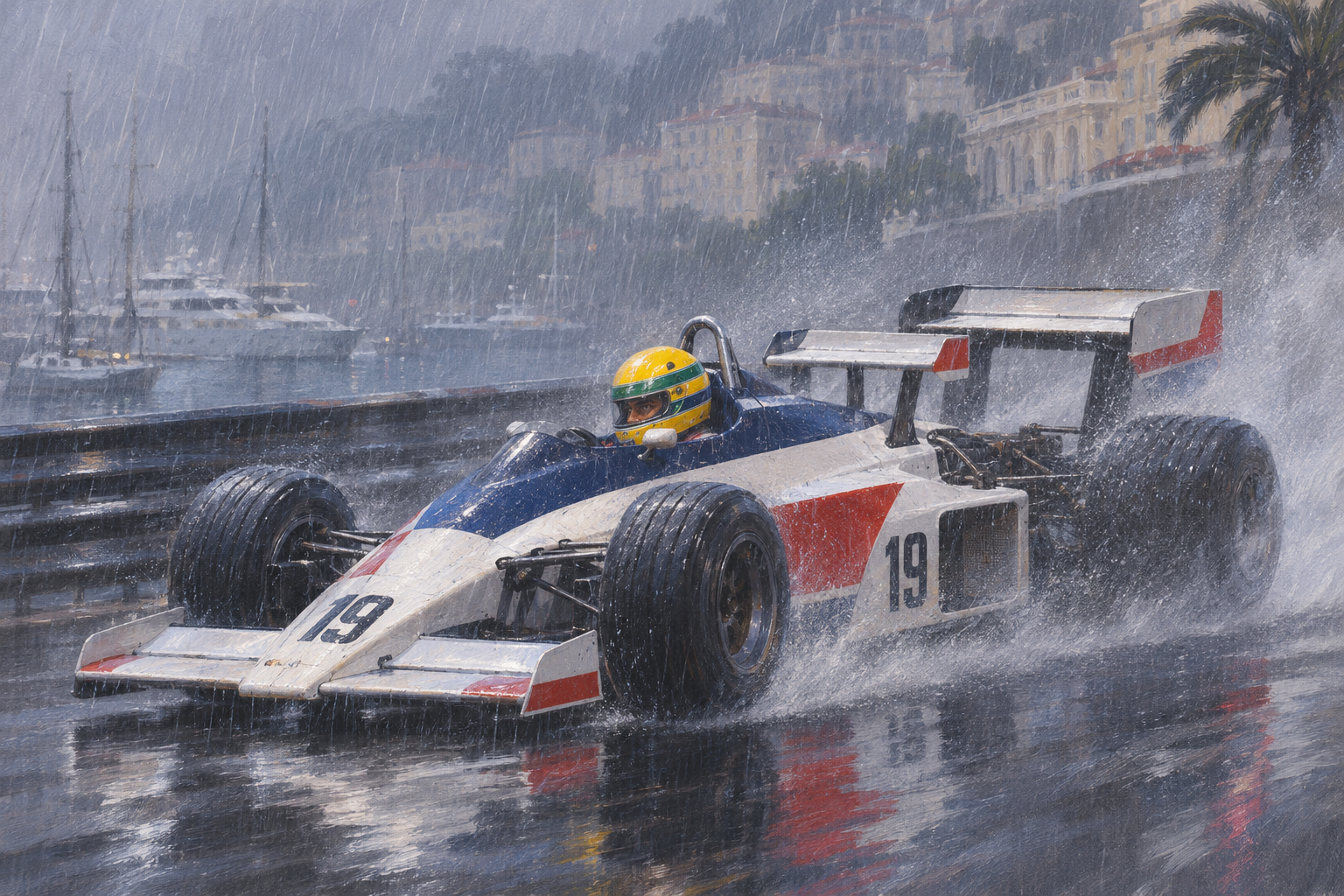
15. Circuit de Monaco 1984 Monaco Grand Prix
3 June 1984 · Alain Prost · McLaren MP4/2
It rained so hard that the race was stopped at less than half distance, and the argument about whether it should have been has gone on ever since. Alain Prost led in a McLaren with failing brakes. Ayrton Senna, in his first season, had started thirteenth in a Toleman and was catching him at three seconds a lap. Behind Senna, Stefan Bellof had come from last on the grid in a Tyrrell and was catching them both. The red flag came out as Senna drew alongside. Prost was given the win and half points, and lost the championship that year by half a point.
Verdict Stopped as Senna caught Prost, with Bellof catching both. Nobody knows who would have won.
Did you know: Because the race was stopped early, half points were given. Prost lost the title that year by half a point.
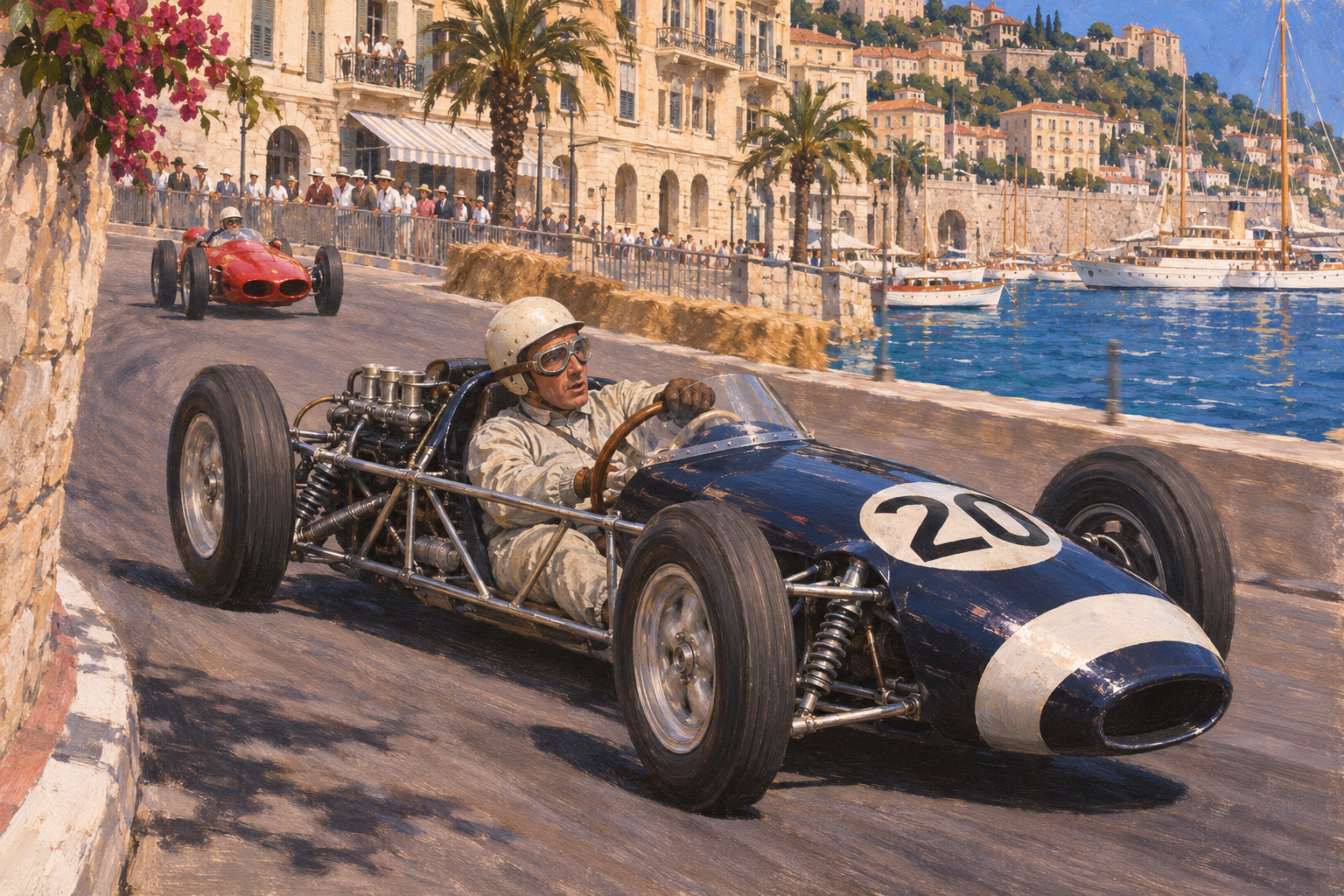
14. Circuit de Monaco 1961 Monaco Grand Prix
14 May 1961 · Stirling Moss · Lotus 18
Ferrari arrived for the new 1.5-litre formula with a V6 that gave thirty horsepower more than anyone else had. Stirling Moss had a year-old Lotus owned by a private team. He put it on pole, took the lead on lap 14, and for the next 86 laps drove every one as if it were a qualifying lap, with Richie Ginther's Ferrari never more than a few seconds behind. Ginther and Moss ended with the same fastest lap, nearly three seconds under Moss's own pole time. He won by 3.6 seconds and always said it was the best race he drove.
Verdict A year-old privateer Lotus beat three works Ferraris by never slowing down.
Did you know: Moss had the side panels taken off the car before the start to keep cool.
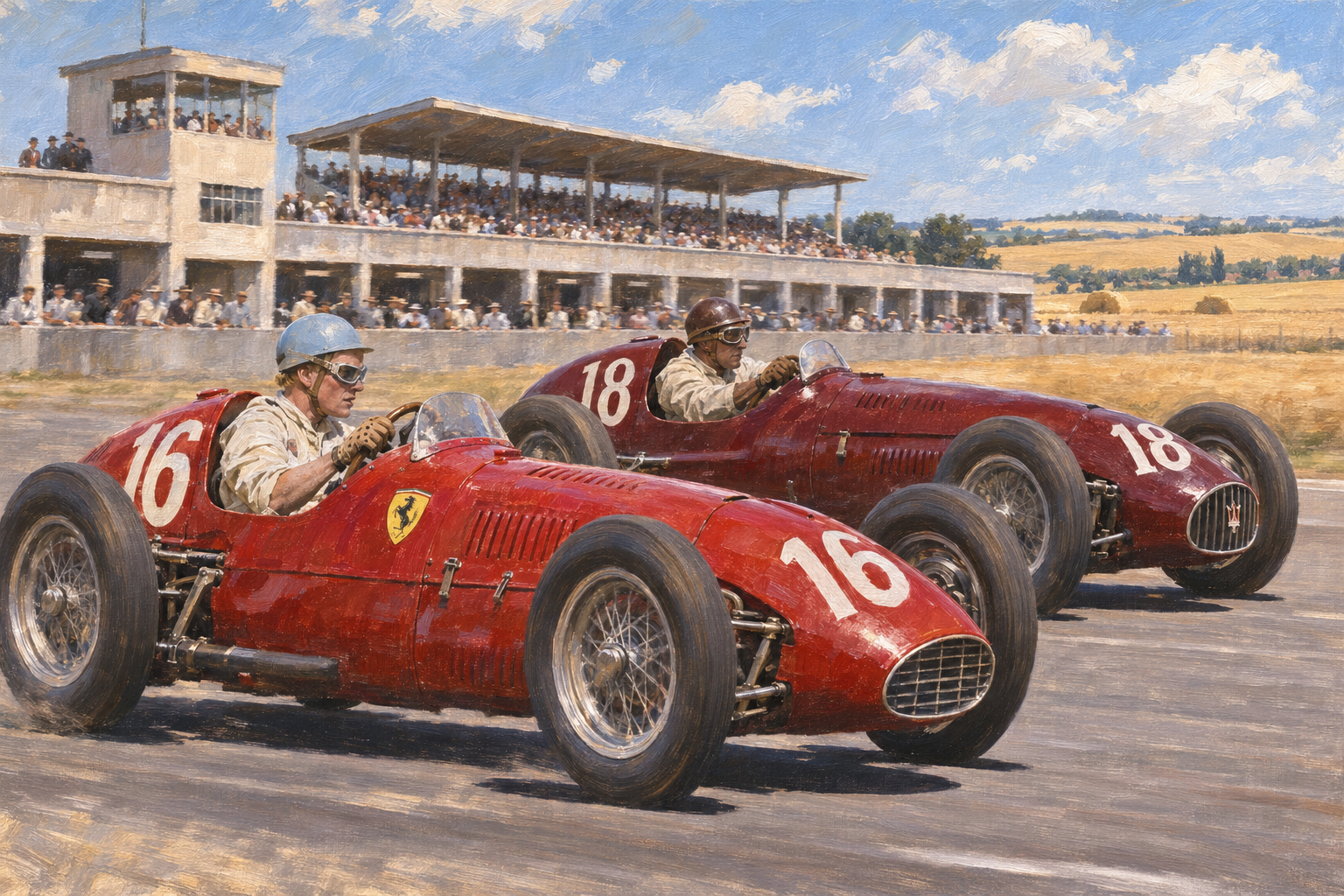
13. Reims-Gueux 1953 French Grand Prix
5 July 1953 · Mike Hawthorn · Ferrari 500
It was called the race of the century at the time, and nothing ran it close until 1971. Reims was a slipstreaming circuit, and for the second half of the race Mike Hawthorn's Ferrari and Juan Manuel Fangio's Maserati were never more than a length apart, swapping the lead several times a lap and often running down the straight side by side, close enough for each to see the other's instruments. Hawthorn was 24 and had never won a Grand Prix. He outbraked Fangio into the last corner and won by a second. The first four finished within five seconds after 300 miles.
Verdict Two cars side by side for an hour, and the young Englishman outbraked Fangio at the end.
Did you know: Hawthorn was the first British driver to win a world championship Grand Prix.
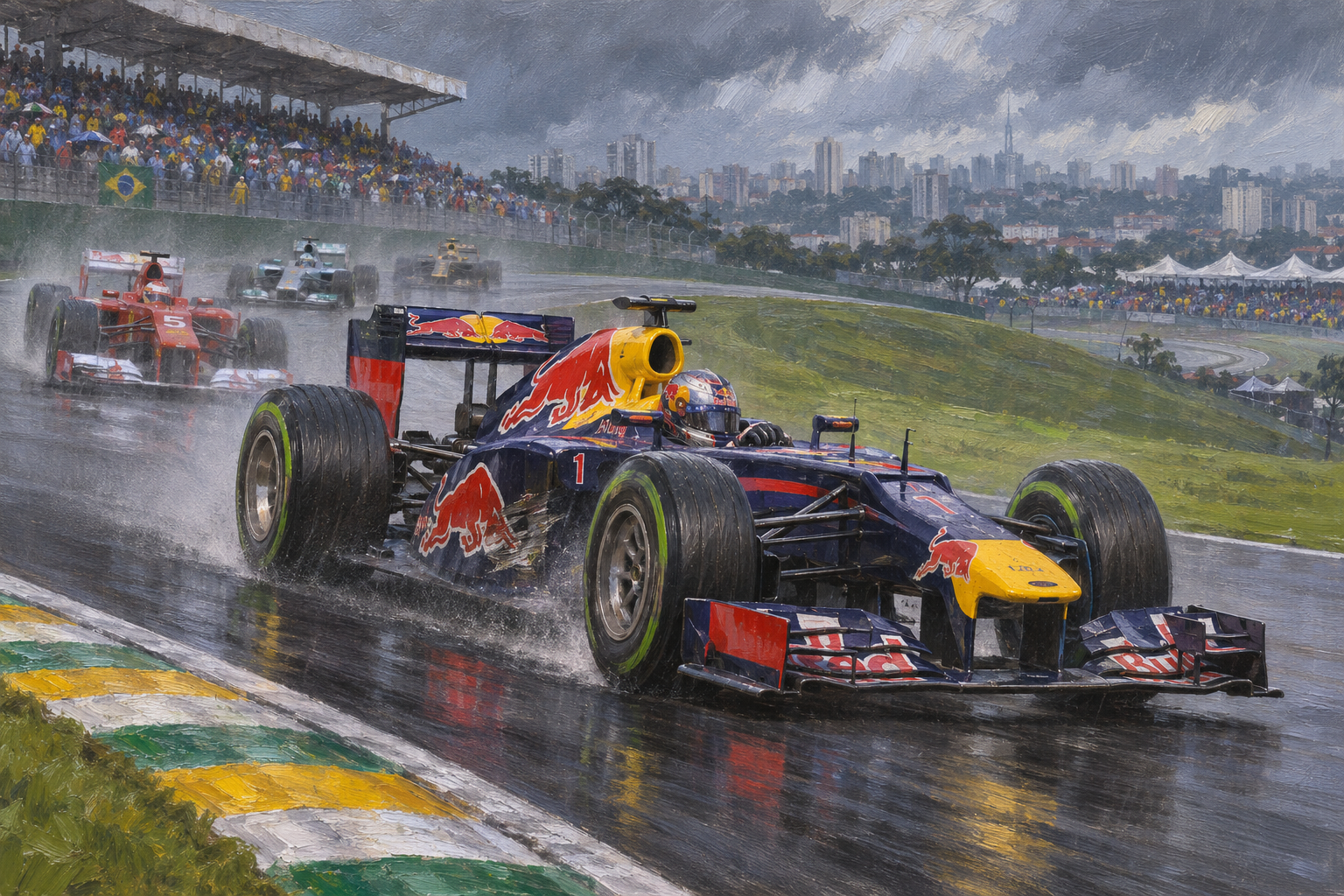
12. Interlagos 2012 Brazilian Grand Prix
25 November 2012 · Jenson Button · McLaren MP4-27
Sebastian Vettel needed only a few points to beat Fernando Alonso to the title, and on the first lap he was hit, spun, and left facing the oncoming field with a damaged car. He was last. It rained, stopped and rained again. Vettel drove back through the field with a hole in his bodywork and a radio that barely worked, and finished sixth. Alonso was second, which left him three points short. Jenson Button won. Nico Hülkenberg led much of it in a Force India. Michael Schumacher, in his final Grand Prix, moved over to let Vettel through.
Verdict Last and backwards on the first lap, champion by three points at the end.
Did you know: It was Michael Schumacher's last Grand Prix.
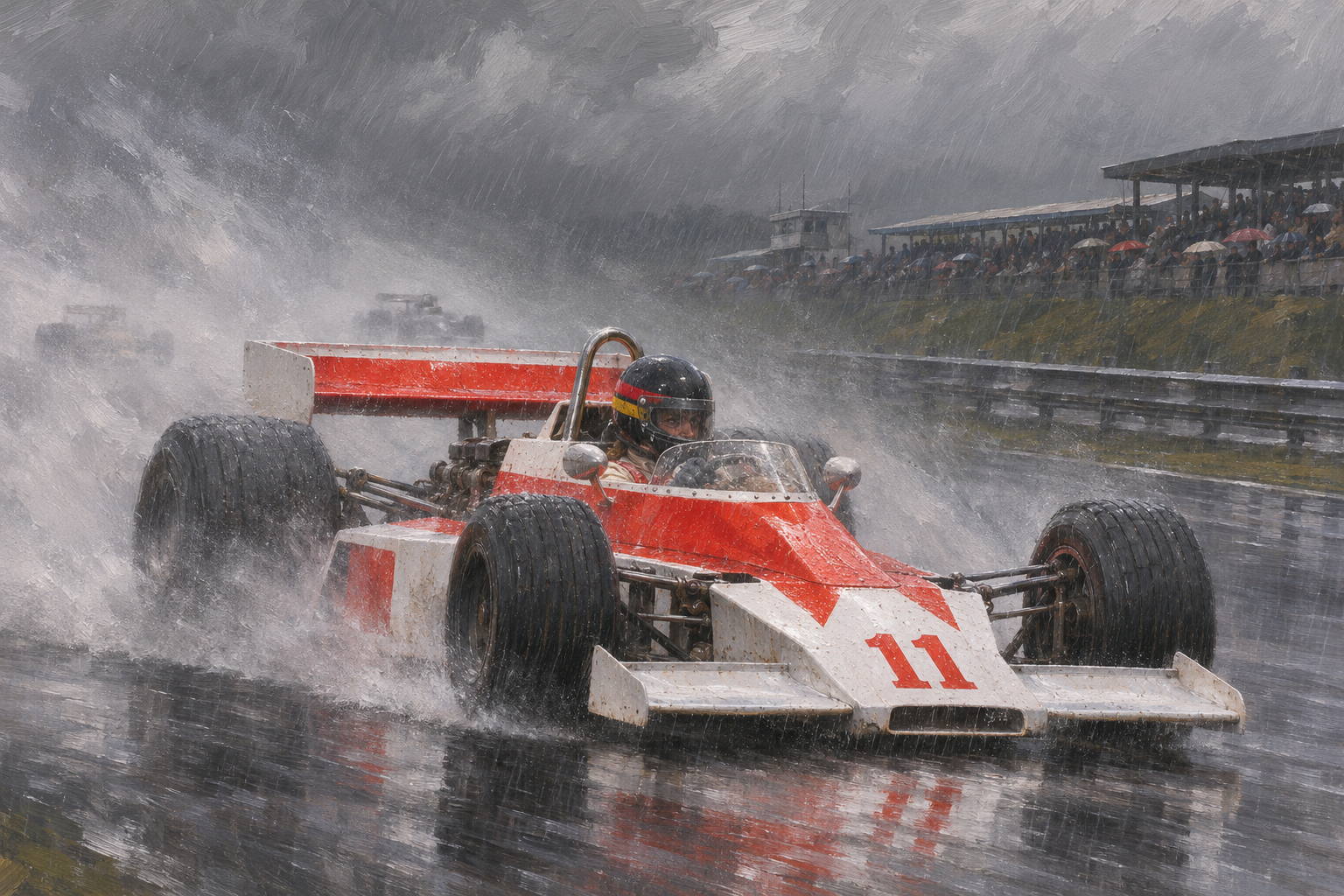
11. Fuji 1976 Japanese Grand Prix
24 October 1976 · Mario Andretti · Lotus 77
Niki Lauda led James Hunt by three points going into the last race, twelve weeks after he had been given the last rites at the Nürburgring. Fuji was under cloud and running with water. Lauda drove two laps, came in, and told his team it was too dangerous to go on. Hunt, leading, needed third place to be champion. As the track dried his wet tyres wore through. He had to stop late with a puncture, came out fifth, and passed two cars in the final laps without knowing where he was. He finished third and climbed out shouting at his team, sure he had lost. Mario Andretti won by a lap.
Verdict Lauda stopped because he chose to live, and Hunt won a title he thought he had thrown away.
Did you know: Hunt got out of the car furious with his team, believing he had lost the title.
The top 10
- Years
- 12 December 2021
- Engine
- Max Verstappen
- Power
- Red Bull RB16B
Race · United Arab Emirates
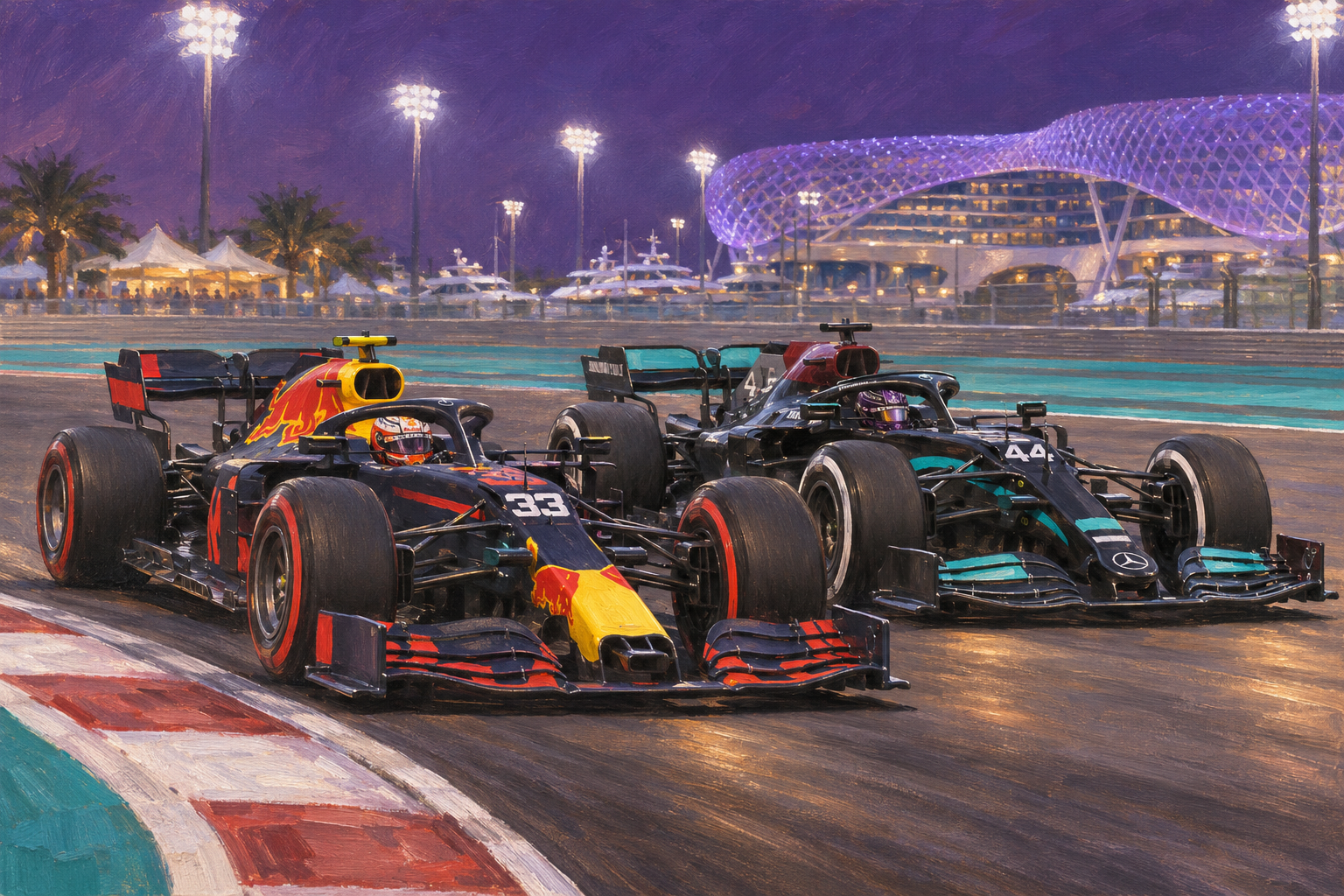
10. Yas Marina 2021 Abu Dhabi Grand Prix
This is the most disputed result in the history of the championship, and it is on the list because the criterion asks about stakes and how the finish is remembered. On both counts nothing since 2008 comes near it. Whether it was a good race is another matter, and whether the outcome was right is a third.
Lewis Hamilton and Max Verstappen arrived level on points after a season of collisions and protests. Hamilton took the lead at the start and controlled the race. With five laps left he was eleven seconds clear, and then Nicholas Latifi crashed and the safety car came out. Verstappen stopped for new soft tyres. Hamilton, who would have lost the lead by stopping, stayed out on old hard ones, with five lapped cars between them.
The race director first said lapped cars could not overtake the safety car. He then allowed only those five to do so, and restarted the race a lap sooner than the usual procedure would have given. That left one racing lap, with Verstappen directly behind on fresh tyres. He took the lead at the fifth corner and won the title.
Mercedes protested and was turned down. The governing body later said the rules had been applied wrongly through human error, and replaced the race director. The result stood. Many people think Hamilton was denied an eighth championship by an official's mistake. Others think a race should end under green if it can. Both things can be said of the same last lap.
Verdict The most argued-over lap in the sport's history, and it decided a championship.
The two title contenders started the race level on points, for the first time since 1974.
- Years
- 26 October 1986
- Engine
- Alain Prost
- Power
- McLaren MP4/2C
Race · Australia
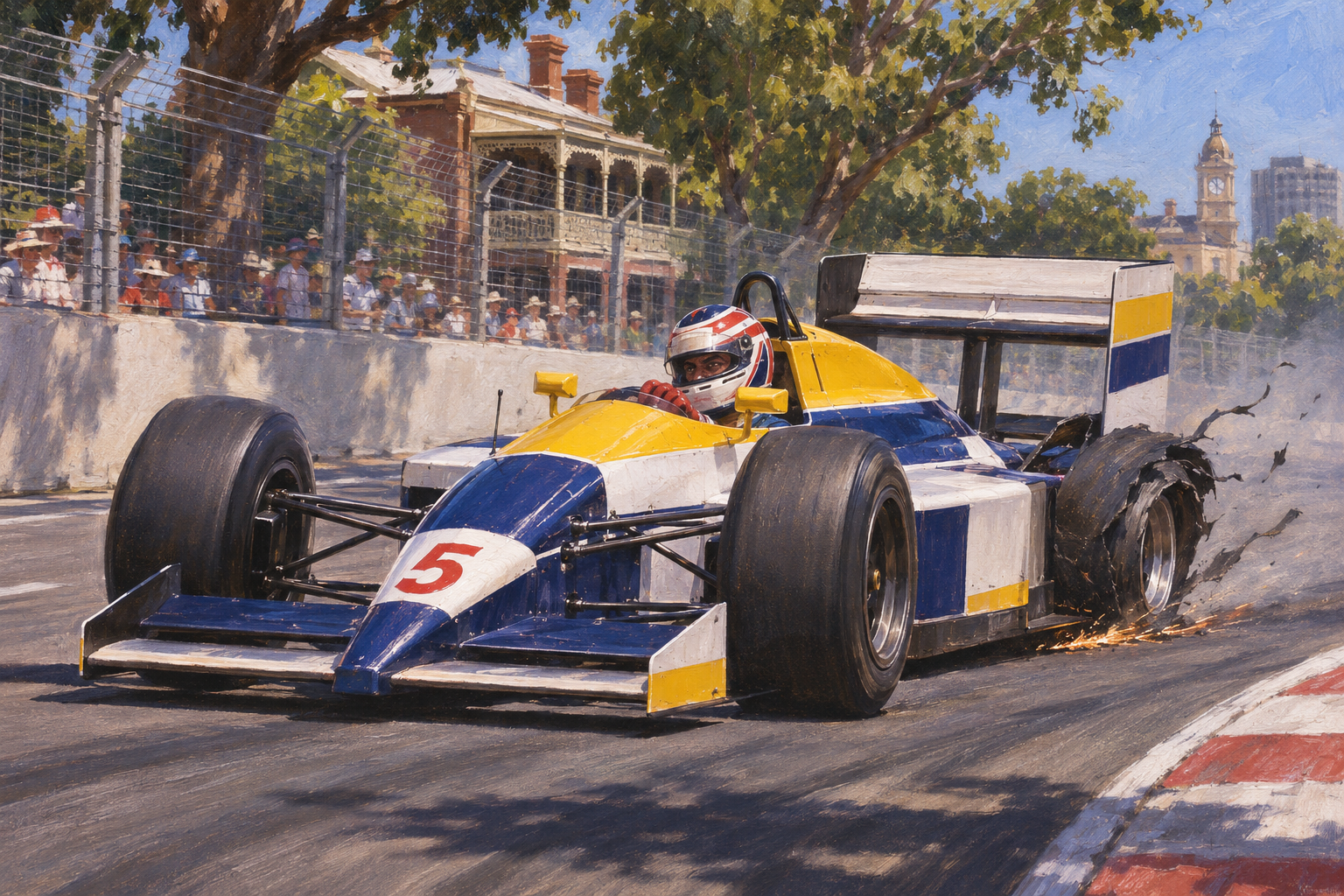
9. Adelaide 1986 Australian Grand Prix
Three drivers came to Adelaide able to win the title. Nigel Mansell led and needed only third place. Alain Prost and Nelson Piquet had to win and hope.
Goodyear had told the teams the tyres would last the distance. Prost had an early puncture and stopped for a new set, which looked like the end of his chances. When his old tyres were examined they showed so little wear that the others decided to run through without stopping. Keke Rosberg, leading in his last race, had a tyre come apart on lap 63. A lap later, on the fastest part of the circuit, Mansell's left rear exploded at about 180 mph. He kept the car out of the wall as it snaked down the straight on three wheels, and his championship ended in the escape road.
Williams had no choice but to call Piquet in from the lead for new tyres. Prost, on the fresher set he had been forced to take, went by. His fuel read-out told him he would not finish. He kept going, won, and stopped just past the line. He was champion by two points.
Verdict Three contenders, one exploding tyre at 180 mph, and a champion nobody expected at half distance.
Prost's fuel read-out said the tank was empty for the last several laps.
- Years
- 21 June 1981
- Engine
- Gilles Villeneuve
- Power
- Ferrari 126CK
Race · Spain
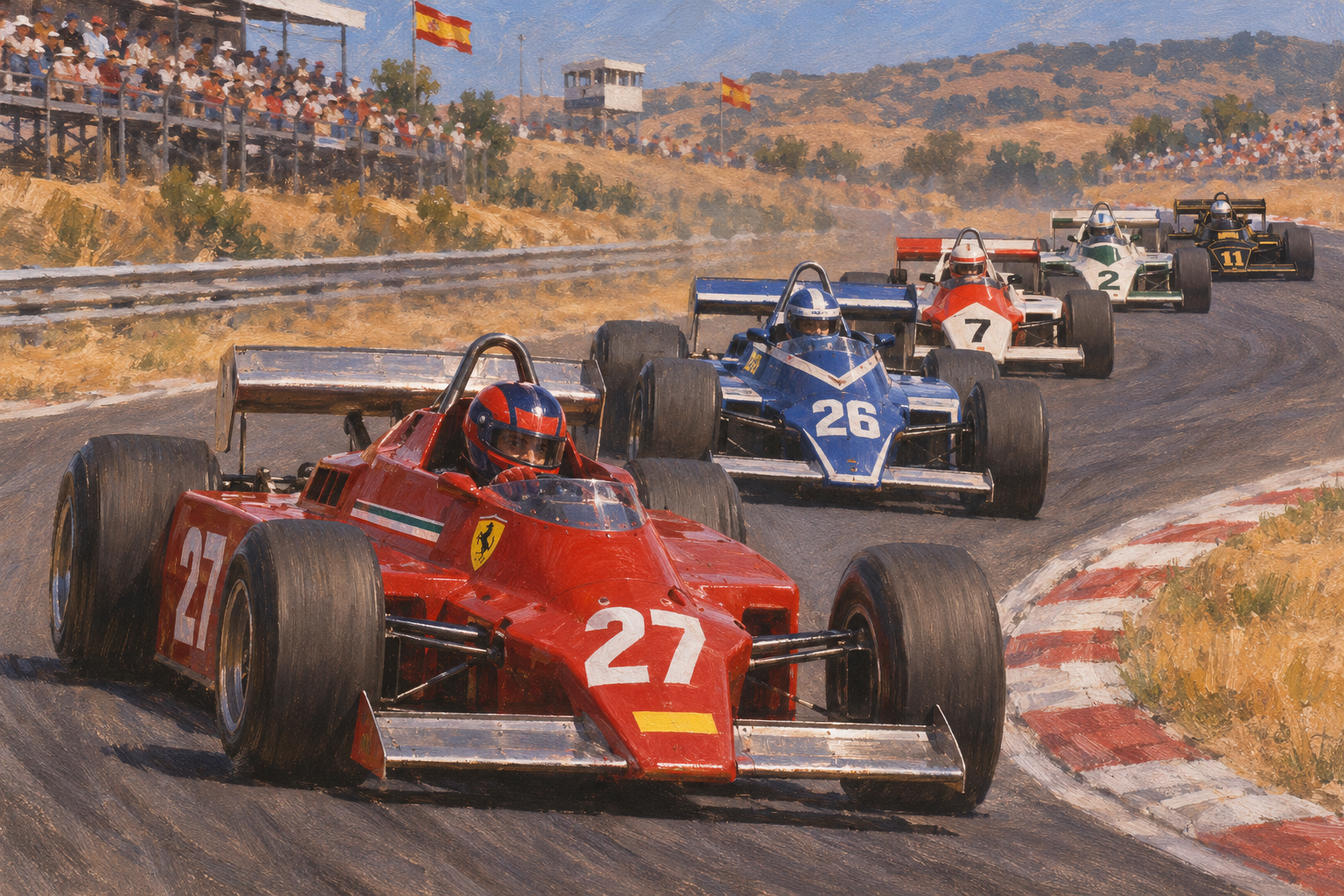
8. Jarama 1981 Spanish Grand Prix
The Ferrari that Gilles Villeneuve drove in 1981 had the most powerful engine in the field and a chassis its own driver compared to a big red Cadillac. At Jarama, a tight circuit where power counted for little, he qualified seventh. He was third after a lap and inherited the lead on lap 14 when Alan Jones went off.
For the remaining 66 laps, in great heat, he had four faster cars behind him: Jacques Laffite, John Watson, Carlos Reutemann and Elio de Angelis. They were quicker everywhere except on the one straight, where the turbo pulled him clear. Villeneuve's answer was to place the car exactly, every corner of every lap, so that none of them could get alongside before the straight came round again. He did not make a mistake in an hour and a quarter.
The five of them crossed the line nose to tail, covered by 1.24 seconds. It is the second-closest top five the championship has seen, after Monza in 1971. It was Villeneuve's sixth win, and his last.
Verdict Four faster cars, sixty-six laps, and not one mistake to let them through.
The first five cars finished within 1.24 seconds. It was Villeneuve's last win.
- Years
- 11 April 1993
- Engine
- Ayrton Senna
- Power
- McLaren MP4/8
Race · UK
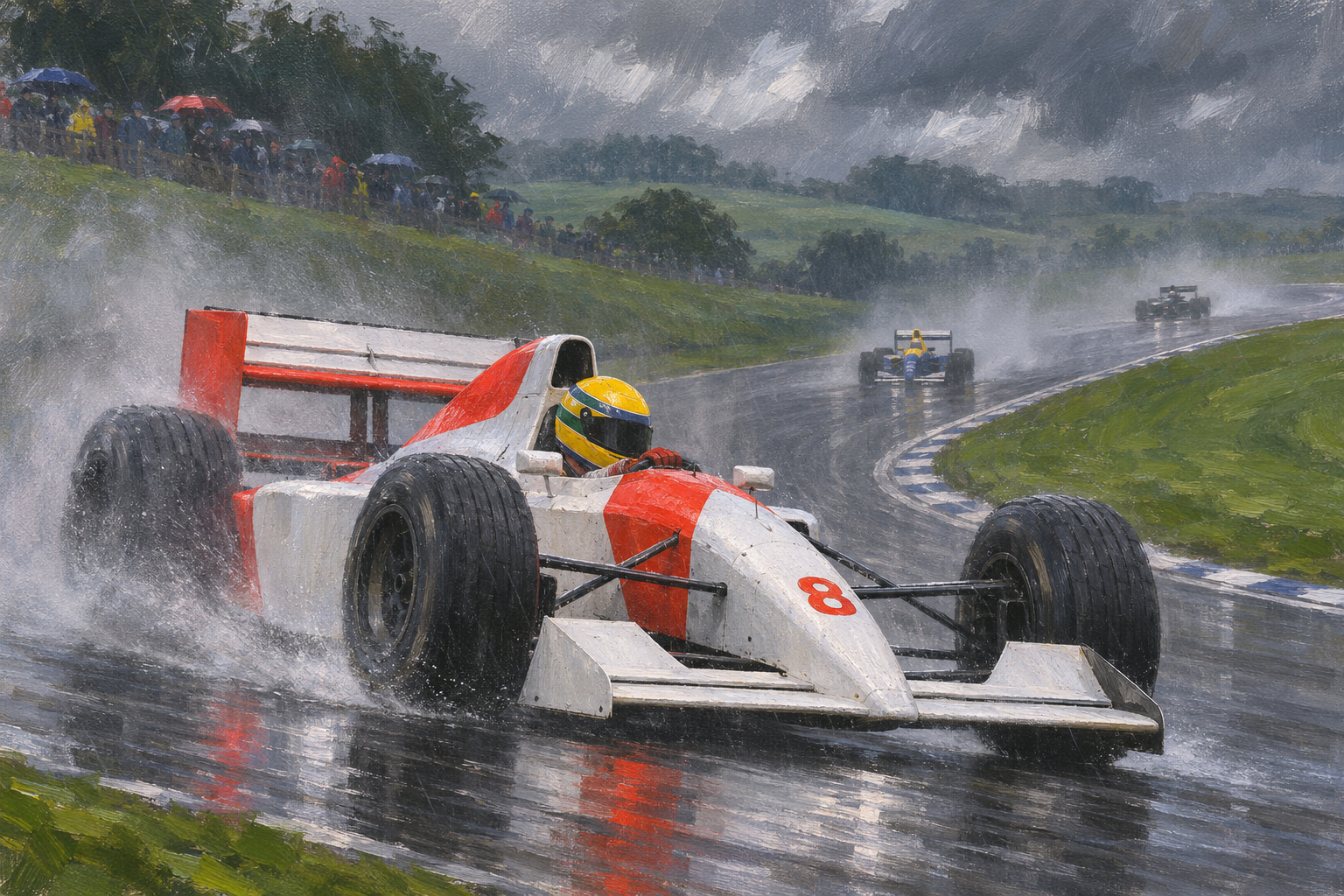
7. Donington Park 1993 European Grand Prix
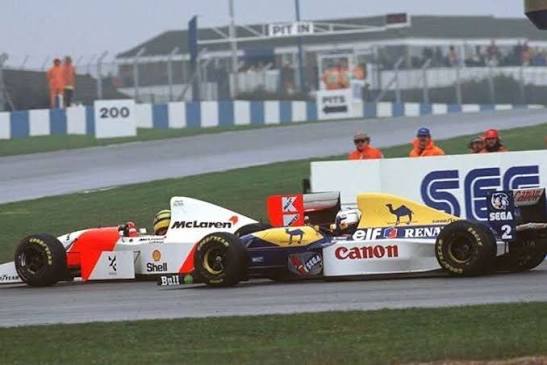
Donington Park held one world championship race, on a cold, wet Easter Sunday, and it is known for its first lap. Ayrton Senna started fourth in a McLaren with a customer engine, well down on power against the Williams cars. He was fifth into the first corner. He passed Michael Schumacher on the way out of it, went round the outside of Karl Wendlinger through the Craner Curves, took Damon Hill into McLean's, and outbraked Alain Prost at the hairpin. He led across the line at the end of the lap.
What followed is why it is a race and not only a lap. The rain came and went all afternoon, and the right tyre changed every few minutes. Prost, in much the faster car, came into the pits seven times, chasing the conditions. Senna stopped four times and stayed out on slicks on a damp track when others could not. At one point he drove through the pit lane without stopping and set the fastest lap of the race in doing so.
He won by a minute and twenty seconds from Hill and lapped everyone else, Prost included.
Verdict The best opening lap ever driven, and then seventy-five more in changing rain.
Senna set the fastest lap of the race on a lap when he drove through the pit lane without stopping.
The full story of the Donington Park 1993 European Grand Prix →
- Years
- 10 September 1967
- Engine
- John Surtees
- Power
- Honda RA300
Race · Italy
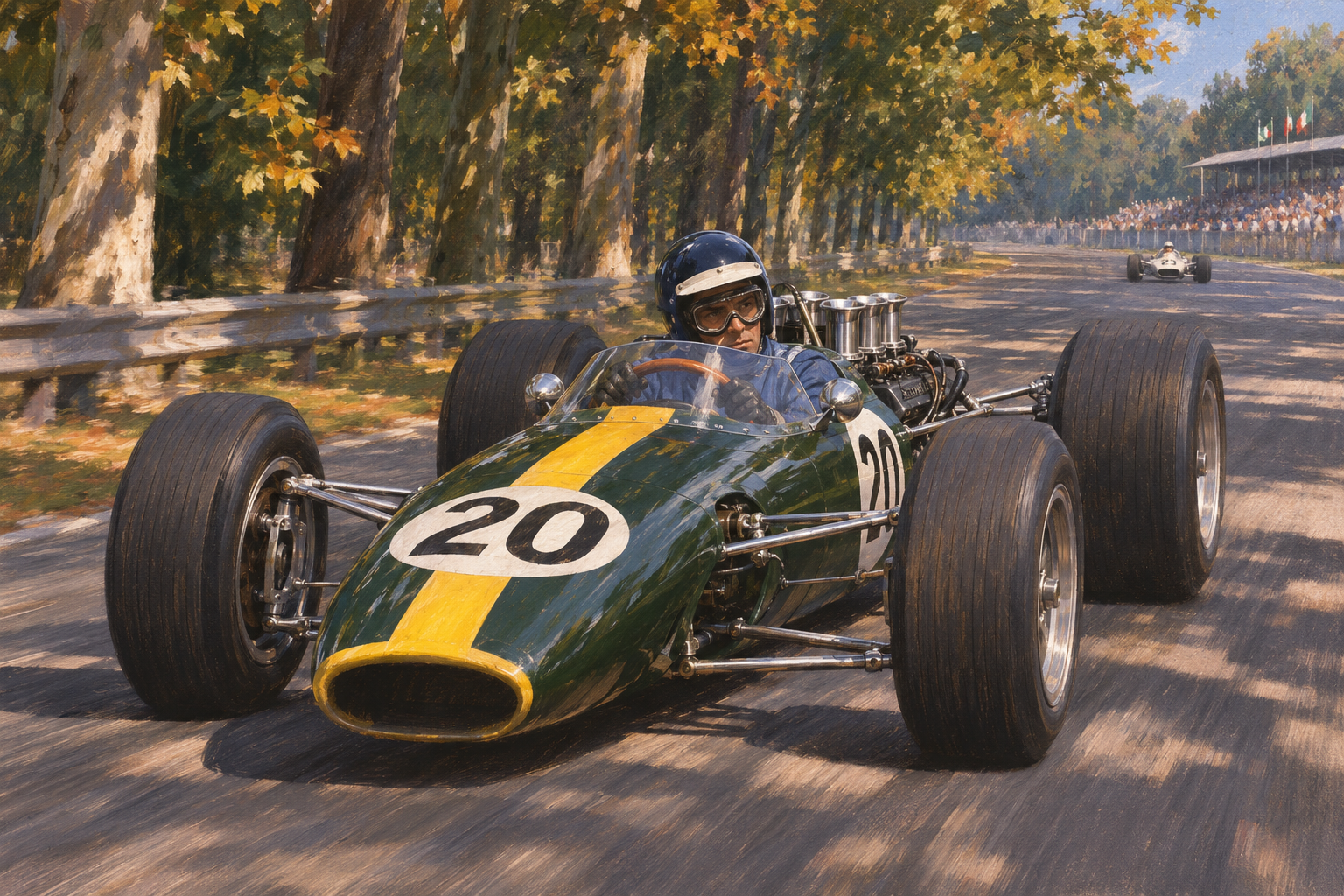
6. Monza 1967 Italian Grand Prix
Jim Clark did not win this race, and it is remembered as his greatest. He took the lead early in the Lotus 49, and on lap 13 had a puncture. The stop cost him a whole lap. He rejoined behind the leaders on the road, a full lap down.
Monza in 1967 was a slipstreaming circuit, where a single car could not escape a group. Clark did. He unlapped himself, pulled away from the men he had just passed, and over the next 45 laps made up the entire lap, equalling the lap record repeatedly. With seven laps to go he was back in the lead. Nobody had done that in a Grand Prix before.
On the last lap his fuel pumps failed to pick up the last few gallons. John Surtees, in a new Honda that had never raced, and Jack Brabham went past. They arrived at the final corner together. Brabham went for the inside, slid wide on oil, and Surtees beat him to the line by a fifth of a second. Clark coasted in third.
So it had the greatest recovery drive anyone had seen and a finish decided by a car's length, with different men involved in each.
Verdict Clark made up a whole lap, led, ran dry, and two other men fought out the finish.
The winning Honda was new and had never raced before.
- Years
- 1 July 1979
- Engine
- Jean-Pierre Jabouille
- Power
- Renault RS10
Race · France
5. Dijon-Prenois 1979 French Grand Prix
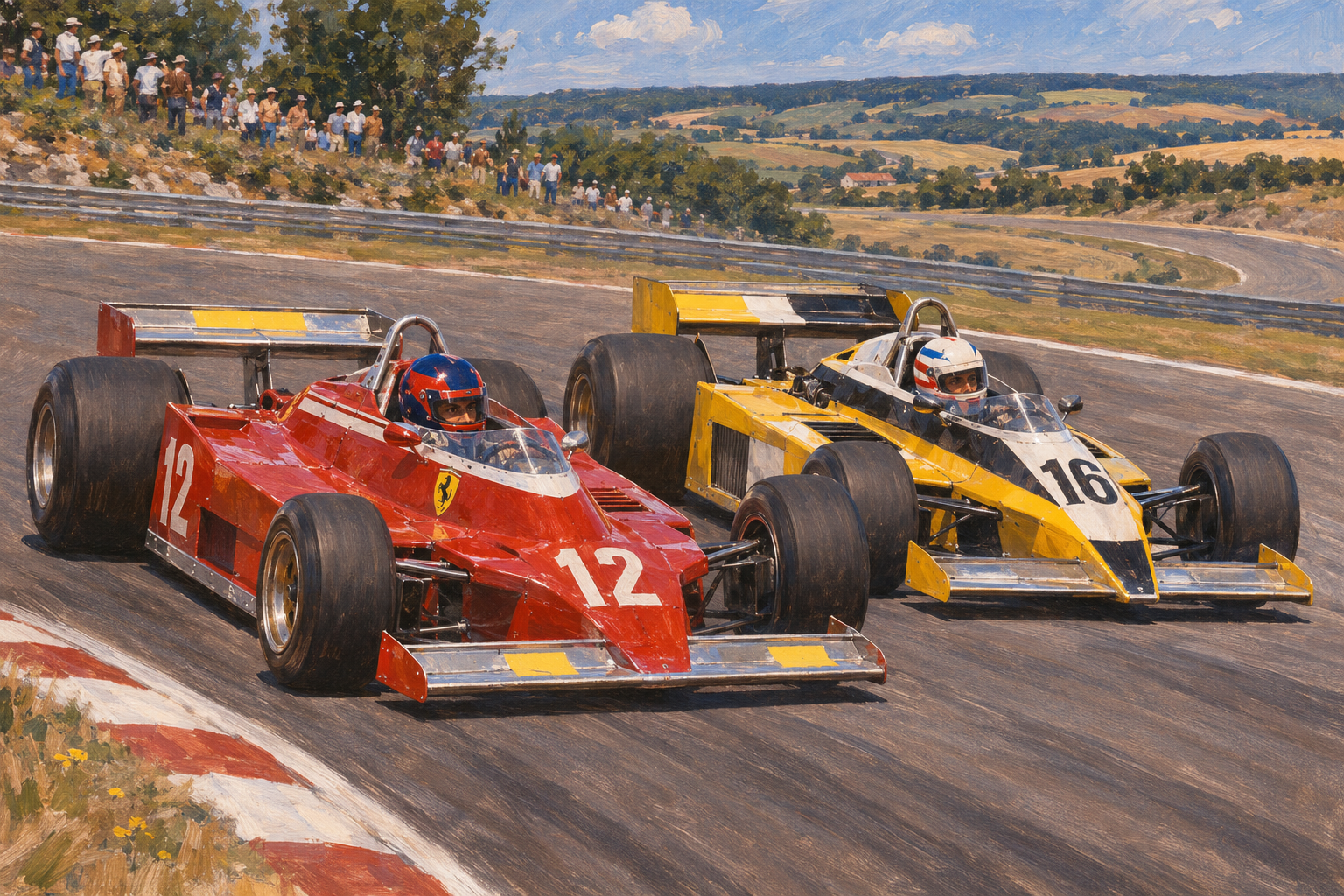
Jean-Pierre Jabouille won this race in a Renault, and it was a landmark: the first Grand Prix victory for a turbocharged engine, achieved by a French driver in a French car on French tyres at the French Grand Prix. Hardly anyone remembers it, because of what was going on fifteen seconds behind him.
Gilles Villeneuve, in a Ferrari with worn tyres and fading brakes, was second. René Arnoux, in the other Renault, with more power and a fuel pick-up problem, was catching him. For the last three laps they went at each other without restraint. Arnoux got by. Villeneuve came back at the next corner with all four wheels locked. They went through bends side by side, banged wheels half a dozen times, ran off the road and came back on, and swapped places again and again. Villeneuve finished second by a quarter of a second.
They got out of their cars laughing and stayed friends. Other drivers were less amused, and some said it was irresponsible. The film of those laps is still the first thing people are shown to explain what wheel-to-wheel racing means. It was for second place.
Verdict The best fight in the sport's history was for second place.
It was the first Grand Prix won by a turbocharged car, and almost nobody remembers that part.
- Years
- 2 November 2008
- Engine
- Felipe Massa
- Power
- Ferrari F2008
Race · Brazil
4. Interlagos 2008 Brazilian Grand Prix
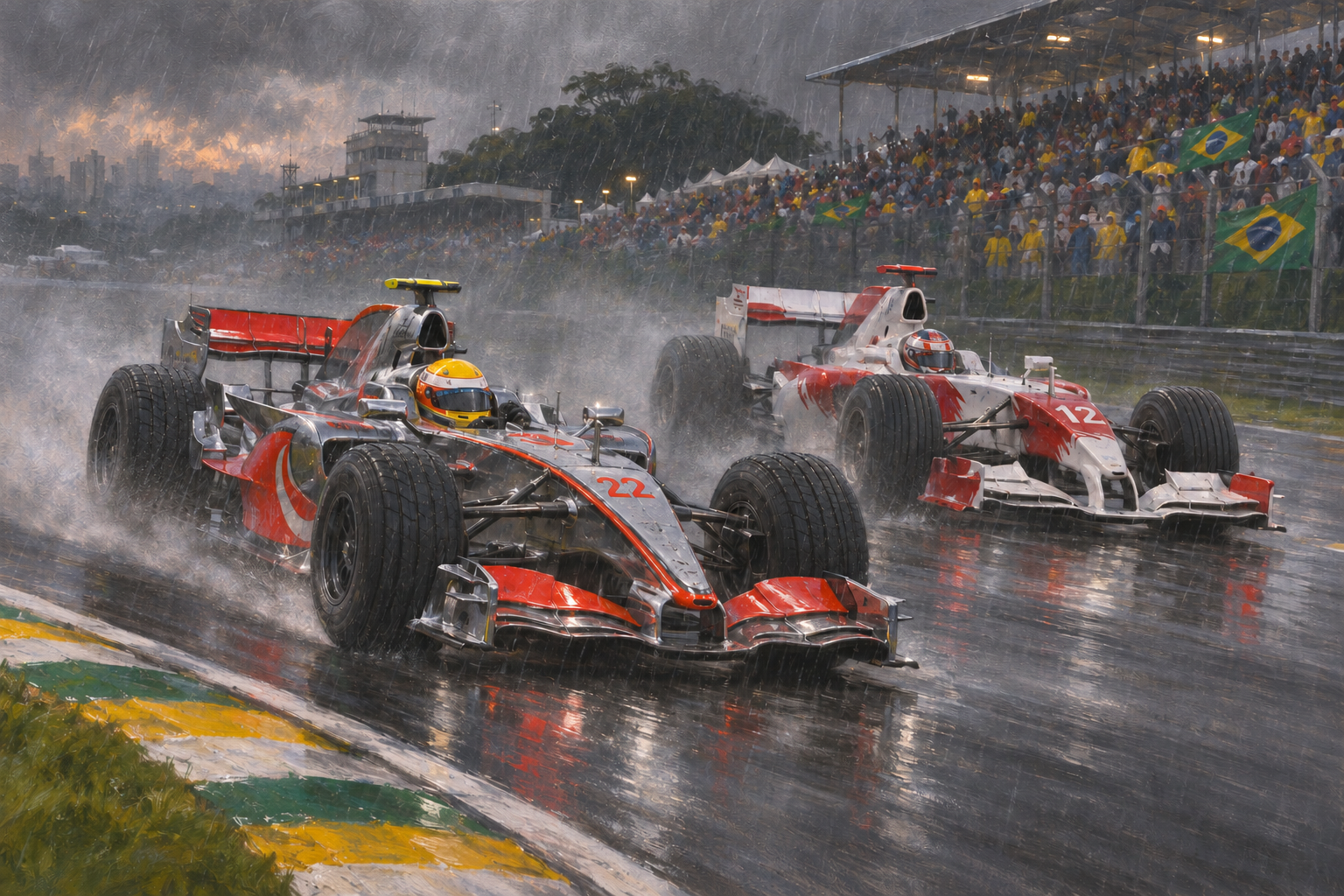
No championship has been decided later than this one. Felipe Massa had to win his home race and hope Lewis Hamilton finished lower than fifth. Massa did his part without a mistake, leading from pole in changing weather.
With a few laps left it began to rain again. Hamilton, running fourth, stopped for wet tyres, as did nearly everyone. Timo Glock did not. Hamilton came out fifth, which was enough, and then Sebastian Vettel passed him with two laps to go. That made him sixth, and Massa champion.
Massa crossed the line. In the Ferrari garage his family and mechanics began to celebrate, and the television pictures showed them doing it. Half a minute behind, Vettel and Hamilton came round the last corner of the last lap and found Glock, on dry tyres in heavy rain, barely able to keep the car on the road. Both went past him. Hamilton was fifth and champion by a point.
Massa stood on the top step of the podium in front of his own crowd and conducted himself better than most winners do. It is fourth because of the stakes. The race in front of it was ordinary until the last three laps.
Verdict A title won and lost at the last corner of the last lap of the last race.
Massa was world champion for about half a minute after he crossed the line.
- Years
- 5 September 1971
- Engine
- Peter Gethin
- Power
- BRM P160
Race · Italy
3. Monza 1971 Italian Grand Prix
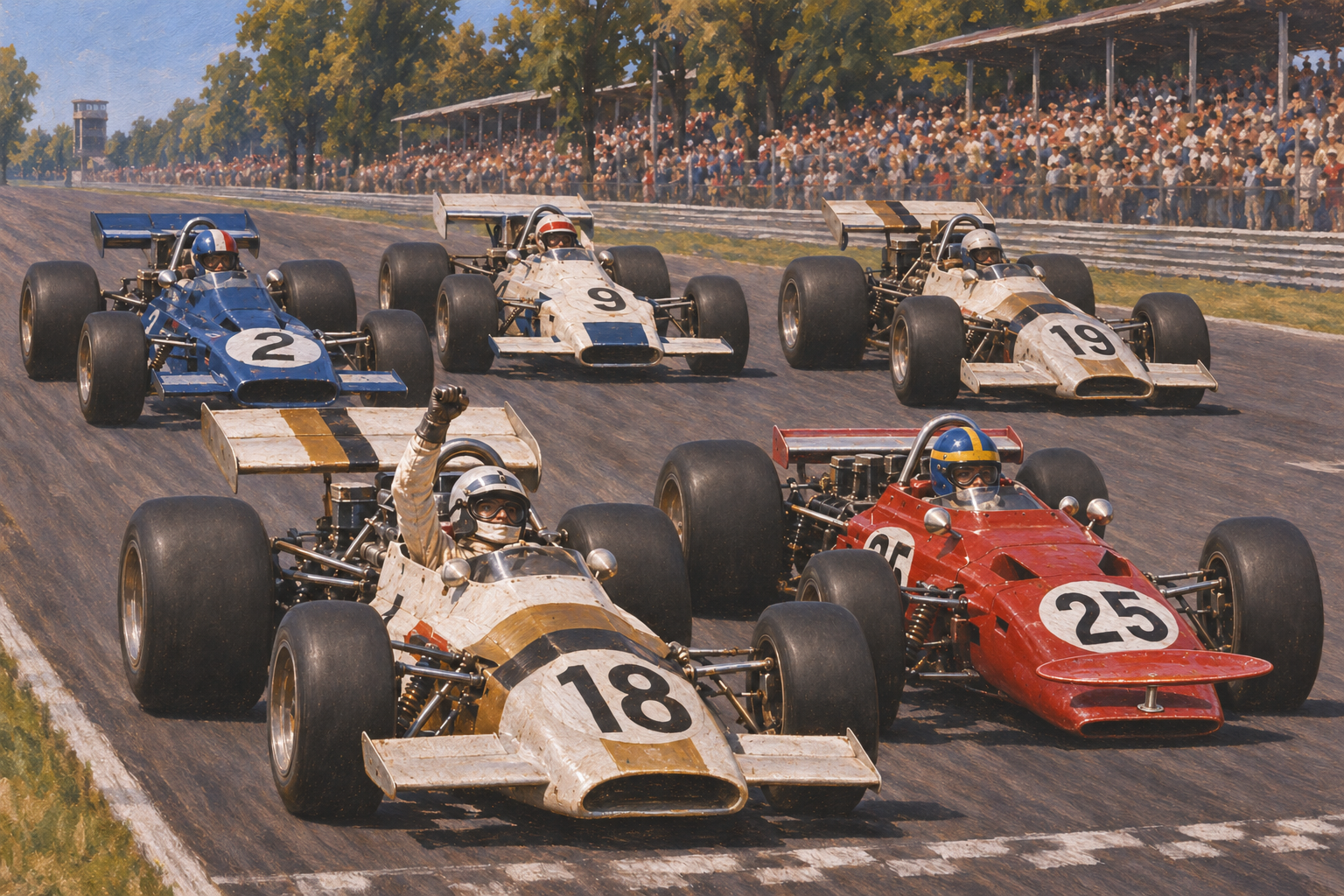
This is the closest finish the championship has had, and the last race on Monza as it was built, before the chicanes went in. With nothing to slow them, the cars ran in a pack for the whole distance, each towing the next along the straights. The lead changed hands about 25 times among eight drivers.
Nobody could break away, so the race came down to who was placed where at the last corner. Peter Gethin, in a BRM, had been dropped by the leading group in mid-race and had caught it again. He started the last lap fourth, went into the Parabolica later than anyone, held the engine past its limit on the way out, and reached the line a hundredth of a second ahead of Ronnie Peterson. He raised his arm as he crossed it, in case the timekeepers were in doubt. The first five cars were covered by 0.61 seconds.
Gethin led three laps and never won another Grand Prix. The winning average of just over 150 mph stood as the fastest in the championship for 32 years.
It is third because nothing was at stake except the race itself. As pure racing it has not been equalled.
Verdict Five cars in six tenths of a second, and the winner by a hundredth.
The winning margin was one hundredth of a second, and Gethin led only three laps.
- Years
- 12 June 2011
- Engine
- Jenson Button
- Power
- McLaren MP4-26
Race · Canada
2. Circuit Gilles Villeneuve, Montreal 2011 Canadian Grand Prix
If the 1957 race is too much one man's work for you, this is the answer, and it is the best race of the modern era. It lasted four hours and four minutes, the longest in the championship's history, of which two hours were spent stopped while rain flooded the track.
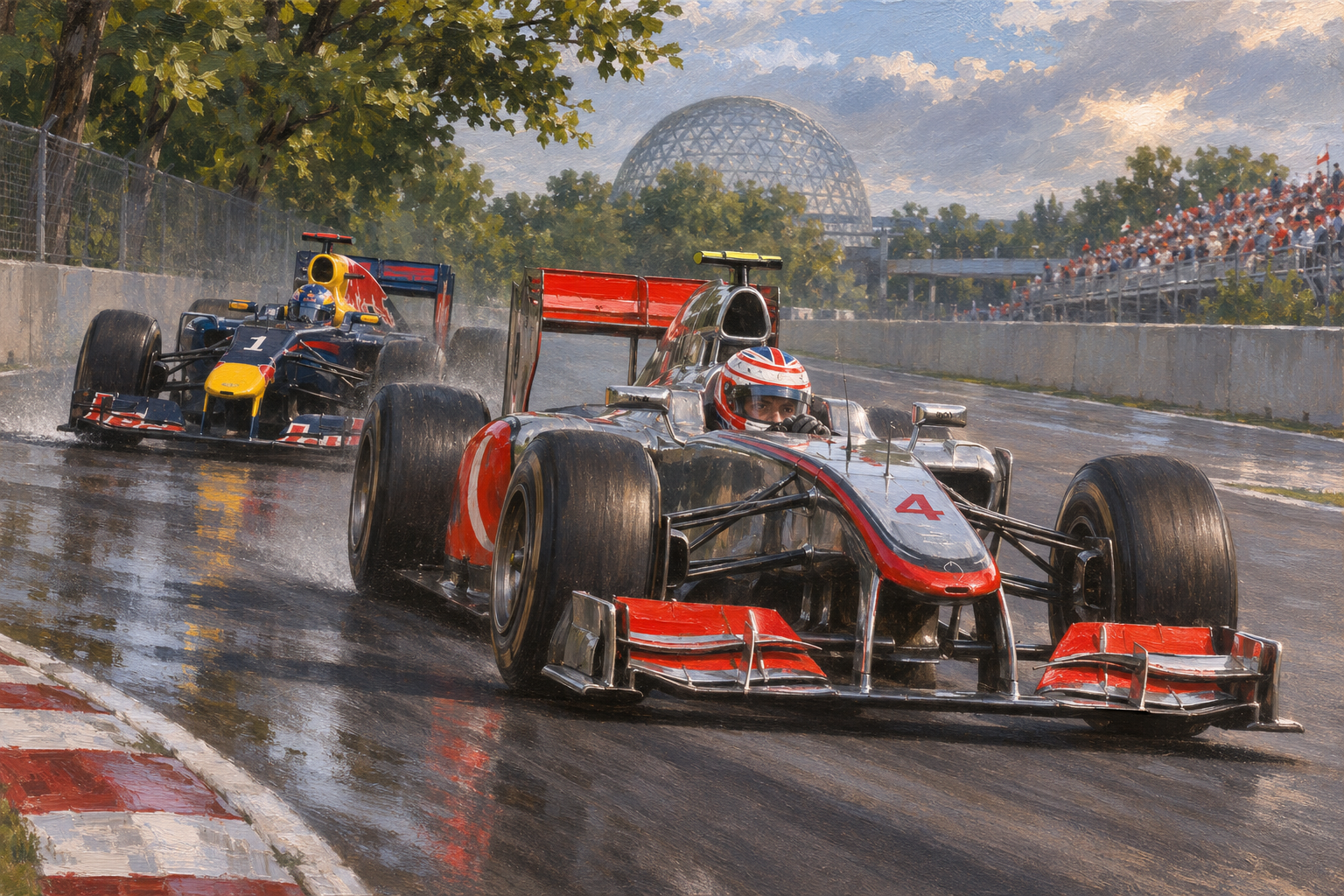
Jenson Button's afternoon would have ended most drivers' interest. He collided with his team-mate Lewis Hamilton, who retired. He was given a drive-through penalty for speeding behind the safety car. He collided with Fernando Alonso and had a puncture. He came into the pits six times. On lap 37 of 70 he was last.
The track then began to dry, and Button was the first to judge it right. He went from intermediates to slicks at exactly the moment and started lapping seconds quicker than the leaders. He passed Mark Webber and Michael Schumacher for second with five laps left. Sebastian Vettel had led every lap from pole. On the last one, with Button a second behind, he ran wide at the sixth corner, and Button went through.
He led for half a lap. There were six safety car periods.
Verdict Last on lap 37, in the pits six times, and into the lead halfway round the final lap.
At four hours and four minutes it is the longest race in the history of the championship.
The best of the 30 · Race · Germany
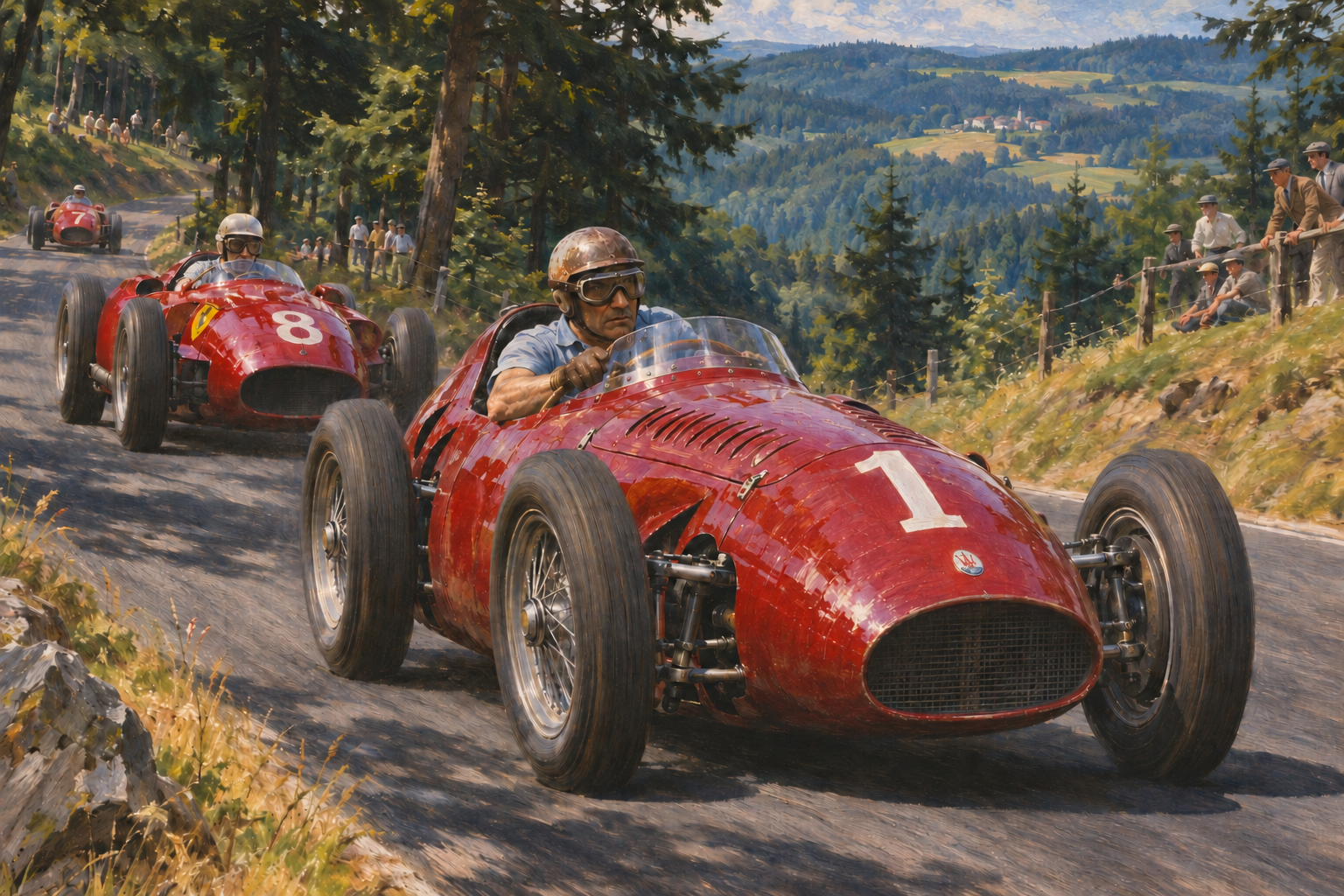
1. Nürburgring Nordschleife 1957 German Grand Prix
- Years
- 4 August 1957
- Engine
- Juan Manuel Fangio
- Power
- Maserati 250F
We said this list was for races, not for one man's drive, and the race at the top of it comes close to breaking that rule. It stays first because it was a chase with a visible quarry, settled by overtaking on the second-last lap, on the hardest circuit in the world. Every comeback since has been measured against it.
Juan Manuel Fangio was 46 and needed a win to be sure of a fifth world championship. His Maserati could not match the Ferraris of Mike Hawthorn and Peter Collins on a full tank, so he started with half a load and soft tyres, planning to build a lead and stop. By half distance he was 30 seconds ahead. The stop went wrong. A mechanic lost a wheel nut under the car, and Fangio rejoined about 48 seconds behind the two Ferraris with ten laps of the Nürburgring to go.
He then broke the lap record nine times. His fastest lap was eight seconds quicker than his own pole position. The Ferrari pit, which had signalled its drivers to ease off, could not get a message to them in time on a lap of fourteen miles. Fangio passed Collins and then Hawthorn on the twenty-first lap of twenty-two and won by three seconds.
It was his last Grand Prix victory. He said afterwards that he had done things in the car that day he had never done before and did not want to do again.
Verdict A lost pit stop, 48 seconds to find and ten laps of the Nürburgring to find them in.
Fangio broke the lap record nine times in the last ten laps. It was his final Grand Prix win.
What we left off, and why
Lower than you might expect
The 1971 Italian Grand Prix, at 3. The closest finish in history, and the best racing. It is behind two races with more at stake.
The 1993 European Grand Prix, at 7. Many would have it in the top three for the first lap alone. After that lap it was a demonstration, and this is a list of races.
The 1984 Monaco Grand Prix, at 15. It is famous for what might have happened. What did happen was 31 laps and a red flag.
The 2000 Belgian Grand Prix, at 23. It contains the best overtaking move of its era. The rest of the race was a two-car pursuit.
Higher than you might expect
The 1967 Italian Grand Prix, at 6. Less well known than the 1971 race at the same circuit. It had a recovery nobody had seen before and a finish won by a car's length.
The 1981 Spanish Grand Prix, at 8. There was almost no overtaking. It is here because five cars ran nose to tail for an hour and the one in front was the slowest of them.
The 1964 Mexican Grand Prix, at 16. Rarely shown and half forgotten. Three men held the championship in the last two laps.
The 1999 European Grand Prix, at 29. Remembered mainly by people who were watching. Few races have had so many leaders fall out one after another.
Not on the list
The 1989 and 1990 Japanese Grands Prix. See above.
The 1997 European Grand Prix at Jerez. Michael Schumacher drove into Jacques Villeneuve and lost the title. A great moment in a tense but ordinary race.
The 1968 German Grand Prix and the 1985 Portuguese Grand Prix. Jackie Stewart winning in fog by four minutes, and Ayrton Senna's first win in a flood. Two of the greatest drives there have been, and nobody else was in either race.
The 2003 Brazilian Grand Prix. Chaos in the rain, a red flag, and a winner announced days later. Entertaining and confused.
The 2008 Belgian Grand Prix. A superb fight between Lewis Hamilton and Kimi Räikkönen in the last three laps, spoiled by a penalty applied after the flag.
The 2016 Spanish Grand Prix. Max Verstappen won on his first drive for Red Bull after the two Mercedes took each other off. A remarkable result more than a remarkable race.
The 2020 Sakhir and 2021 Italian Grands Prix. Both produced first-time or unexpected winners, and either could have taken the last place.
Anything from 2025 or 2026. Too recent to judge.
Tell us what we got wrongQuestions about this list
What is the greatest Formula One race of all time?
We rank the 1957 German Grand Prix first. Juan Manuel Fangio lost 48 seconds in a pit stop, broke the lap record nine times on the Nürburgring and passed both Ferraris on the second-last lap. The 2011 Canadian Grand Prix, which Jenson Button won on the last lap after being last at half distance, is second.
What was the closest finish in Formula One history?
The 1971 Italian Grand Prix at Monza. Peter Gethin beat Ronnie Peterson by one hundredth of a second, and the first five cars finished within 0.61 seconds.
What is the longest Formula One race ever held?
The 2011 Canadian Grand Prix, which lasted four hours and four minutes including a two-hour stoppage for rain. The rules were changed afterwards to limit the total time of a race.
Why is the 2021 Abu Dhabi Grand Prix on the list?
The list ranks races on the stakes and on how the finish is remembered, as well as on the racing. Abu Dhabi 2021 decided a championship on the last lap after a disputed safety car restart. The governing body later found the rules had been applied wrongly, and the result stood. Our entry describes what happened without taking a side.
Why are Senna and Prost's Suzuka collisions not included?
The 1989 and 1990 Japanese Grands Prix are famous for the collisions that decided the championships, but the races themselves were not close. They are covered in our lists of the greatest moments and the greatest rivalries in motor racing.
Each race was judged on three things: the quality of the racing, what was at stake, and how the finish is remembered. Only world championship Grands Prix from 1950 onwards were considered. Races that were chiefly one driver's performance were left for a separate list unless the result was in doubt near the end. Races from the two most recent seasons were not considered.