
A car is a collection of other people's good ideas. Very few of them were invented by the company whose badge is on the bonnet, and almost none arrived fully formed. Most were patented decades before anyone could make them work, tried once by a maker who was too early, and then made to last by someone else.
This is a list of fifty of those ideas. For each we give the year it first appeared on a car and the car that carried it, and where the first attempt and the one that lasted are different, we give both.
The ranking is on one question: how much did it change what came after? That favours things every car now has over things that were merely clever, and it favours the ordinary over the exotic.
The calls we expect to be argued with
The assembly line is first, and it is not a part of a car at all. It is the reason everything else on the list reached people who were not rich.
The electric starter is above the seat belt. The belt has saved more lives. The starter decided who could drive.
Hydraulic brakes are sixth and the disc brake is thirteenth. Fluid made four-wheel braking work. The disc made it work better.
The overhead-valve engine is above anti-lock brakes. One is the basic shape of the engine and the other is a refinement that came seventy years later.
The lithium-ion electric car is thirtieth. It may well belong in the top five. We have ranked on what has already changed, and it is too soon.
The racing ideas are near the bottom. The mid-engined layout, downforce and carbon fibre remade the sport and reached a small fraction of road cars.
A note on firsts
Nearly every first in motoring is disputed. Where we found an earlier claim we have said so in the entry. In two cases the checking changed what we had planned to write: electronic fuel injection appeared on a Chrysler nine years before the Volkswagen usually credited, and electronic anti-lock brakes on a Chrysler seven years before the Mercedes-Benz.
See the full ranking, 1 to 50
50 to 31
50. Toyota The reversing camera
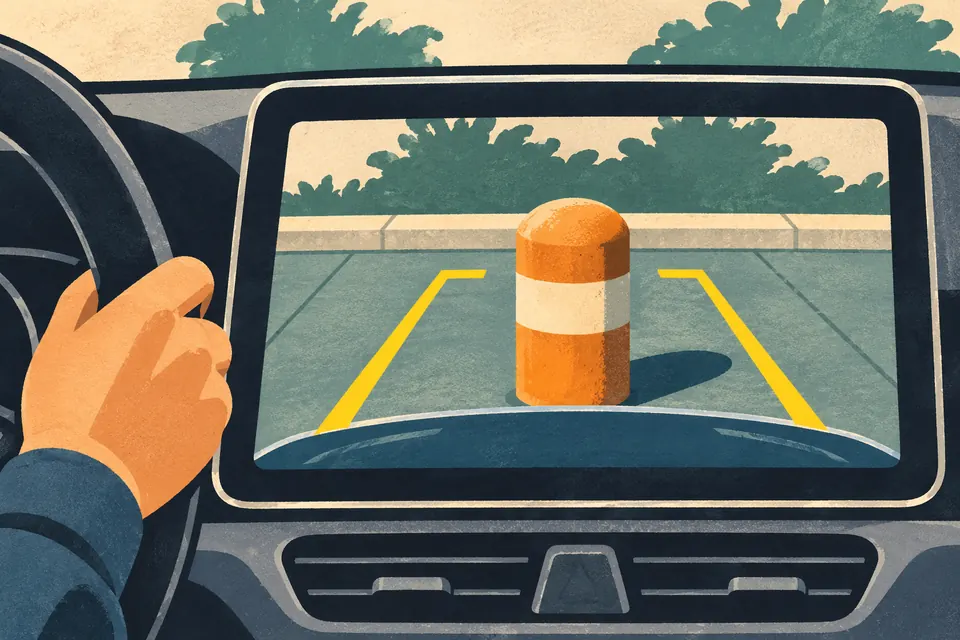
1987 · First used: Toyota Crown, Japan, 1987 · Credited to: Toyota · Shows what is behind the car
Buick showed one on a concept car in 1956. Toyota put one on the Crown in Japan in 1987. New cars sold in the United States have had to have one since May 2018, after a law named for a child killed by a reversing car.
Verdict From show-car gimmick to legal requirement in sixty years.
49. Renault The remote key
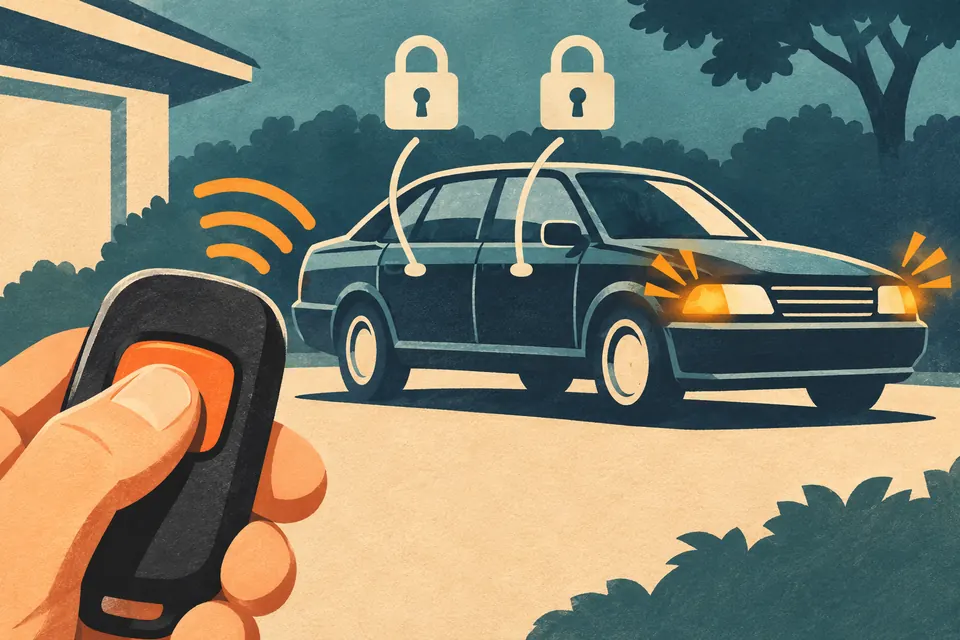
1982 · First used: Renault Fuego, 1982 · Credited to: Paul Lipschutz (patent, 1981) · Replaced the key in the door
The Renault Fuego of 1982 was the first car to unlock at the press of a button in the hand, by an infrared signal. General Motors made it common in America from 1989. The key has been turning into a transmitter ever since.
Verdict Nobody has scratched round a keyhole in the dark since.
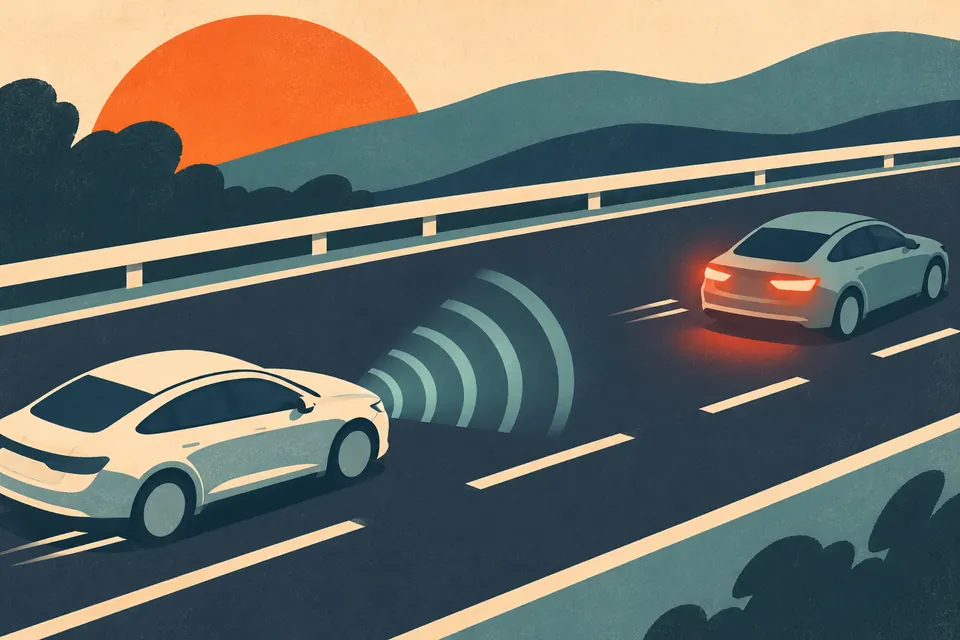
48. Mercedes-Benz Radar cruise control and automatic braking
1999 · First laser system: Mitsubishi Diamante, 1995. First radar: Mercedes-Benz S-Class, 1999 · Credited to: Mitsubishi; Mercedes-Benz · The car watches the one in front
Mitsubishi used a laser in 1995 to hold a gap to the car in front. Mercedes-Benz used radar on the S-Class in 1999, and in the years after, cars learned to brake by themselves when the driver did not. It is the first step towards a car that drives itself, which is why it is on the list and why it is not higher yet.
Verdict The car began to look where it was going.
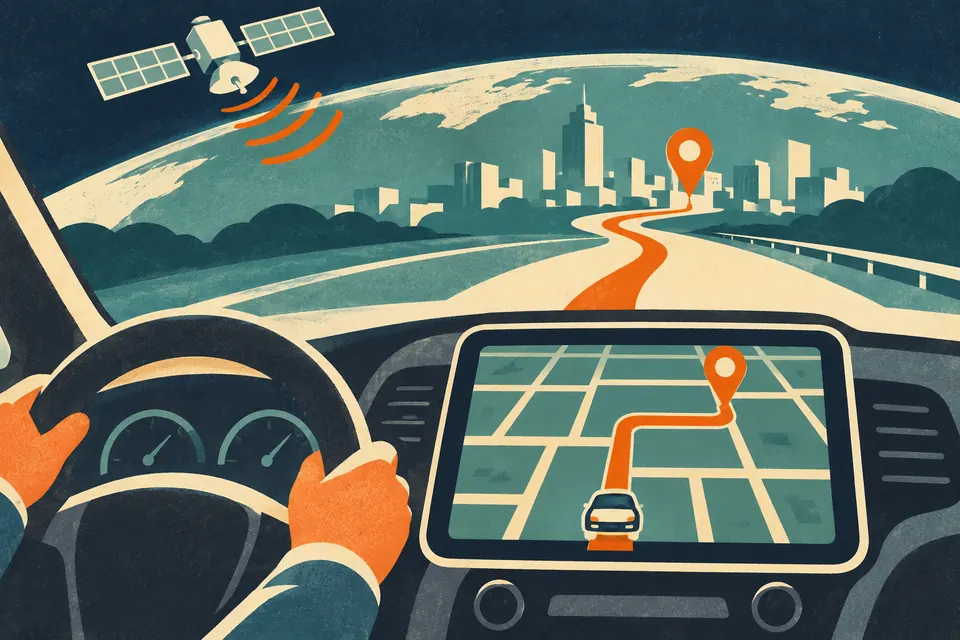
47. Mazda Satellite navigation
1990 · First in-car navigation: Honda, 1981. First with GPS: Mazda Eunos Cosmo, 1990 · Credited to: Honda; Mazda · Replaced the map on the passenger's knee
Honda sold an in-car navigation system in 1981 that worked out position with a gyroscope. The Mazda Eunos Cosmo of 1990 was the first production car with GPS. It changed how people drive more than how cars are built, and the telephone has largely taken the job over.
Verdict The end of the road atlas.
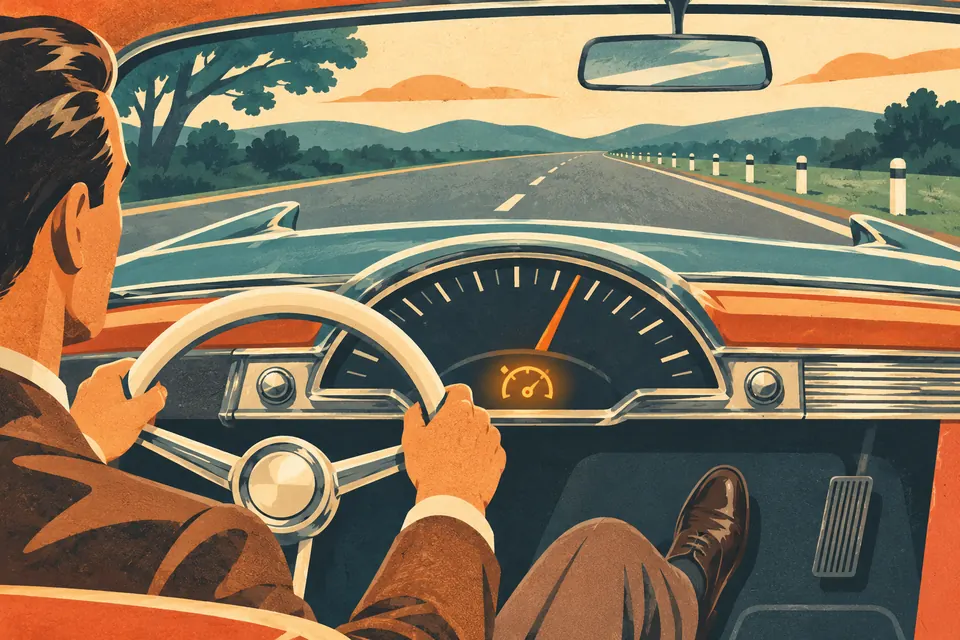
46. Chrysler Cruise control
1958 · First used: Chrysler Imperial, 1958 · Credited to: Ralph Teetor (patent, 1950) · Holds a set speed
Ralph Teetor, an engineer who had been blind since childhood, was irritated by a driver who sped up and slowed down as he talked. He patented a speed control in 1950, and the 1958 Chrysler Imperial was the first car to carry it. The oil crisis of 1973 made it popular.
Verdict Invented by a man who never drove.
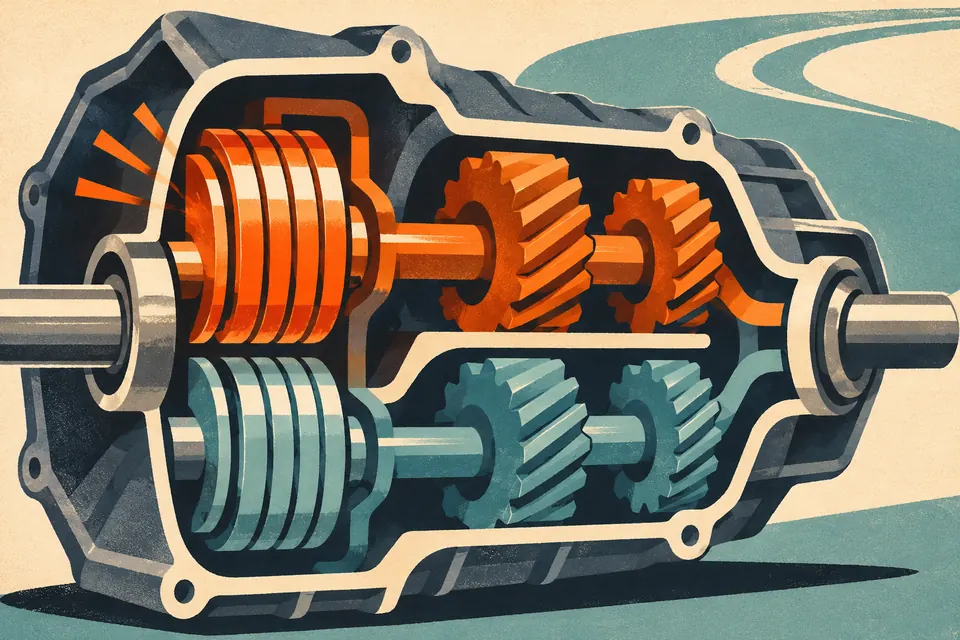
45. Volkswagen The dual-clutch gearbox
2003 · First raced: Porsche 962, 1985. First production car: Volkswagen Golf R32, 2003 · Credited to: Adolphe Kégresse (concept, 1939); Porsche; BorgWarner · Changes gear without interrupting the drive
Two clutches, one holding the next gear ready while the other drives. A French engineer drew it in 1939, Porsche raced it in 1985, and the Volkswagen Golf R32 of 2003 was the first production car to have it. The change takes a few hundredths of a second.
Verdict It ended the argument about whether a machine could change gear better than a person.
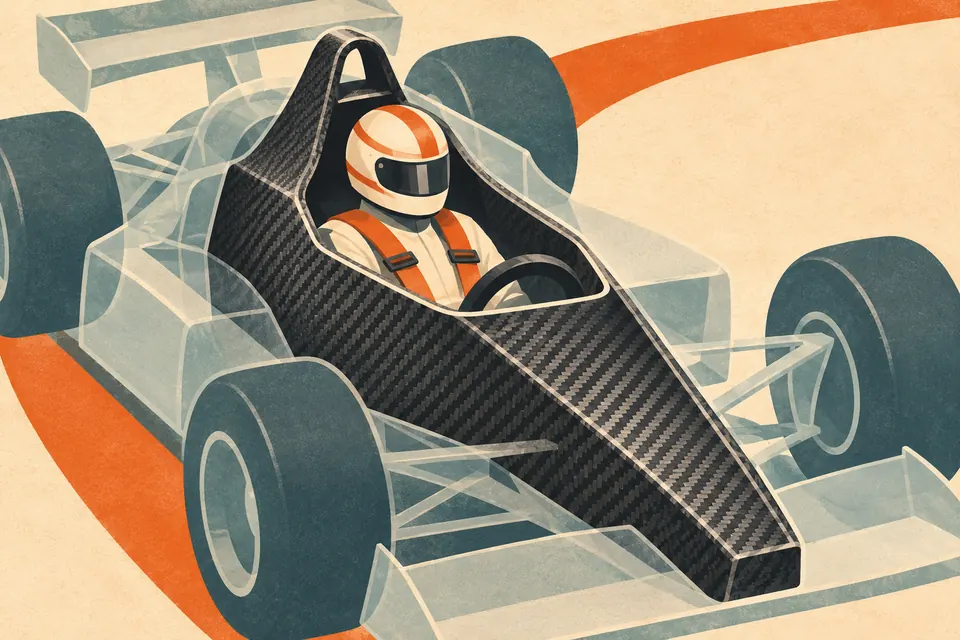
44. McLaren The carbon-fibre chassis
1981 · First raced: McLaren MP4/1, 1981 · Credited to: John Barnard · Replaced aluminium
John Barnard's McLaren MP4/1 of 1981 was the first Formula One car to race with a chassis of carbon fibre. Rivals doubted it would survive a crash. John Watson's accident at Monza that year destroyed the car and left him unhurt, and within a few seasons every team had one.
Verdict Lighter than aluminium and, it turned out, far safer.
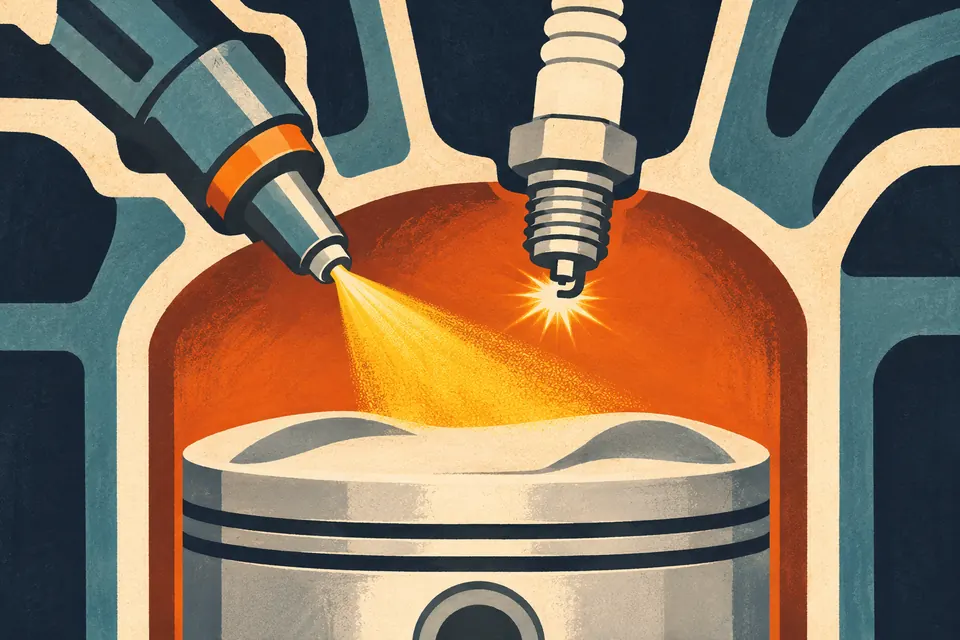
43. Mitsubishi Petrol direct injection
1996 · First four-stroke car: Mercedes-Benz 300 SL, 1954. First modern system: Mitsubishi Galant, 1996 · Credited to: Bosch; Mitsubishi · Fuel sprayed straight into the cylinder
Spraying petrol straight into the cylinder gives more power from less fuel. The Mercedes-Benz 300 SL had a mechanical version in 1954. Mitsubishi's Galant of 1996 had the first modern electronic one, and by 2016 about half of new American cars used it.
Verdict A racing car's trick that took forty years to come down in price.
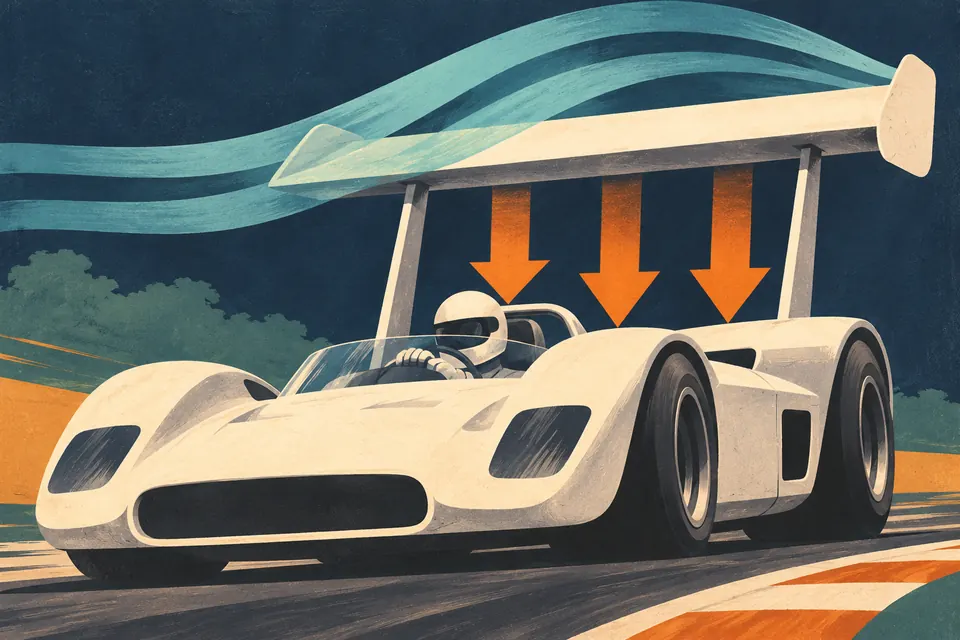
42. Chaparral Aerodynamic downforce
1966 · First high wing: Chaparral 2E, 1966 · Credited to: Jim Hall · Used air to push the car on to the road
Jim Hall's Chaparral 2E of 1966 carried a wing on tall struts that pressed the car on to the track, and a pedal that let the driver flatten it on the straights. Racing has been an argument about air ever since. Road cars have borrowed the look more than the effect.
Verdict The day racing cars started flying upside down.
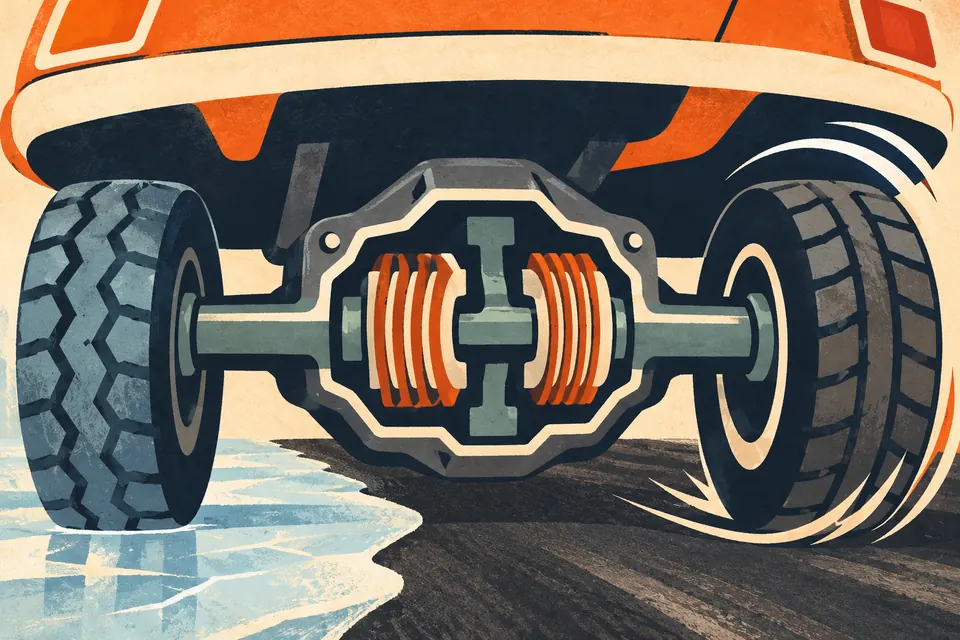
41. ZF The limited-slip differential
1935 · First used: Auto Union grand prix cars, 1935. First road car: Packard, 1956 · Credited to: ZF, for Ferdinand Porsche · Stops one wheel spinning the power away
An ordinary differential sends power to whichever wheel is easiest to turn, which is the one that is spinning. ZF built a differential in 1935 to tame the sixteen-cylinder Auto Union. Packard put one on a road car in 1956, for American winters.
Verdict Power to the wheel that can use it.
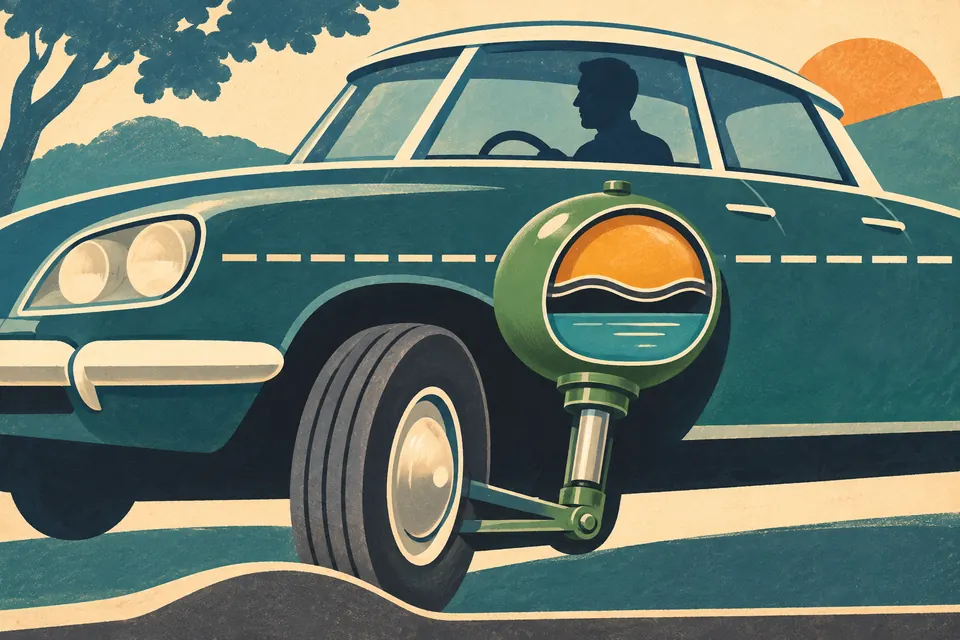
40. Citroën Hydropneumatic suspension
1954 · First used: rear of the Citroën Traction Avant 15H, 1954. All four wheels on the DS, 1955 · Credited to: Paul Magès · Gas and fluid in place of steel springs
Paul Magès, who had no formal engineering training, replaced steel springs with spheres of gas and fluid. Citroën tried it on the rear of the Traction Avant in 1954 and on all four wheels of the DS a year later. The car levelled itself and rode like nothing else. Rolls-Royce took a licence.
Verdict The best ride ever engineered, and too complicated to catch on.
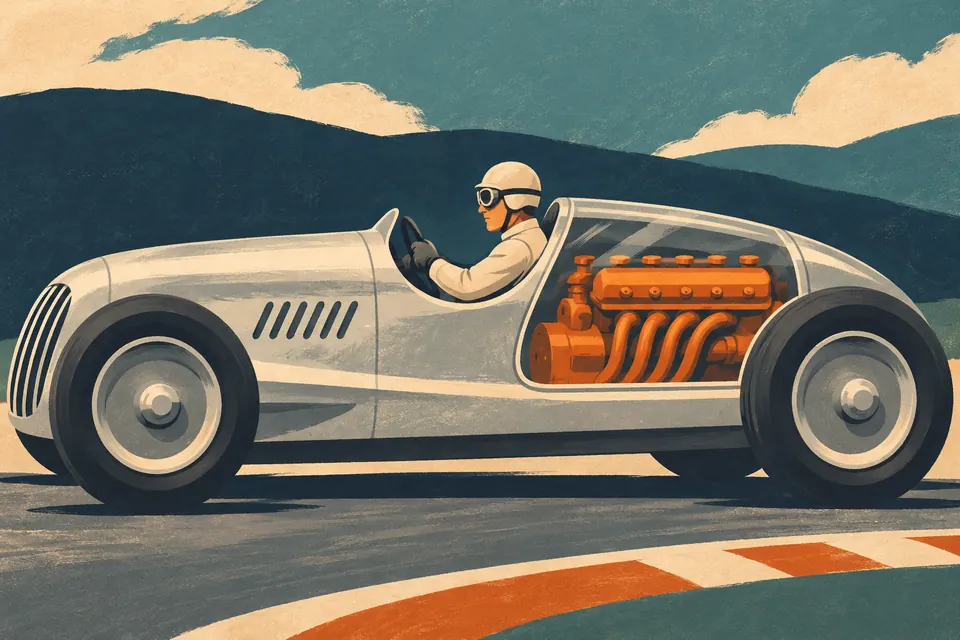
39. Auto Union The mid-engined layout
1934 · First to win grands prix: Auto Union, 1934. First road car: René Bonnet Djet, 1962 · Credited to: Ferdinand Porsche; Cooper · Put the engine behind the driver
Put the engine behind the driver and ahead of the rear wheels, and the car turns more willingly and puts its power down better. Auto Union won grands prix that way from 1934, and Cooper made it universal in racing by 1959. The first road car was the little René Bonnet Djet of 1962, four years before the Lamborghini Miura.
Verdict It transformed racing and supercars, and almost nothing else.
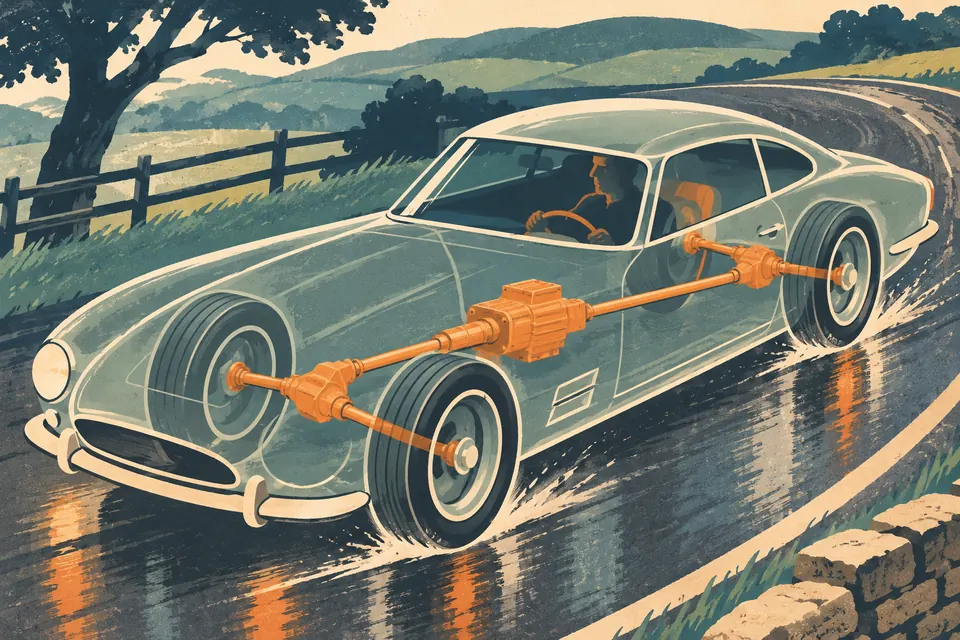
38. Jensen Four-wheel drive for road cars
1966 · First on a road car: Jensen FF, 1966. Audi Quattro, 1980 · Credited to: Ferguson Research; Audi · Took four-wheel drive off the farm
Four-wheel drive belonged to Jeeps and tractors until the Jensen FF of 1966 put it under a fast road car. The Audi Quattro of 1980 proved the point in rallying and then in the showroom. It is low on this list only because most cars still do without it.
Verdict Grip at both ends, on tarmac.
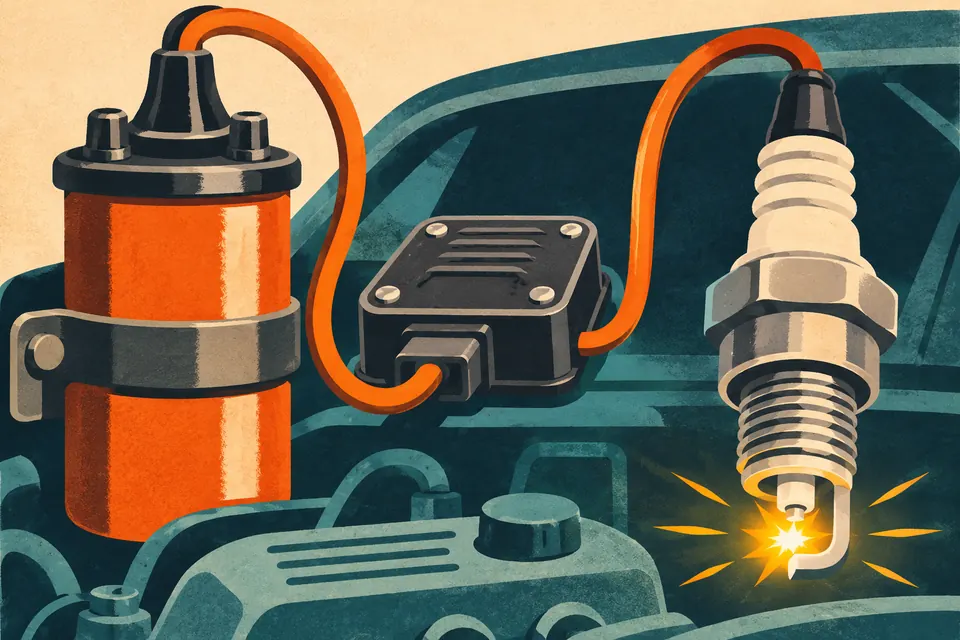
37. Pontiac Electronic ignition
1963 · First offered: Pontiac, 1963. First standard: Fiat Dino, 1968 · Credited to: Delco; Lucas (1955) · Replaced contact-breaker points
Contact-breaker points wore and needed setting every few thousand miles. Pontiac offered a system without them in 1963, and the Fiat Dino of 1968 was the first production car to have one as standard. By the middle of the 1970s the American makers had all changed over.
Verdict One less thing to adjust on a Sunday morning.
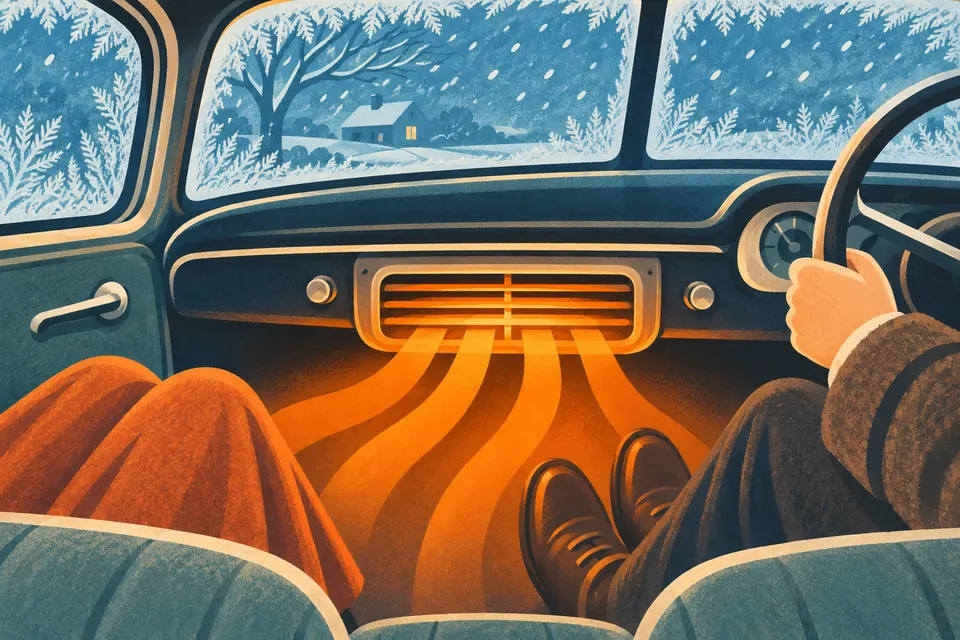
36. Nash The car heater
1938 · First fresh-air system: Nash Weather Eye, 1938 · Credited to: Nash · Replaced rugs and overcoats
For decades winter motoring meant rugs, gloves and a heavy coat. Nash's Weather Eye of 1938 drew fresh air in from outside, warmed it with engine heat and pushed it through the cabin, which is how every heater since has worked.
Verdict The car became an all-year machine.
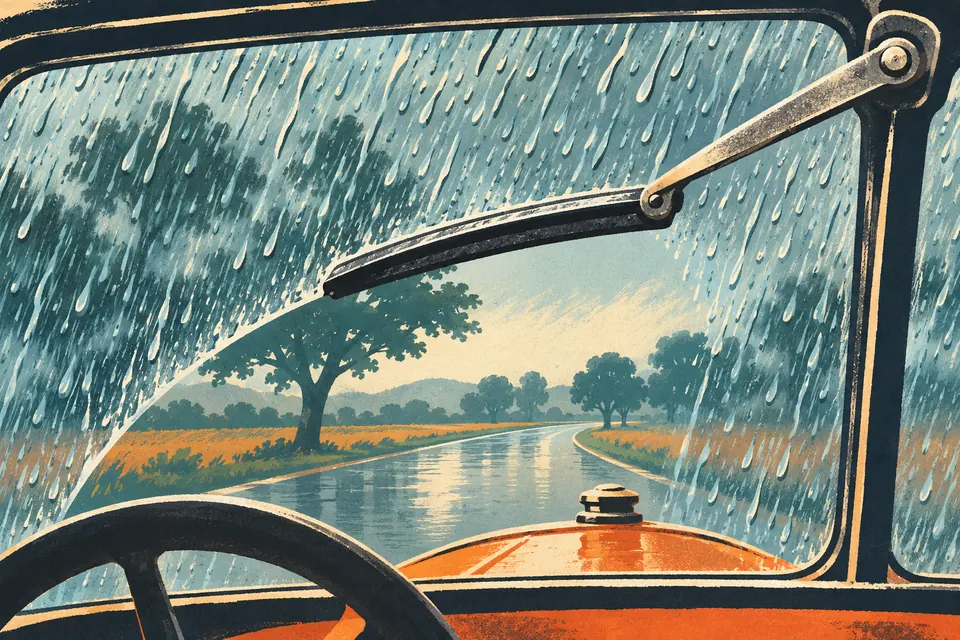
35. The windscreen wiper
1903 · Patented 1903 · Credited to: Mary Anderson, with several rival claimants · Replaced stopping to wipe the glass
Mary Anderson of Alabama patented a hand-worked wiper blade in 1903. Several others have a claim to the idea from about the same time. Before it, drivers stopped to wipe the glass or folded the windscreen down and looked over it.
Verdict A rubber blade on an arm, and nothing has replaced it.
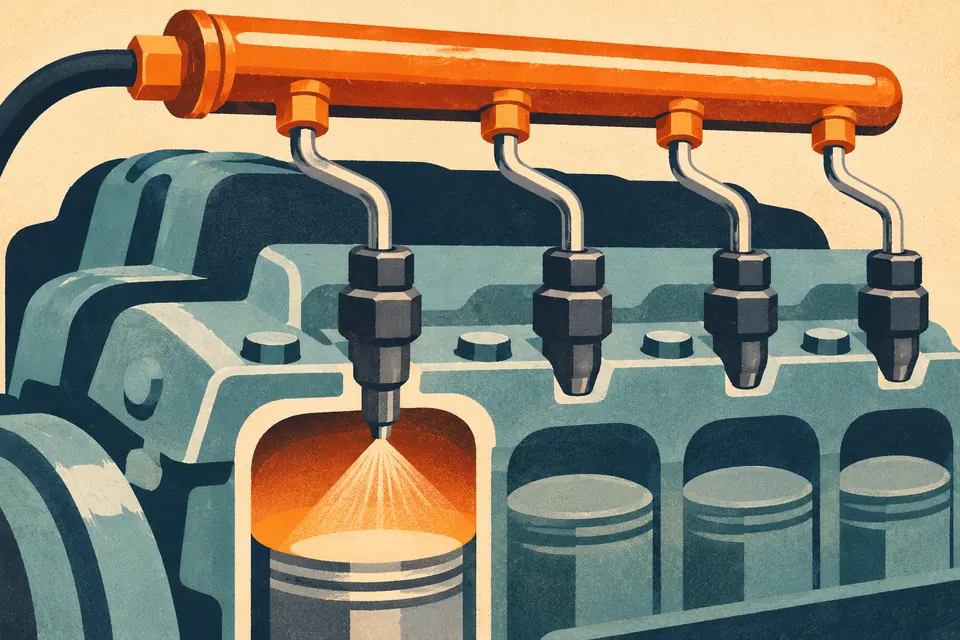
34. Alfa Romeo Common-rail diesel injection
1997 · First in a car: Alfa Romeo 156 JTD, 1997 · Credited to: Fiat's research centres; Bosch; Denso (lorries, 1995) · Made diesels quiet and quick
Hold the fuel at very high pressure in one shared pipe and let electronics open each injector exactly when needed. Fiat's engineers developed it for cars, Bosch bought it and put it into production, and the Alfa Romeo 156 JTD of 1997 was the first car to have it. Diesels stopped rattling.
Verdict The idea that made the diesel car civilised.
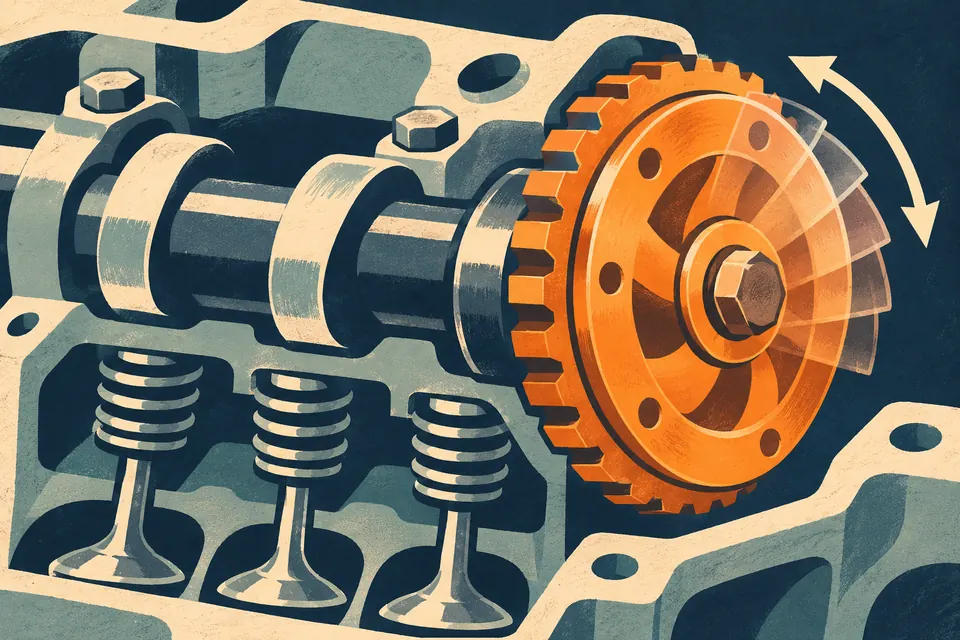
33. Alfa Romeo Variable valve timing
1980 · First used: Alfa Romeo Spider 2000, 1980. Honda VTEC, 1989 · Credited to: Alfa Romeo; Honda · One engine tuned for both low and high revs
An engine's valves want different timing at low revs and high. The Alfa Romeo Spider of 1980 was the first production car that could change it. Honda's VTEC of 1989, which switched to a second cam profile at speed, made the idea famous, and it is now nearly universal.
Verdict One engine, two characters.
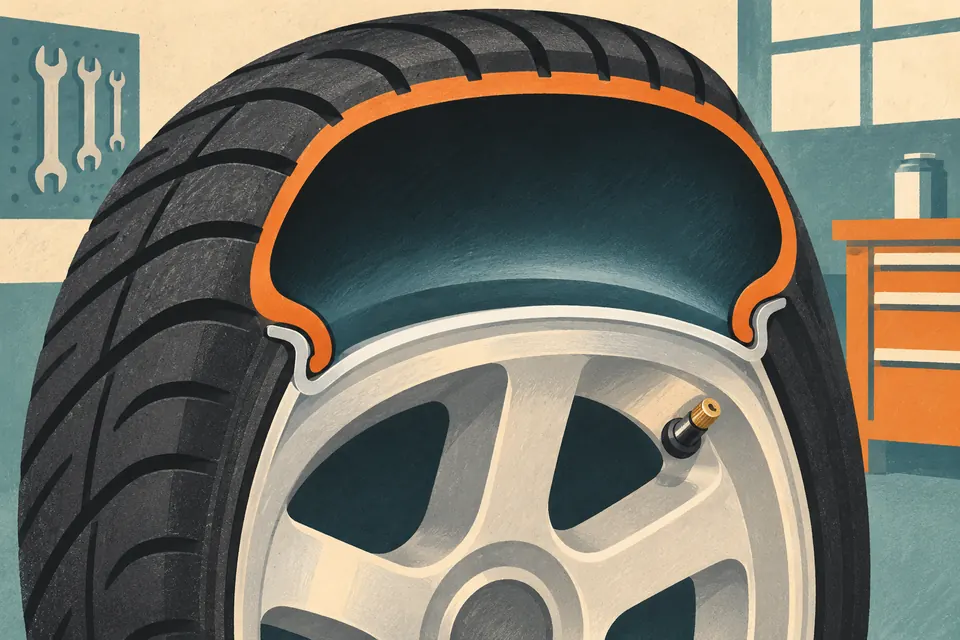
32. BF Goodrich The tubeless tyre
1947 · Patent applied for 1946. Standard on new American cars by 1955 · Credited to: Frank Herzegh at BF Goodrich · Replaced the inner tube
Frank Herzegh of BF Goodrich applied for his patent in 1946: a tyre that sealed against the rim and needed no inner tube. By 1955 new American cars had them as standard. A nail now meant a slow leak and not a sudden flat.
Verdict The puncture stopped being an emergency.
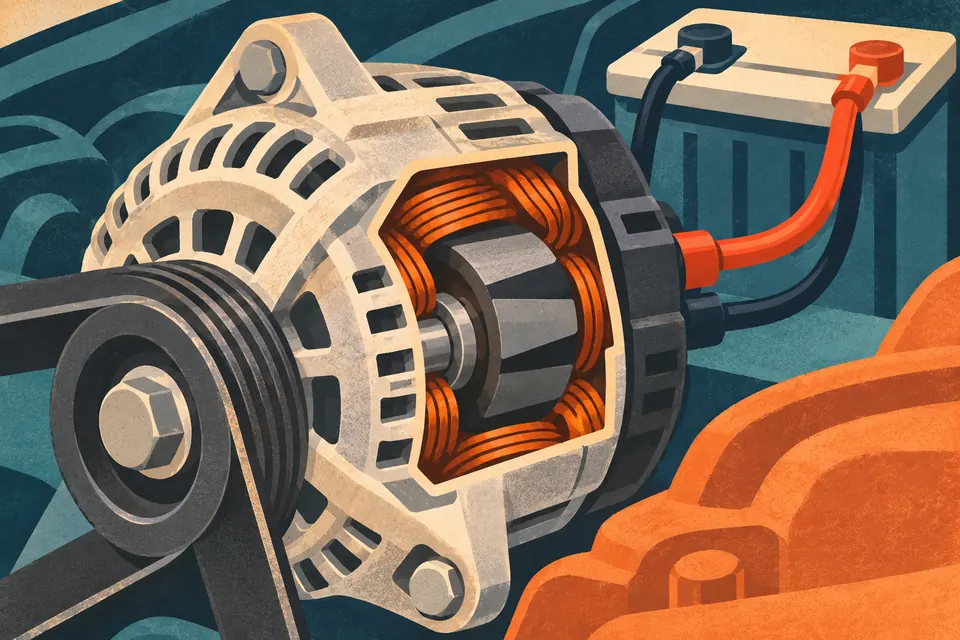
31. Chrysler The alternator
1960 · First standard: Chrysler Valiant, 1960 · Credited to: Chrysler · Replaced the dynamo
The dynamo charged poorly at idle, which mattered more with every electrical extra a car gained. Once silicon diodes were cheap, an alternator could do the job, and the 1960 Chrysler Valiant was the first car to have one as standard. Ford and General Motors followed within a few years.
Verdict Enough electricity for everything that came next.
30 to 16
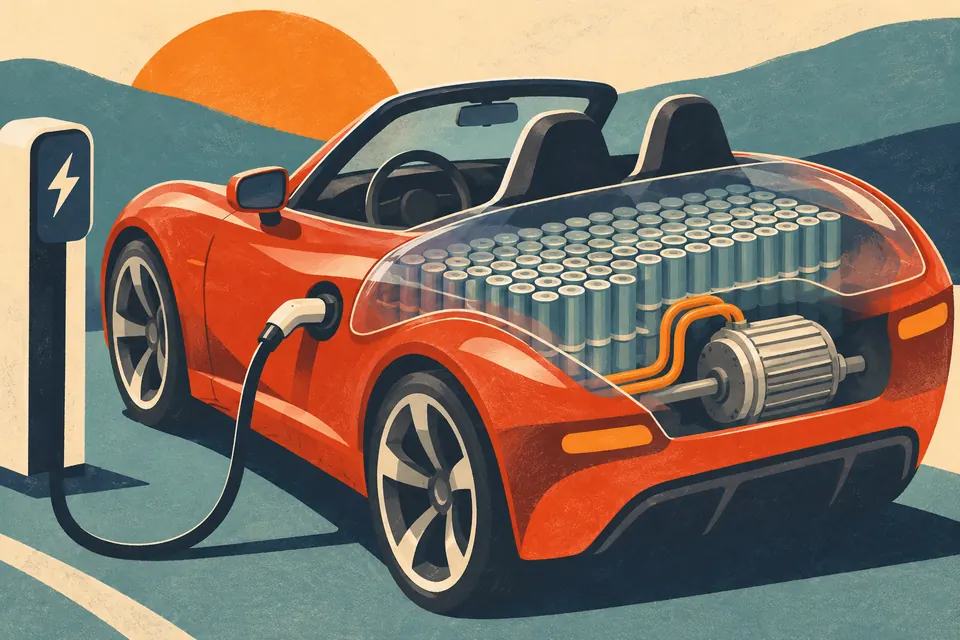
30. Tesla The lithium-ion electric car
2008 · First used: Tesla Roadster, February 2008 · Credited to: Tesla · Made an electric car that could go more than 200 miles
Electric cars are as old as petrol ones. What they lacked for a century was a battery. The Tesla Roadster, first delivered in February 2008, used 6,831 lithium-ion cells of the kind made for laptop computers and was the first production electric car to go more than 200 miles on a charge. About 2,450 were sold. Everything since follows from it. It is thirtieth because this list ranks what has already changed, and most of that change is still arriving. Ask again in twenty years.
Verdict Possibly the most important idea here, ranked on the evidence so far.
Did you know: The battery was 6,831 laptop-type cells.
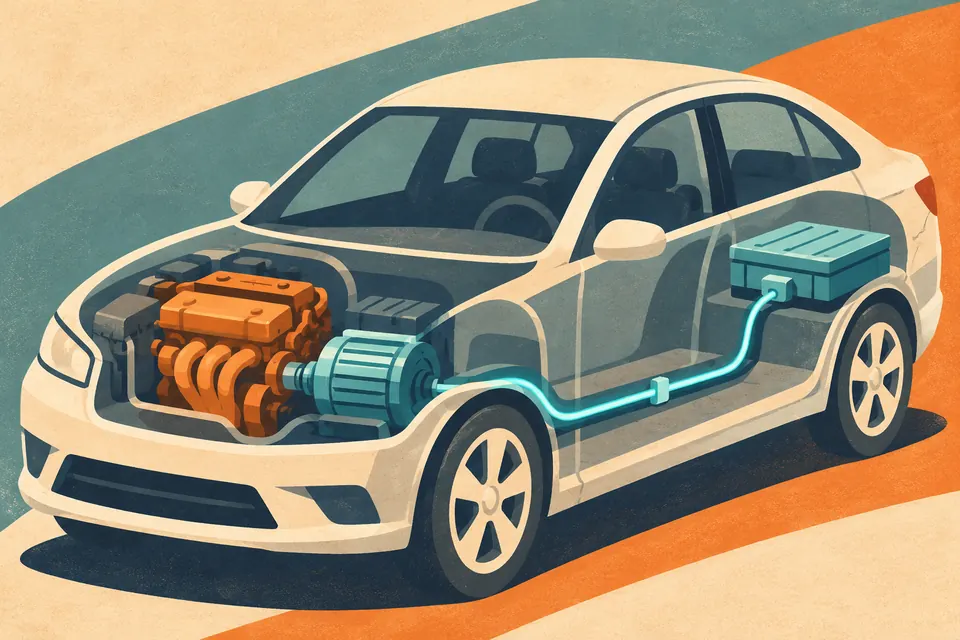
29. Toyota The hybrid drivetrain
1997 · First in volume: Toyota Prius, 10 December 1997 · Credited to: Toyota · A petrol engine and an electric motor sharing the work
The Toyota Prius went on sale in Japan on 10 December 1997, the first petrol-electric car made in volume. An electric motor helps the engine, a battery stores the energy that braking would otherwise waste, and a computer decides from moment to moment who does what. It reached the rest of the world in 2000 and passed a million sales in 2008. It taught a generation of buyers, and every other car maker, that a car could have a battery driving its wheels.
Verdict The bridge between the petrol car and the electric one.
Did you know: Sales passed a million in 2008.
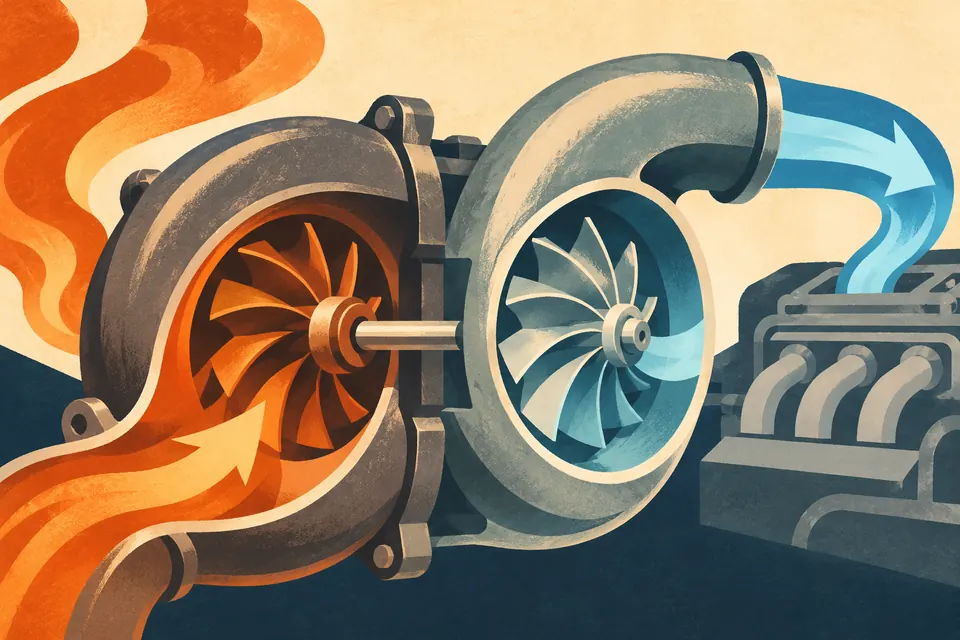
28. General Motors The turbocharger
1962 · First on production cars: Chevrolet Corvair Monza and Oldsmobile Jetfire, 1962 · Credited to: Alfred Büchi (patent, 1905) · Power from exhaust that was being thrown away
Alfred Büchi patented the idea in 1905: use the exhaust to spin a turbine that pumps more air into the engine. It went to ships, lorries and wartime bombers. General Motors put it on two production cars in 1962, the Chevrolet Corvair Monza and the Oldsmobile Jetfire, and neither lasted. Europe made it stick in the 1970s. Today it is on most new engines, petrol and diesel, because it lets a small engine do a large one's work.
Verdict Power from what was going down the exhaust pipe.
Did you know: It spent fifty years on ships, lorries and aircraft before it reached a car.
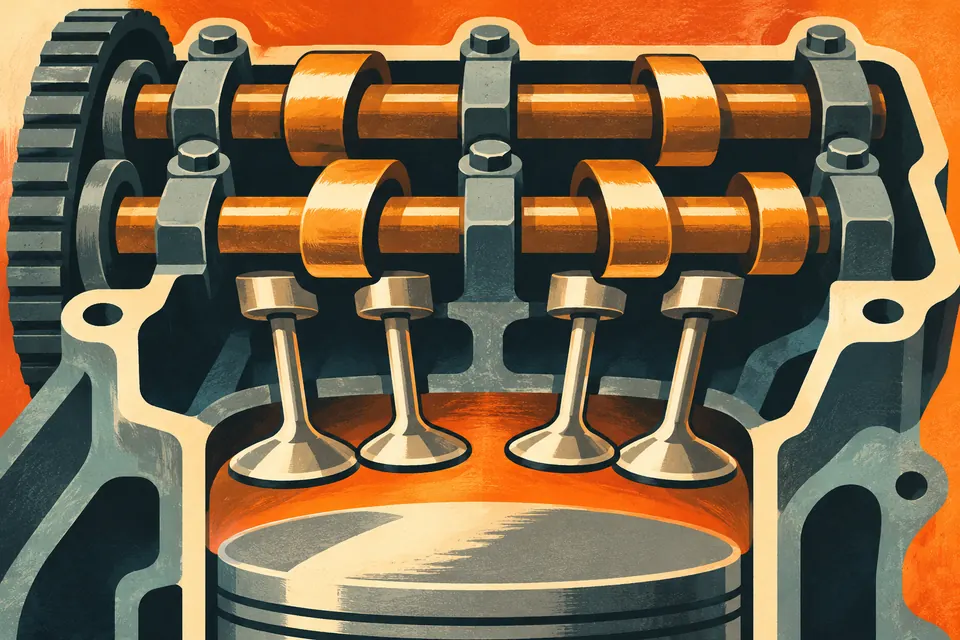
27. Peugeot The twin-cam, four-valve engine
1912 · First used: Peugeot L76 Grand Prix car, 1912 · Credited to: Ernest Henry · The pattern for nearly every modern petrol engine
Two camshafts in the head and four valves for each cylinder: the Peugeot grand prix car of 1912, designed by Ernest Henry, was the first car engine built that way, and it made the giant engines it raced against look like antiques. Racing engines copied it at once. Road cars took sixty years, until the Triumph Dolomite Sprint of 1973 put sixteen valves in an affordable saloon, and the Japanese makers of the 1980s made it ordinary.
Verdict Drawn in 1912 and still the pattern.
Did you know: It took sixty years to reach an affordable saloon.
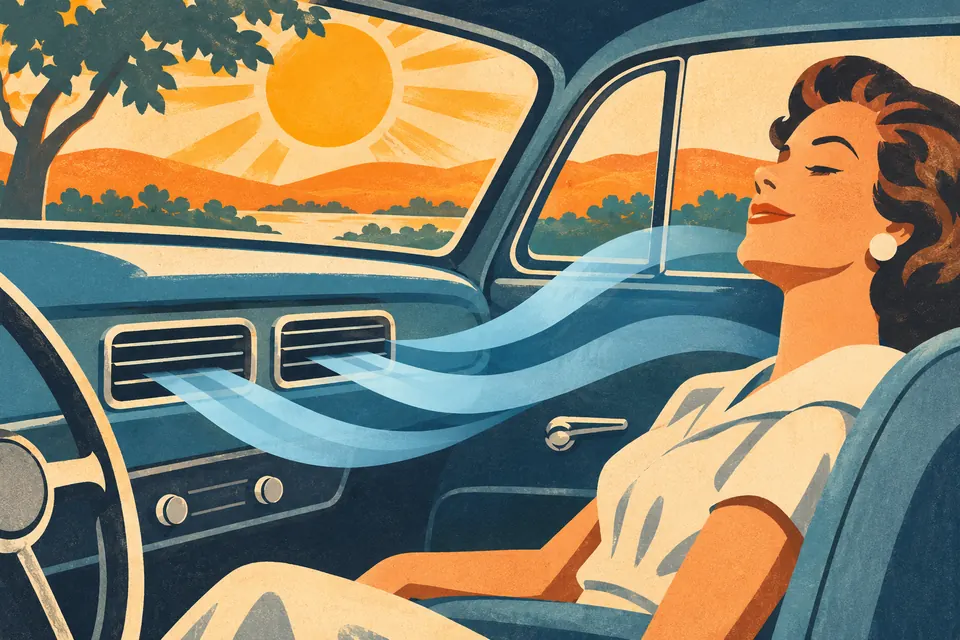
26. Packard Air conditioning
1940 · First offered: Packard, 1940 model year · Credited to: Packard; Nash for the integrated system, 1954 · Made cars habitable in hot places
Packard offered it first, on its 1940 models. The machinery filled half the boot, there was no thermostat, and it cost $274, so about 2,000 buyers took it and Packard dropped it after 1941. Nash built the first system that fitted wholly under the bonnet and dashboard in 1954. By 1969 more than half of new American cars were air-conditioned. In the hot half of the world, this is what turned the car from something you endured into somewhere you would choose to be.
Verdict It made the car habitable south of a certain line.
Did you know: The first system filled half the boot and had no thermostat.
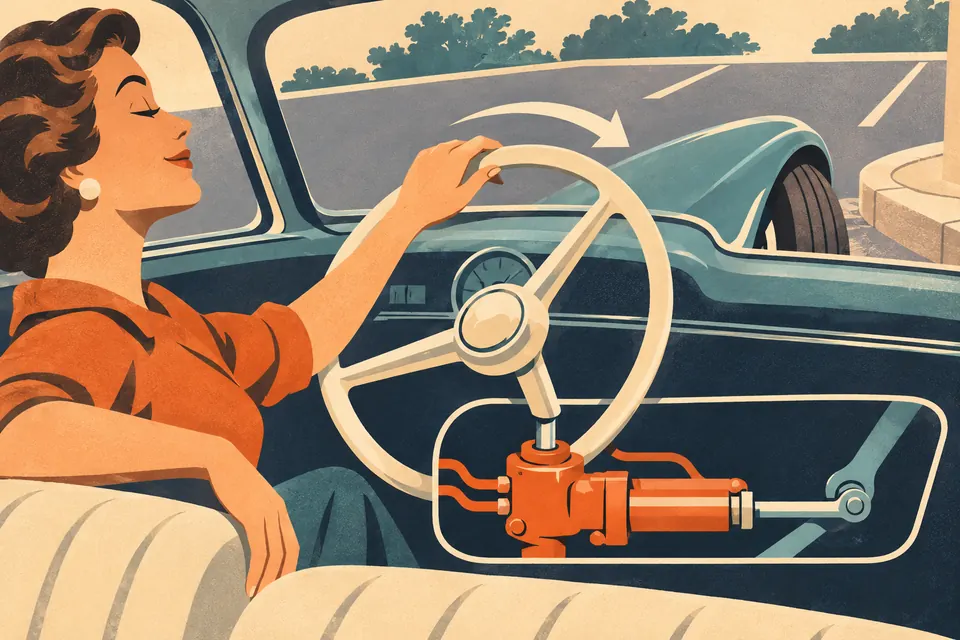
25. Chrysler Power steering
1951 · First used: Chrysler Imperial, 1951 · Credited to: Francis W. Davis (1926) · Made heavy cars steerable with one hand
Francis Davis, an engineer at Pierce-Arrow, built a working hydraulic system in 1926 and could not sell it. General Motors judged it too dear. The war put it on armoured vehicles, and Chrysler put it on the 1951 Imperial, with Cadillac a year behind. Without it the big, heavy, wide-tyred cars of the following decades could not have been parked by most of the people who bought them.
Verdict The reason a two-ton car can be turned with a finger.
Did you know: General Motors turned Davis's system down in the 1930s as too expensive.
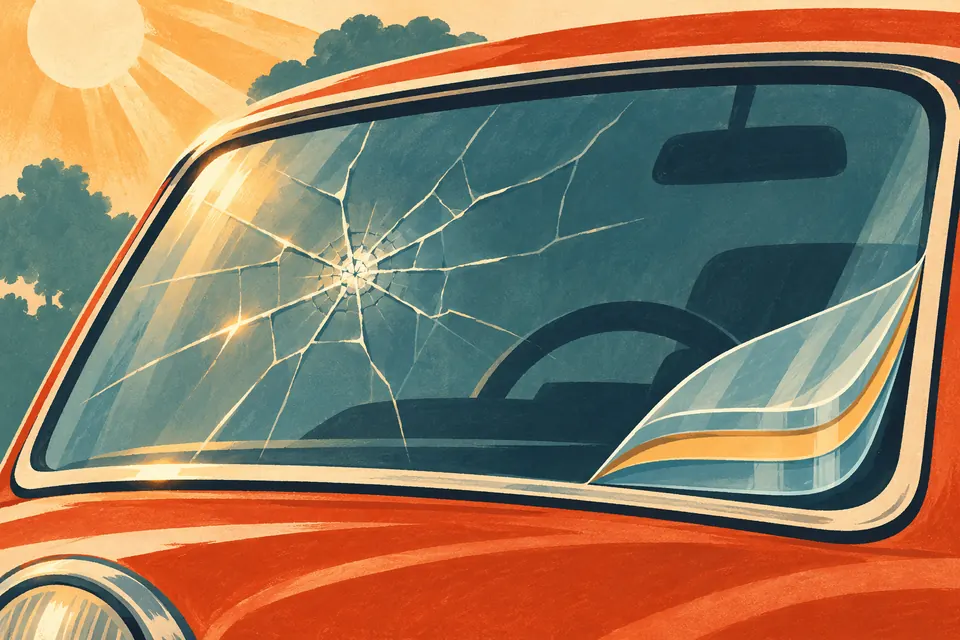
24. Triplex Laminated safety glass
1911 · Invented 1903, patented 1909, in production from 1911 · Credited to: Édouard Bénédictus · Replaced plate glass
In 1903 the French chemist Édouard Bénédictus knocked a glass flask off a shelf. It had held cellulose nitrate, and it cracked without falling apart. He patented a sandwich of glass and plastic in 1909, after reading of a car crash in which two women were badly cut, and it was in production as Triplex from 1911. Britain required safety glass in windscreens from 1930. Before it, the windscreen was the most dangerous thing in the car.
Verdict Glass that breaks and stays where it is.
Did you know: Bénédictus found it when a coated laboratory flask fell and did not shatter.
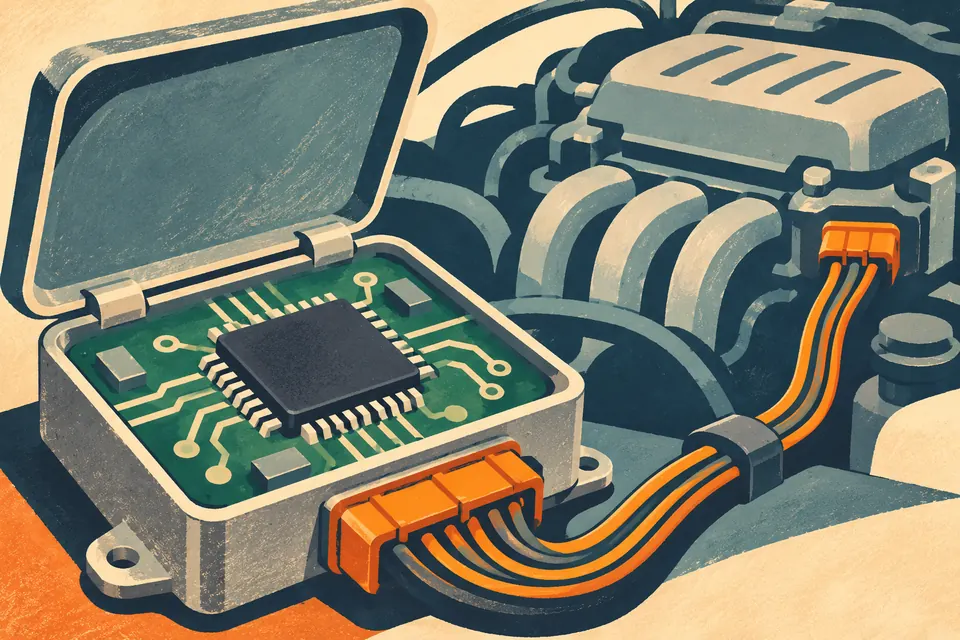
23. Bosch The engine control computer
1979 · First in production: Ford EEC, 1975. First to run fuel and spark together: Bosch Motronic, BMW 7 Series, 1979 · Credited to: Ford; Bosch · Replaced mechanical settings with a program
Ford put a microprocessor in charge of an engine in 1975. Bosch's Motronic, on the BMW 7 Series in 1979, ran fuel injection and ignition from one unit, and that became the pattern. A modern engine's computer decides the fuel, the spark, the idle, the valve timing and the turbocharger's boost thousands of times a minute. It is what made engines clean, economical and powerful at once, three things that used to be a choice of two.
Verdict The engine's settings became a program.
Did you know: The first one used a Toshiba microprocessor.
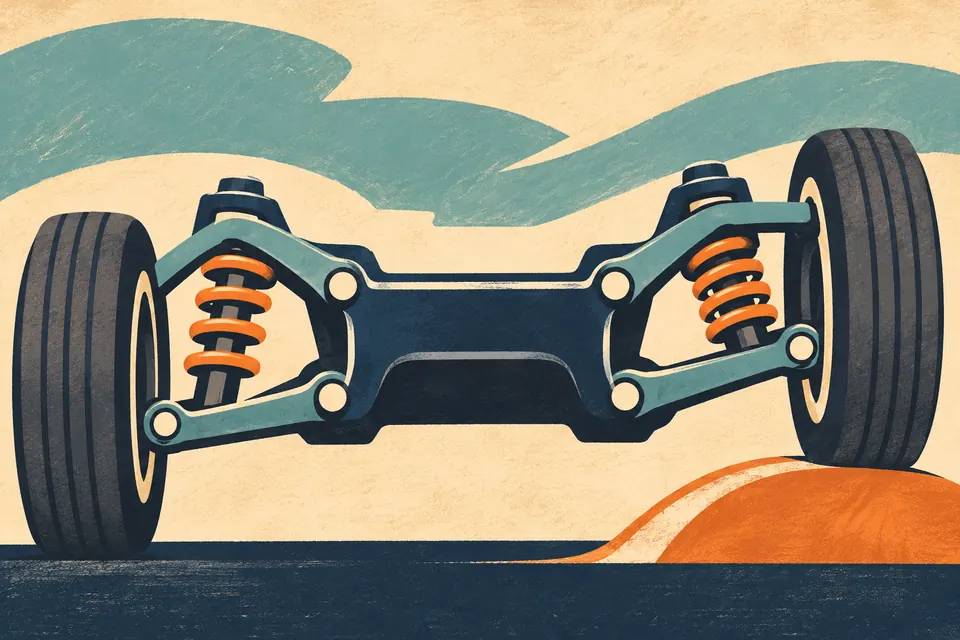
22. Lancia Independent front suspension
1922 · First on a volume car: Lancia Lambda, 1922 · Credited to: Amédée Bollée (steam car, 1878); Vincenzo Lancia; Earle MacPherson · Replaced the beam axle
With a beam axle, a bump under one front wheel tilts the other. Let each wheel move on its own and the car rides better and steers more truly. The idea goes back to a French steam carriage of 1878. The Lancia Lambda of 1922 had it on a volume car, and during the 1930s it spread across the industry. Earle MacPherson's strut, which reached the public on British Fords in the 1950s, made it cheap enough for the smallest cars.
Verdict Each wheel minding its own business.
Did you know: The MacPherson strut reached the public on British Fords in the 1950s.
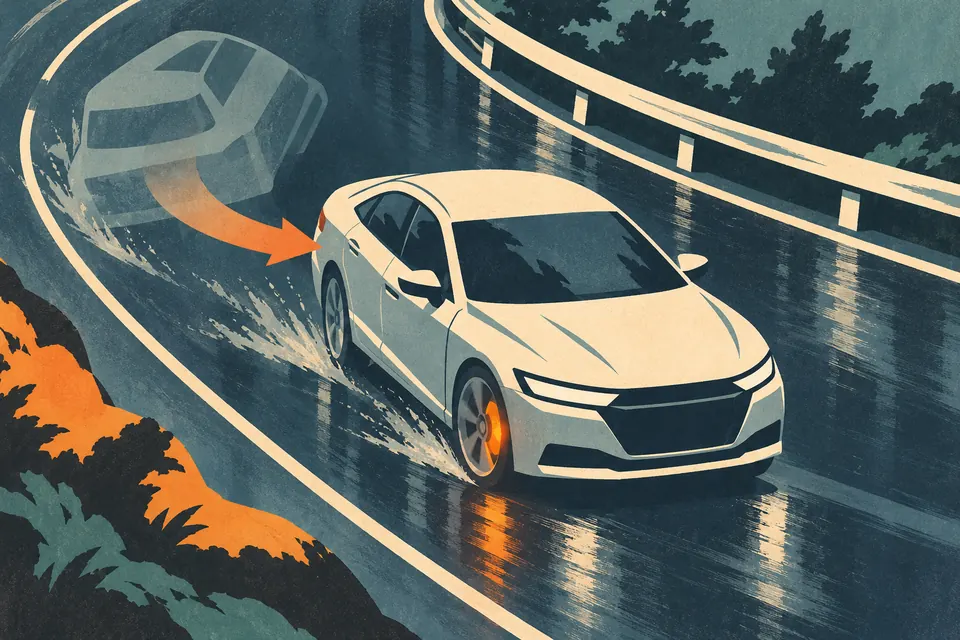
21. Mercedes-Benz Electronic stability control
1995 · First used: Mercedes-Benz S 600 Coupé, 1995, with Bosch · Credited to: Bosch and Mercedes-Benz · Brakes single wheels to stop a skid
Bosch and Mercedes-Benz launched it on the S 600 Coupé in 1995. It compares where the driver is steering with where the car is going, and brakes one wheel to pull the car back into line. In 1997 a Mercedes A-Class rolled over in a Swedish avoidance test, and Mercedes fitted the system to every A-Class in response. Other makers followed. One American study found it cut fatal crashes by 43 per cent, the largest gain from any device since the belt.
Verdict It catches the skid before the driver knows there is one.
Did you know: It became standard on small cars because a Mercedes A-Class fell over in a Swedish test in 1997.
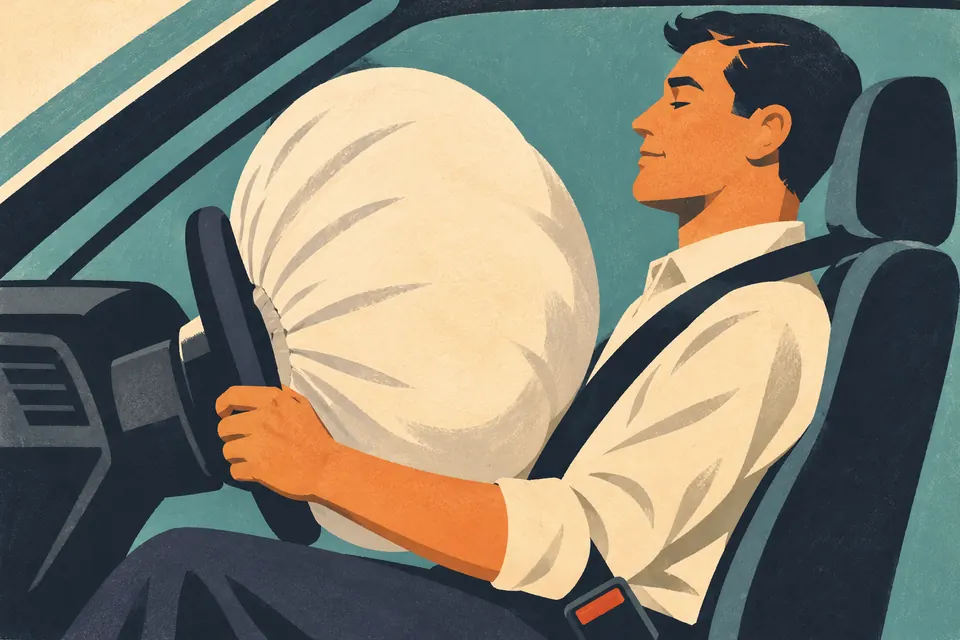
20. General Motors The airbag
1973 · First offered: Oldsmobile Toronado, 1973. Mercedes-Benz S-Class, 1981 · Credited to: John Hetrick (patent, 1953); Allen Breed (crash sensor, 1967) · Added to the belt, not instead of it
The patents date from the early 1950s and the idea did not work until Allen Breed built a sensor in 1967 that could detect a crash and fire the bag in under thirty thousandths of a second. General Motors offered airbags in 1973 and withdrew them in 1977 because buyers were not interested. Mercedes-Benz brought them back on the S-Class in 1981, paired with a belt that tightened first. That is the point: it adds to the seat belt and does not replace it.
Verdict The second line of defence, and useless without the first.
Did you know: General Motors withdrew it in 1977 because too few buyers wanted it.
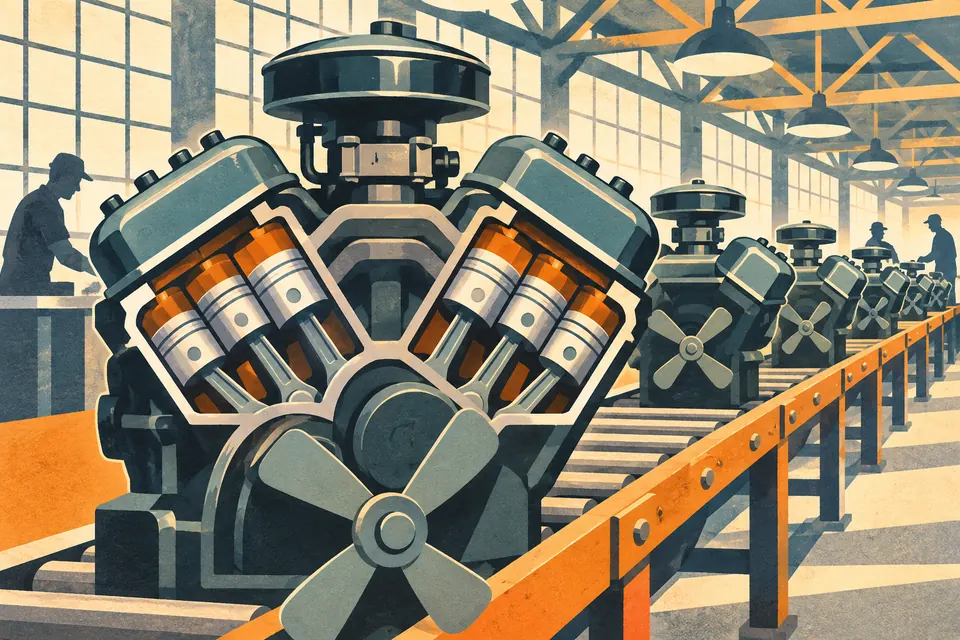
19. Cadillac The mass-produced V8
1914 · First in volume: Cadillac, 1914. First cheap one: Ford, 1932 · Credited to: Cadillac; Henry Ford · Put eight cylinders within reach
The V8 was a French idea, first built in 1904 for boats and aeroplanes. Rolls-Royce tried one in a car in 1905 and stopped after three. Cadillac made it a production engine in 1914 and sold about 13,000 in the first year. Then in 1932 Henry Ford cast one in a single block, cheaply, and put it in a car that ordinary Americans could buy. The sound and the appetite of the American car for the next fifty years came from that decision.
Verdict Eight cylinders for the price of four.
Did you know: Rolls-Royce built a V8 car in 1905 and gave up after three.
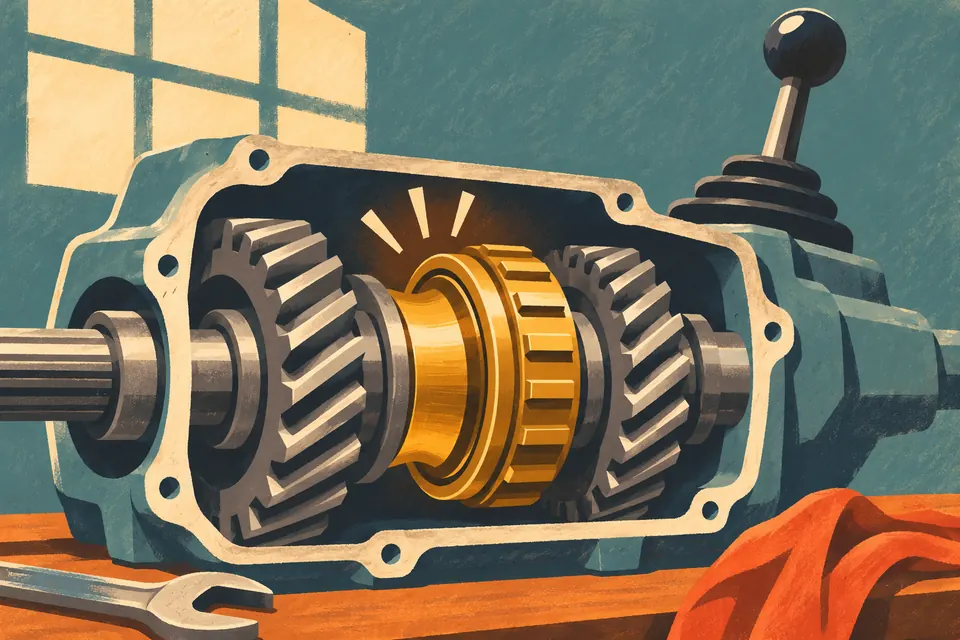
18. Cadillac Synchromesh
1928 · First used: Cadillac, 1928 · Credited to: Earl A. Thompson (1919) · Replaced double-declutching
Changing gear in an early car meant matching the speed of two spinning shafts by ear, with a double press of the clutch and a blip of the throttle. Get it wrong and the gears told everyone. Earl Thompson devised a way of bringing the gears to the same speed before they met, and Cadillac put it into production in 1928. It spread gear by gear. The Porsche 356 of 1952 was the first car to have it on every forward ratio.
Verdict It made the gear lever something anyone could use.
Did you know: Porsche's 356 of 1952 was the first car with it on every forward gear.
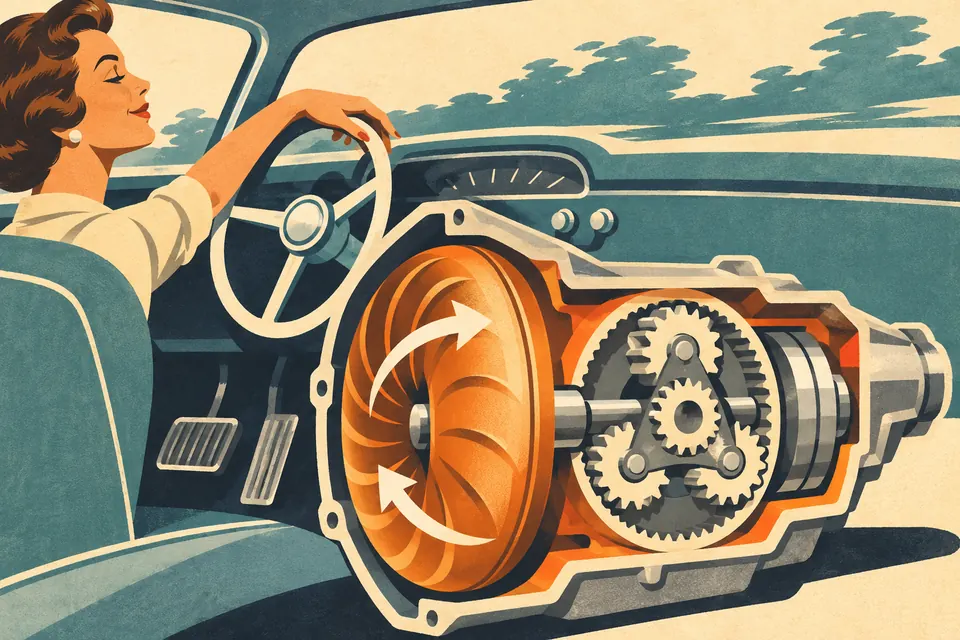
17. General Motors The automatic gearbox
1939 · First used: Hydra-Matic, 1940 model year Oldsmobile · Credited to: General Motors · Replaced the clutch pedal
General Motors offered the Hydra-Matic on Oldsmobiles for the 1940 model year: four speeds, no clutch pedal, and the first automatic to be made in real numbers. Buick's Dynaflow of 1948 added the torque converter. By 1957 more than four in five new American cars had an automatic. Europe took another half-century to agree. It is this low only because the world divided over it for so long. In the countries that took to it, it changed driving as much as the starter had.
Verdict Two pedals instead of three.
Did you know: By 1957 more than 80 per cent of new American cars had one.
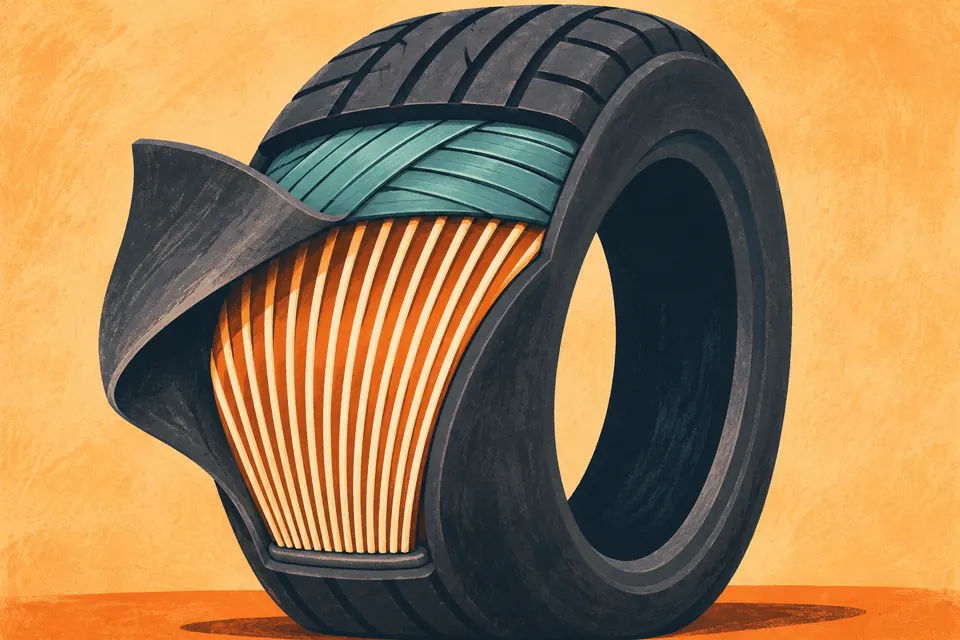
16. Michelin The radial tyre
1946 · First used: Michelin X, 1946. On the Citroën 2CV from 1948 · Credited to: Marius Mignol at Michelin · Replaced the cross-ply tyre
Marius Mignol, an accountant whom Michelin had moved into research, worked out during the war that a tyre would run cooler and grip better if its cords ran straight across from bead to bead with a stiff belt under the tread. The Michelin X followed in 1946, and the Citroën 2CV was among the first cars to wear it. It lasted far longer than a cross-ply, rolled more easily and held the road better. America resisted for twenty years. By 1976 radials were standard there too.
Verdict The same four patches of rubber, made to work properly.
Did you know: Mignol had been an accountant before Michelin moved him into research.
The top 15
- Years
- 1978
- Engine
- First electronic four-wheel system: Chrysler Imperial, 1971. First to last: Bosch on the Mercedes-Benz S-Class, 1978
- Power
- Credited to: Dunlop (aircraft Maxaret); Bendix; Bosch
- Built
- Let a driver brake hard and steer at once
Innovation · Germany
15. Mercedes-Benz Anti-lock brakes
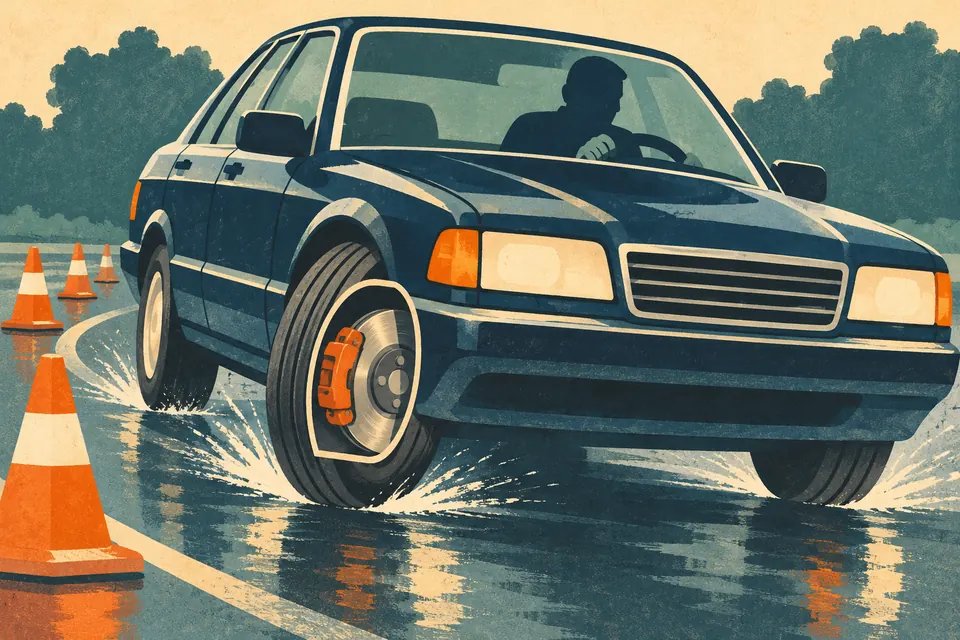
Brake too hard on a wet road and the wheels lock. A locked wheel slides, and a sliding wheel cannot steer. The trained answer was to pump the pedal, which almost nobody does in a panic.
Aircraft had a mechanical answer by the early 1950s. The first four-wheel electronic system on a car was Chrysler's, on the 1971 Imperial. The one that lasted was built by Bosch and offered on the Mercedes-Benz S-Class in 1978. It senses a wheel about to lock and releases and reapplies the brake many times a second, faster than any driver could.
It has been compulsory on new cars in Europe since the early 2000s. Its larger importance is what it started. Once a car had sensors on each wheel and a computer that could work each brake, traction control and stability control were a matter of software. Both are further down this list, and both stand on this.
Verdict The first time the car was allowed to overrule the driver.
The idea came from aircraft, which had it by the early 1950s.
- Years
- 1904
- Engine
- First used: Buick Model B, 1904
- Power
- Credited to: Walter Marr at Buick
- Built
- Replaced the side-valve engine
Innovation · United States
14. Buick The overhead-valve engine
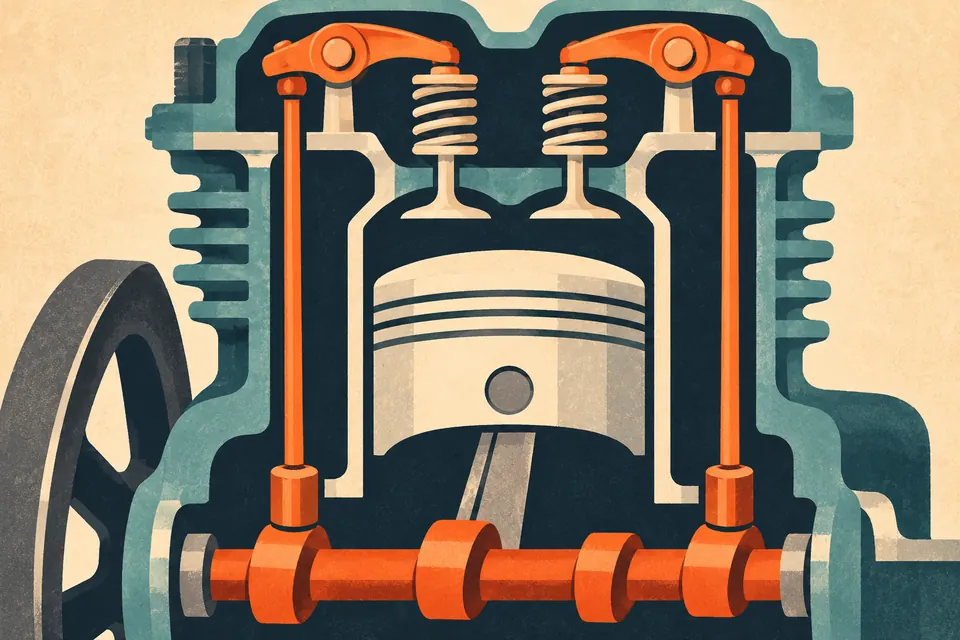
In an early engine the valves sat beside the cylinders, in the block, and the mixture had to turn two corners to get in and out. It was simple to make and it could not breathe.
Walter Marr, working for Buick, put the valves in the head, directly above the piston, and the Buick Model B of 1904 was the first production car with an overhead-valve engine. The gas now had a straight path, the combustion chamber could be compact, and the same size of engine made more power.
The side-valve hung on for decades because it was cheap, and was still common in America in the 1950s. But every petrol car engine made today has its valves in the head, whether pushrods or camshafts work them.
It ranks above anti-lock brakes, which will surprise some. A safety system that arrived in the 1970s is a refinement. This is the basic shape of the engine itself.
Verdict Where the valves have been ever since.
Side-valve engines stayed common in America into the 1950s.
- Years
- 1953
- Engine
- Proved: Jaguar C-type, Le Mans, 1953. First in volume: Citroën DS, 1955
- Power
- Credited to: Frederick Lanchester (patent, 1902); Dunlop
- Built
- Replaced the drum
Innovation · United Kingdom
13. Jaguar The disc brake
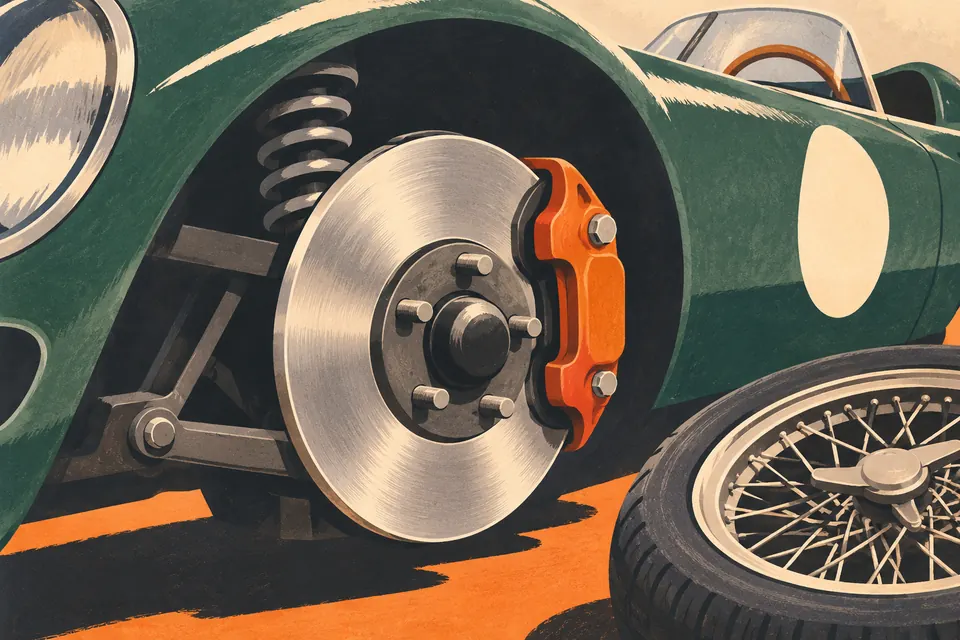
A drum brake works well once. Use it hard several times in a row and it overheats, the drum expands away from the shoes and the pedal goes soft. Racing drivers of the early 1950s planned their races around it.
Frederick Lanchester had patented a disc brake in 1902, with copper pads that wore out on the roads of the day. Dunlop made one that worked, and in 1953 Jaguar took C-types fitted with them to Le Mans. They were the only cars in the race with disc brakes. They could brake later into every corner for twenty-four hours, and they won.
Citroën put discs on the front of the DS in 1955, the first lasting use on a car made in volume, and Triumph followed on the TR3 the next year. It is the clearest case on this list of an idea proved on a circuit and then handed to everyone.
Verdict Won Le Mans on a Sunday and was on a family car two years later.
The C-type was the only car in the 1953 race with them, and it won.
- Years
- 1967
- Engine
- First offered: Bendix Electrojector, Chrysler, 1958. First to last: Bosch D-Jetronic, Volkswagen 1600, 1967
- Power
- Credited to: Bendix; Bosch
- Built
- Replaced the carburettor
Innovation · Germany
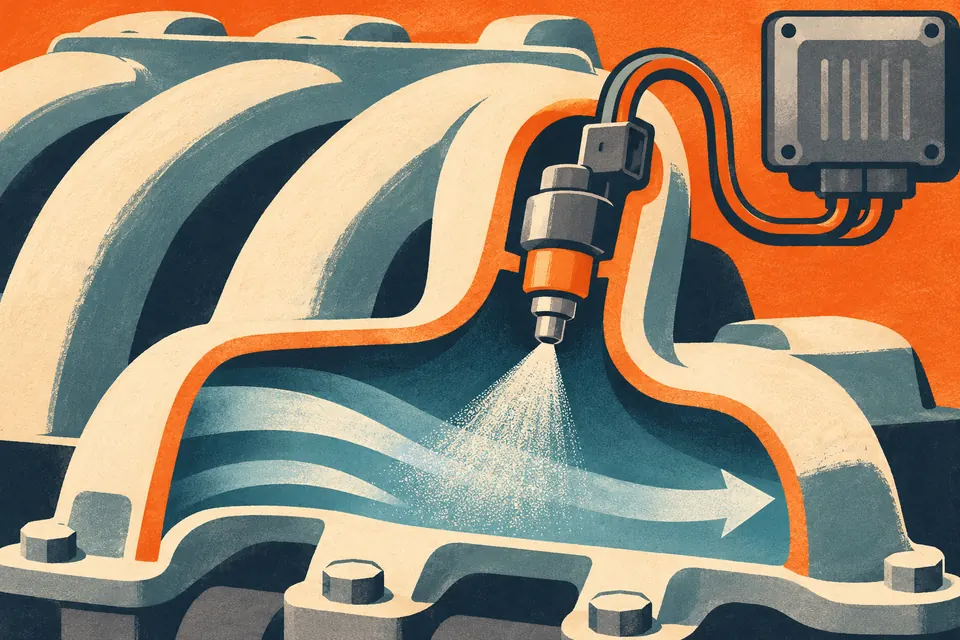
12. Bosch Electronic fuel injection
A carburettor mixes fuel and air by suction, and gets it roughly right. Fuel injection measures and delivers it, and gets it exactly right.
The first electronic system on a car was the Bendix Electrojector, offered by Chrysler in 1958. It was ahead of the electronics available to build it and few were sold. Bosch took up the idea and its D-Jetronic went on the Volkswagen 1600 in 1967, followed in 1974 by L-Jetronic, which measured the air going in and worked on the same principles as every system since.
We gave Volkswagen as the first in our working draft and the record corrected us: Chrysler was nine years earlier. The ranking stands on what lasted. By the early 1990s the carburettor had gone from new cars in the developed world. Cold starts, flat spots and seasonal tuning went with it, and a modern engine's economy and cleanliness would be impossible without it.
Verdict The end of the choke knob.
The proposal gave Volkswagen as first. Chrysler was nine years earlier, and it did not work well.
- Years
- 1975
- Engine
- First fitted widely: American cars of the 1975 model year
- Power
- Credited to: Eugene Houdry; Carl Keith and John Mooney's team at Engelhard
- Built
- Cleaned the exhaust after the engine instead of in it
Innovation · United States
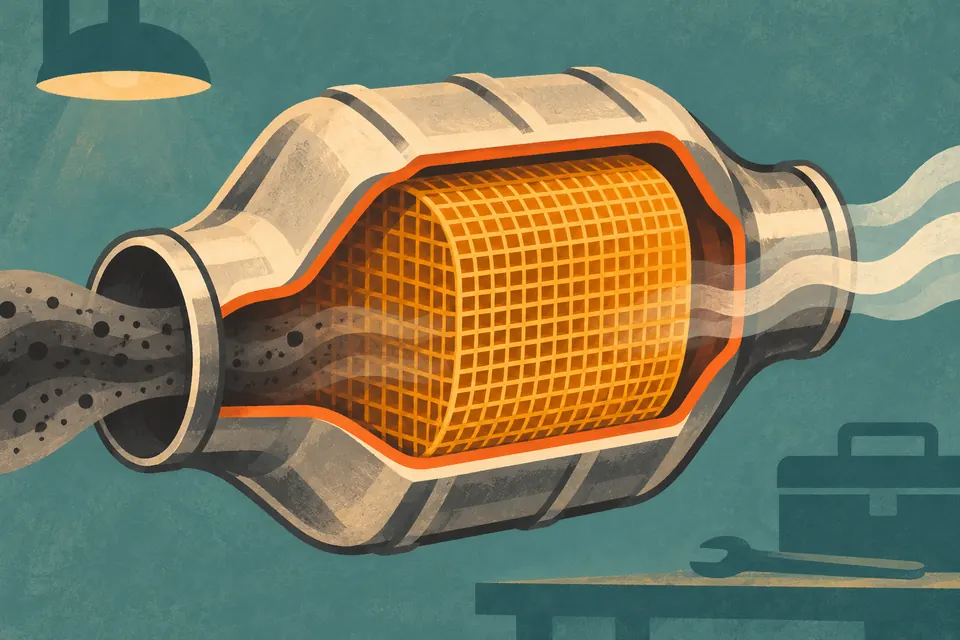
11. Engelhard The catalytic converter
By the 1960s the air in Los Angeles was brown, and cars were the main cause. Eugene Houdry, a French engineer who had moved to America, had patented a catalytic converter for exhausts in the 1950s. It could not be used, because the lead added to petrol destroyed the catalyst.
A team at Engelhard led by Carl Keith and John Mooney produced the first production converter in 1973, and American law did the rest. Most petrol cars sold in the United States from the 1975 model year had one. Volvo fitted the first three-way converter, which deals with all three main pollutants at once, to Californian cars in 1977.
It changed more than the exhaust. Lead had to come out of petrol, which was a public health gain in itself. Engines had to hold their fuel mixture precisely, which finished the carburettor and brought in fuel injection and the computer. Three other entries on this list exist largely because of this one.
Verdict It cleaned the air and forced the engine to grow a brain.
It is the reason lead came out of petrol: lead poisons the catalyst.
- Years
- 1912
- Engine
- First offered: Columbia Electric, 1898. First integrated system: Cadillac, 1912
- Power
- Credited to: Charles Kettering, Delco, for the integrated system
- Built
- Replaced acetylene and oil lamps
Innovation · United States
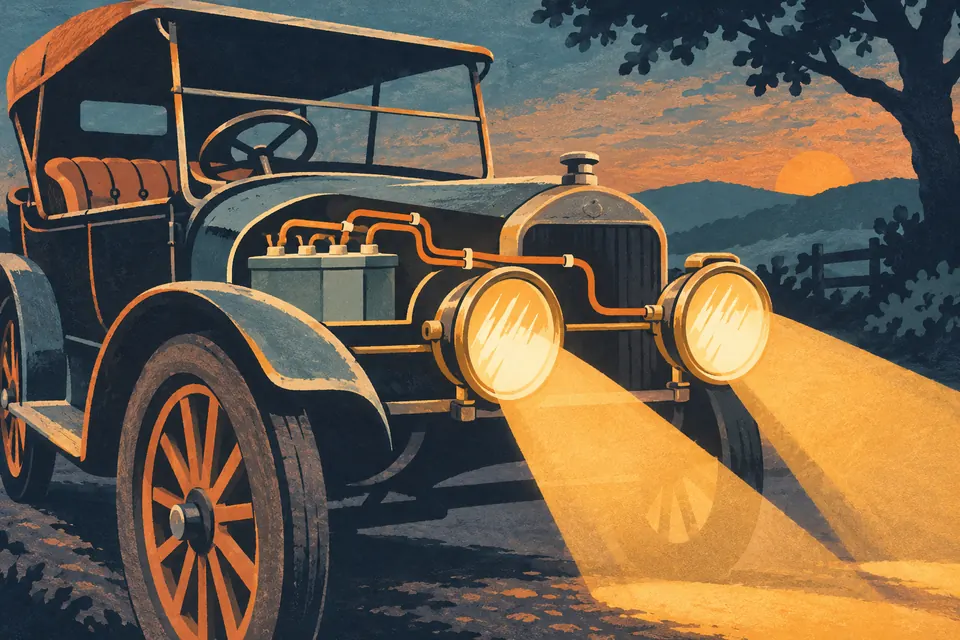
10. Cadillac Electric lighting
Early motorists lit their way with acetylene lamps, which made gas by dripping water on to calcium carbide and had to be lit with a match. They were brighter than oil and they stayed alight in the wind. They were also a chemistry set bolted to the front of the car.
Electric headlamps were offered as an option on the Columbia Electric as early as 1898, and Peerless made them standard in 1908. The step that mattered came with the 1912 Cadillac, which combined ignition, lighting and the new starter in one electrical system fed by a battery and a generator.
That is why it is in the top ten. Lamps you could switch on from the driver's seat made night driving normal. The system behind them, a battery kept charged by the engine, is what every later electrical device on a car has plugged into, from the wiper motor to the computer.
Verdict It made the car usable after dark, and gave it a nervous system.
Peerless made electric headlamps standard in 1908.
- Years
- 1959
- Engine
- First used: Mini, announced 26 August 1959
- Power
- Credited to: Alec Issigonis
- Built
- Gave about 80 per cent of the floor to people and luggage
Innovation · United Kingdom
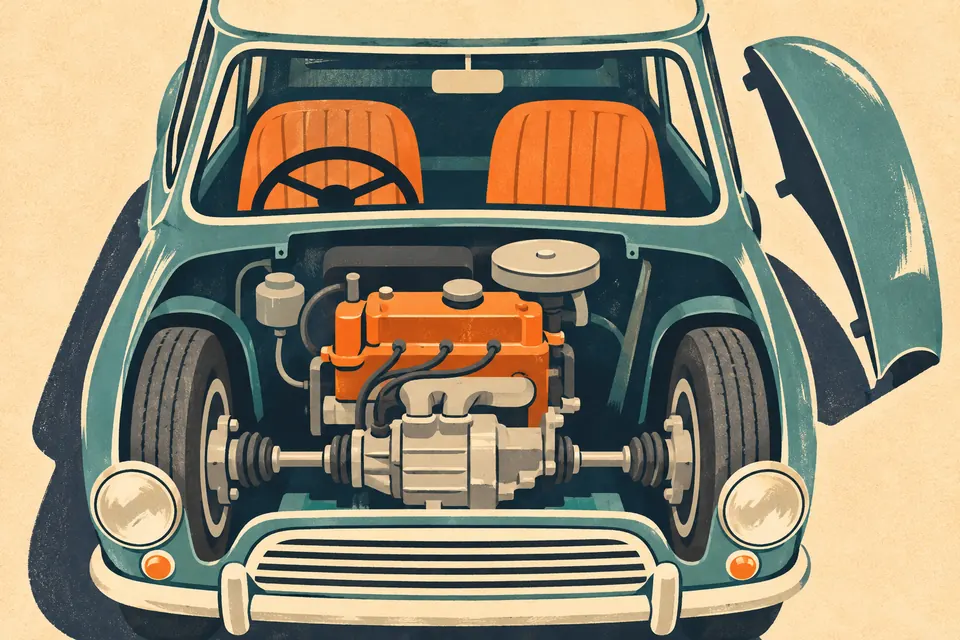
9. BMC The transverse engine with front-wheel drive
Alec Issigonis was asked for a small car after the Suez fuel crisis, and the Mini, announced on 26 August 1959, was his answer. He turned the engine sideways, put the gearbox underneath it in the sump and drove the front wheels. About 80 per cent of the car's floor area was left for people and luggage.
Front-wheel drive was not new, and nor were sideways engines. The Mini was the car that showed what the two together could do for space, and 5,387,862 were built. The detail was later improved by Dante Giacosa at Fiat, who moved the gearbox to the end of the engine, and that is the arrangement nearly every small and medium-sized car has used since.
It is ninth because it is the last great change to the basic layout of the ordinary car. Open the bonnet of almost any hatchback built in the past fifty years and you are looking at this idea.
Verdict The reason small cars are roomy.
5,387,862 Minis were built.
- Years
- 1959
- Engine
- First used: Mercedes-Benz W111 saloon, 1959
- Power
- Credited to: Béla Barényi (patent, 1952)
- Built
- Replaced the belief that a strong car was a stiff car
Innovation · Germany
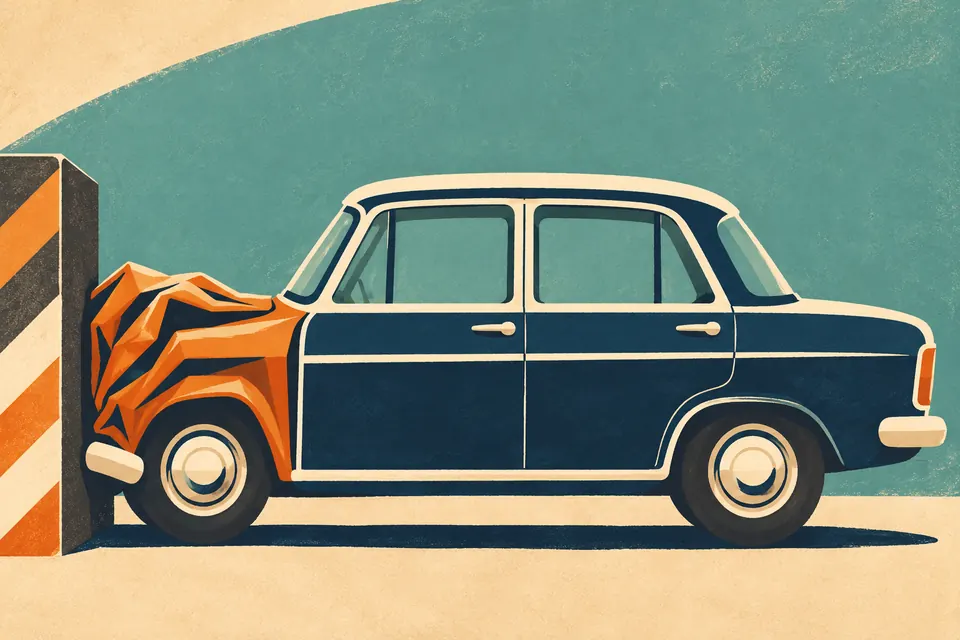
8. Mercedes-Benz The crumple zone and safety cell
For half a century the safest car was assumed to be the strongest one. Béla Barényi, an engineer at Mercedes-Benz, saw that this was backwards. A rigid car stops instantly in a crash, and the people inside it keep going.
He had the idea in 1937 and patented it in 1952: a stiff cell around the occupants, with the front and rear of the car designed to fold progressively and soak up the energy. The 1959 Mercedes-Benz W111 saloon was the first production car built that way.
It is the idea behind every crash test since. The seat belt holds you in place, and this is what makes the place worth being held in. It ranks below the belt because the belt works in any car. But the two were introduced in the same year, in Sweden and Germany, by men who had never met, and between them they are most of the reason a modern car can be driven into a wall at 40 mph and walked away from.
Verdict The car is supposed to break, so that you do not.
Barényi had the idea in 1937.
- Years
- 1914
- Engine
- First used in volume: Dodge, from 1914
- Power
- Credited to: Edward G. Budd
- Built
- Replaced wooden framing with steel panels over it
Innovation · United States
7. Dodge The all-steel body
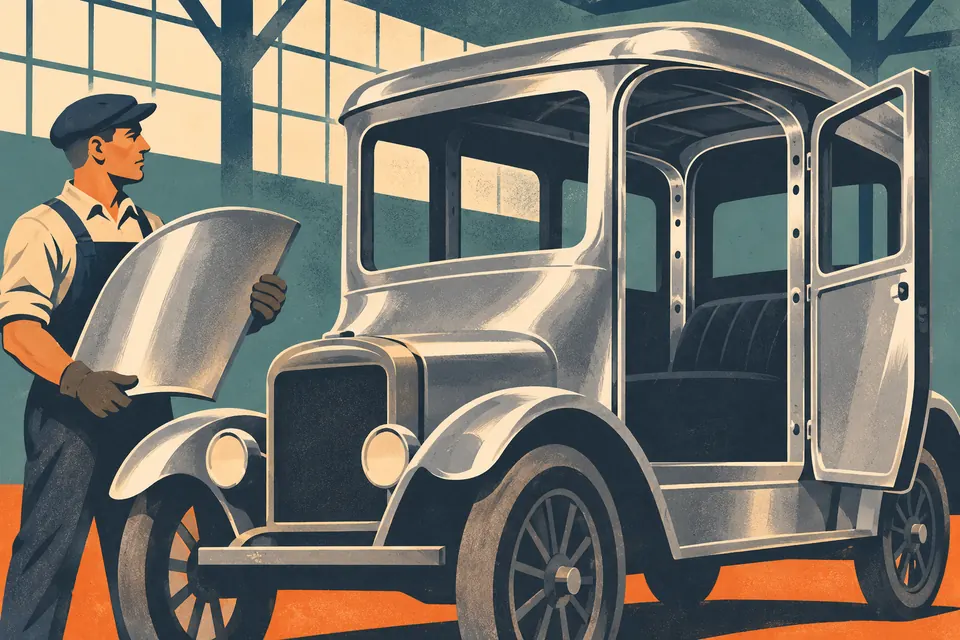
A car body in 1910 was a wooden frame, made by men who had built carriages, with metal panels tacked over it. It took weeks, needed many coats of slow-drying varnish, creaked, rotted, and splintered in a crash.
Edward Budd of Philadelphia developed a body pressed and welded entirely from steel in 1913, and the Dodge brothers became his great customer, ordering bodies by the tens of thousands. Steel could be stamped in seconds and painted with baked enamel in hours. It also made the closed car affordable. A wooden saloon body was a luxury item. A steel one could be made on a line, and within fifteen years the open tourer had gone from the usual sort of car to the unusual one.
The assembly line made the mechanical parts cheap. This did the same for the part people sit in, and it led directly to the unitary body two places above.
Verdict It put a roof over the ordinary motorist.
Budd's methods later went into the Citroën Traction Avant.
- Years
- 1921
- Engine
- First used: Duesenberg Model A, 1921
- Power
- Credited to: Malcolm Loughead (patent, 1917)
- Built
- Replaced rods and cables, usually on the rear wheels only
Innovation · United States
6. Duesenberg Hydraulic brakes on all four wheels
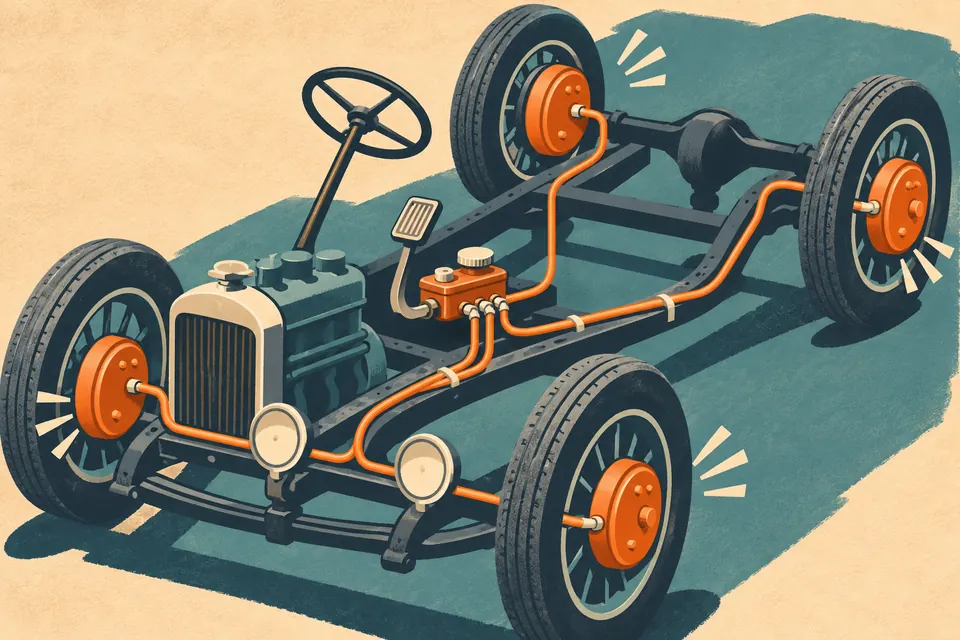
In 1920 most cars had brakes on the rear wheels only, worked by rods or cables that stretched, went out of adjustment and pulled harder on one side than the other. Stopping in a straight line was a matter of luck and maintenance.
Malcolm Loughead patented a system in 1917 that used fluid in pipes instead. Press the pedal and the same pressure reaches every wheel, automatically balanced. The Duesenberg Model A, which went into production in late 1921, was the first production car to have hydraulic brakes on all four wheels. Loughead later changed the spelling of his name to match the way people said it, and his brakes were sold as Lockheed.
We have it above the disc brake, which is the better-known idea. Hydraulics made four-wheel braking work at all. The disc made it work better. Every car now has both, and it is the fluid that came first.
Verdict Equal pressure at every wheel, every time.
Loughead later respelt his name the way it was pronounced: Lockheed.
- Years
- 1922
- Engine
- First used: Lancia Lambda, 1922
- Power
- Credited to: Vincenzo Lancia
- Built
- Replaced the separate chassis frame
Innovation · Italy
5. Lancia The unitary body
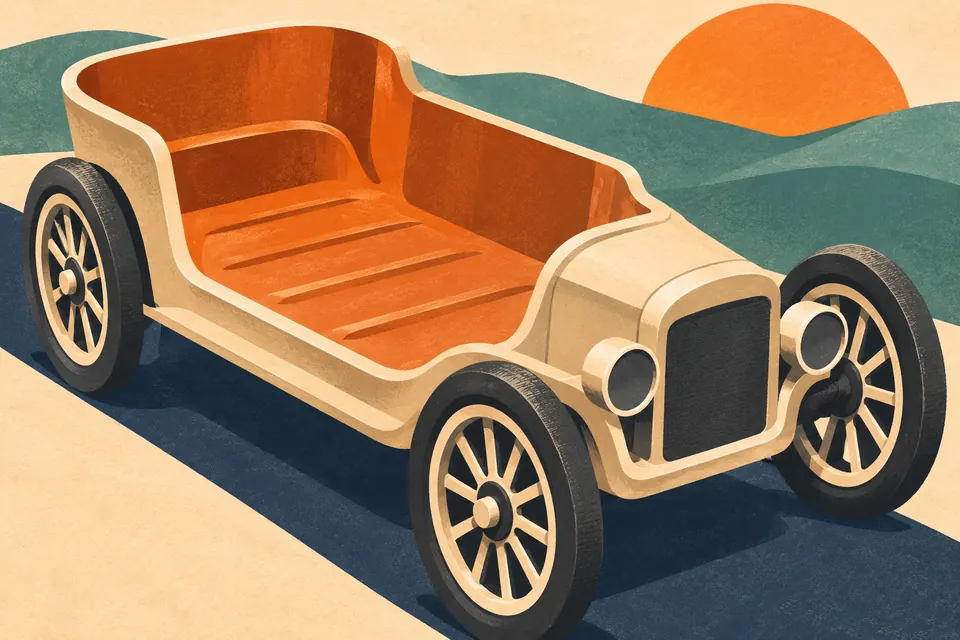
Early cars were built like carts: a ladder of steel girders underneath, with the engine bolted to it and a body sat on top. The chassis did the work and the body was a passenger.
Vincenzo Lancia's Lambda of 1922 made the body carry the load. Its steel shell was the structure, which made the car lower, lighter and stiffer than anything built the old way. About 13,000 were made over nine years. It took the rest of the industry longer to follow, because pressing a strong steel shell in volume needed tools that did not exist yet. Citroën's Traction Avant brought it to a mass-produced car in 1934, using American pressing methods.
Nearly every car made today is built this way. The separate chassis survives under pick-up trucks and a few off-roaders. Lightness, crash protection and the low floor of a modern car all follow from it.
Verdict The moment the body stopped being a passenger.
The Lambda also had independent front suspension and a V4, all on the same car.
- Years
- 1895
- Engine
- First used on a car: Michelin's L'Éclair, Paris-Bordeaux-Paris, 1895
- Power
- Credited to: Robert Thomson (patent, 1845), John Boyd Dunlop (1888), the Michelin brothers
- Built
- Replaced solid rubber and iron
Innovation · France
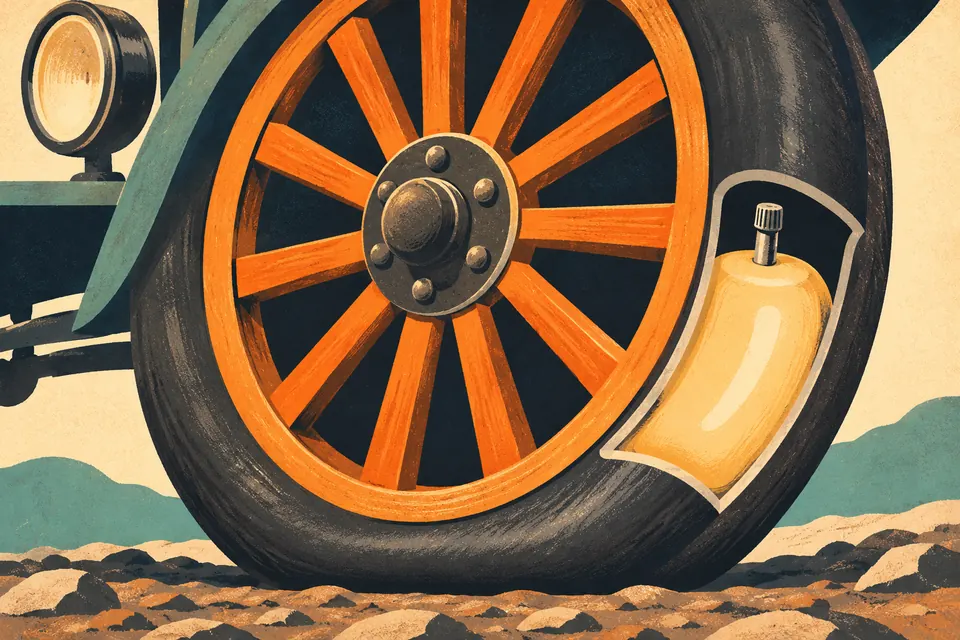
4. Michelin The pneumatic tyre
Robert Thomson patented an air-filled tyre in 1845, forty years before there was a motor car to put it on, and nothing came of it. John Boyd Dunlop, a vet in Belfast, made one that worked in 1888, for his son's tricycle.
The Michelin brothers put pneumatic tyres on a car for the Paris-Bordeaux-Paris race of 1895. Everyone else ran on solid rubber or iron. Within a few years nobody did.
It is this high because of what the alternative was. A car on solid tyres cannot go fast without shaking itself and its passengers apart, cannot grip in the wet and cannot brake hard. Speed, comfort, roadholding and braking all pass through four patches of rubber the size of a hand, and every one of them depends on that rubber being held up by air. It is the one invention on this list that the car could not have done without at all.
Verdict Everything a car does, it does through this.
Thomson patented it forty years before anyone had a use for it.
- Years
- 1959
- Engine
- First used: Volvo PV544, delivered 13 August 1959
- Power
- Credited to: Nils Bohlin
- Built
- Replaced the lap belt, where there was a belt at all
Innovation · Sweden
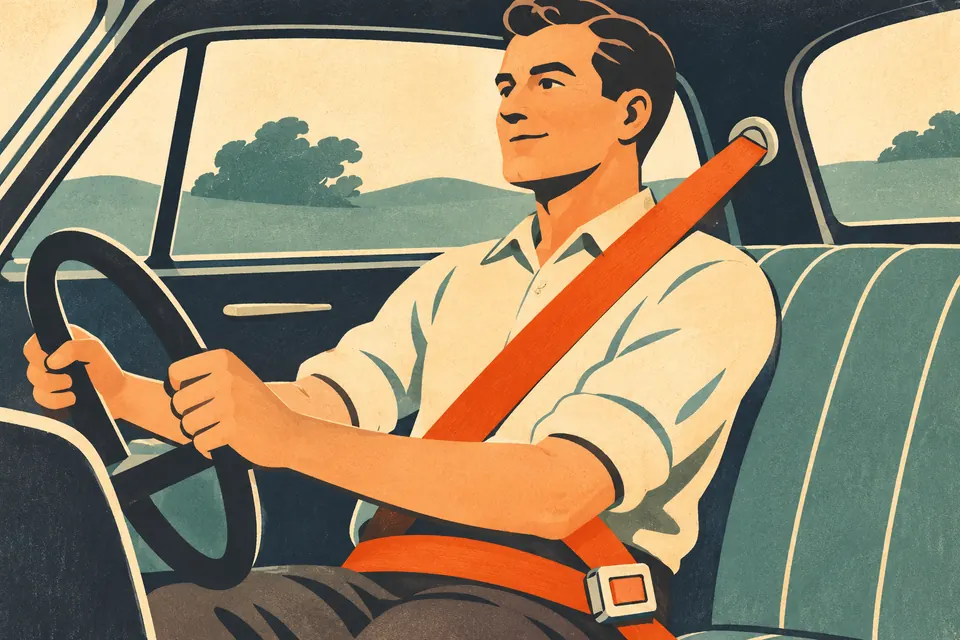
3. Volvo The three-point seat belt
Lap belts existed before 1959. Nash offered them in 1949 and Saab made them standard in 1958. They held you in the car and did little for your chest or your head.
Nils Bohlin, an engineer who had worked on aircraft ejector seats, designed a belt for Volvo with one strap across the hips and one across the chest, joined low at the side, that could be fastened with one hand. The first car to carry it was a Volvo PV544 delivered to a dealer in Kristianstad on 13 August 1959.
Then Volvo did the unusual thing. It opened the patent and let every other maker use the design for nothing. Bohlin later studied 28,000 accidents and found that no belted occupant had been killed at speeds below 60 mph.
The design has barely changed in more than sixty years. No other piece of safety equipment has done as much, and none cost its inventor's employer so much in royalties it chose not to collect.
Verdict The most effective safety device ever fitted, and it was given away.
Volvo opened the patent to every other maker for nothing.
- Years
- 1912
- Engine
- First used: Cadillac Model Thirty, 1912
- Power
- Credited to: Charles Kettering and Henry Leland, Delco
- Built
- Replaced the starting handle
Innovation · United States
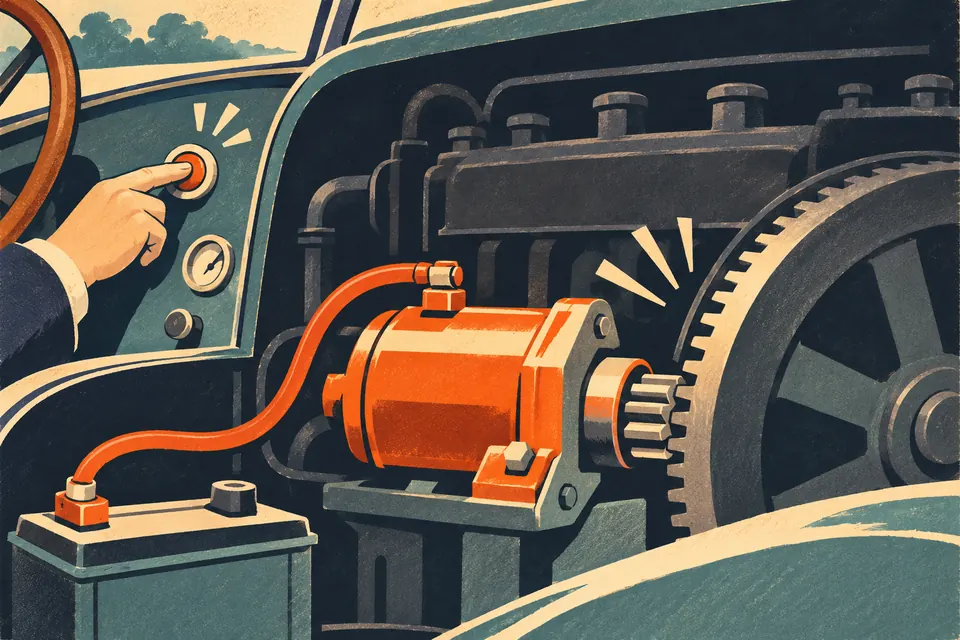
2. Cadillac The electric starter
Before 1912 you started a car by walking to the front and swinging a handle against the compression of the engine. It took strength, and if the engine kicked back it could break your wrist or worse.
Charles Kettering had already replaced the hand crank on cash registers with a small electric motor. With Henry Leland he did the same for the car, and the 1912 Cadillac was the first production car to have it. It was not the first electric starter ever fitted. One was put on an Arnold in Kent in 1896, and an American patent dates from 1903. Cadillac's was the one that worked every morning, and by the 1920s nearly every new car had one.
We have it above the seat belt. The belt has saved more lives. The starter decided who could drive at all, and it is the reason the petrol engine beat steam and electricity, both of which started at the turn of a switch.
Verdict It opened the driver's door to everybody.
An electric starter was fitted to an Arnold in Kent in 1896, sixteen years before Cadillac.
The best of the 50 · Innovation · United States
1. Ford The moving assembly line
- Years
- 1913
- Engine
- First used: Ford Model T, Highland Park, 7 October 1913
- Power
- Credited to: William Klann, Charles Sorensen, Clarence Avery and others at Ford
- Built
- Cut the time to build a Model T from about 12.5 hours to 93 minutes
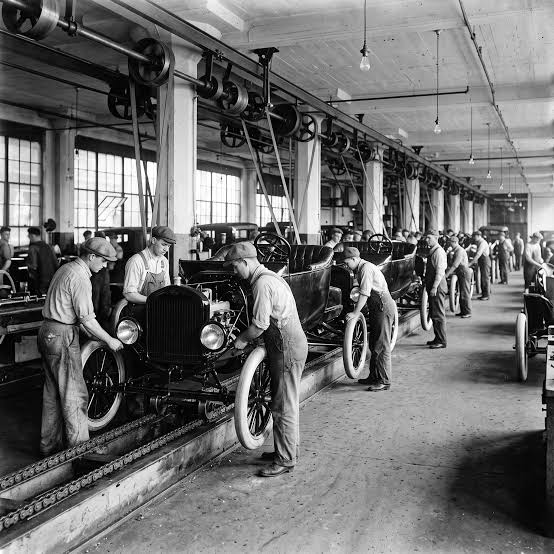
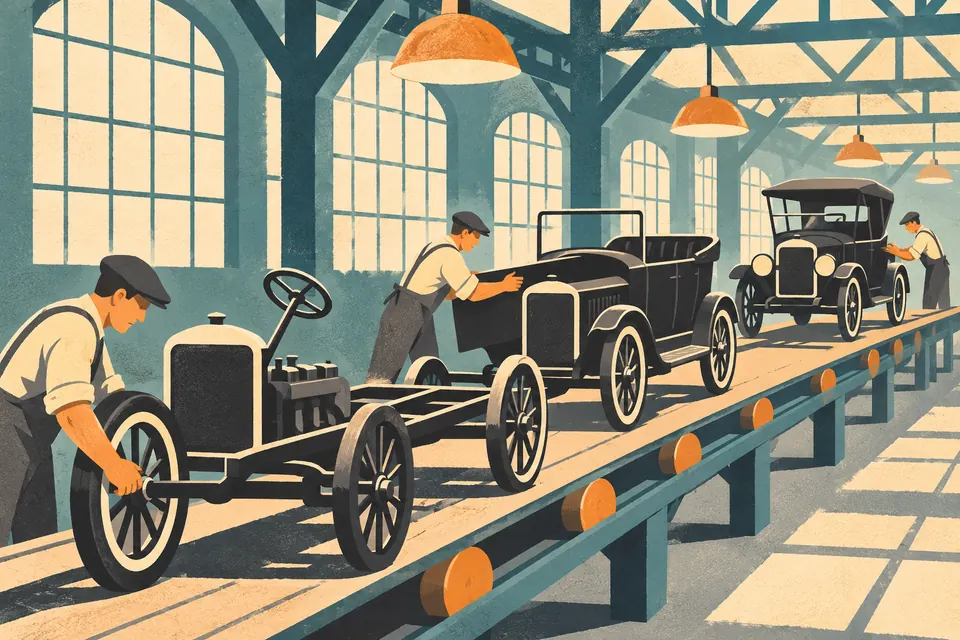
On 7 October 1913, at Highland Park in Detroit, Ford began pulling Model T chassis past its workers instead of sending the workers to the chassis. The job was cut into 45 steps. A car that had taken about twelve and a half hours of labour to put together now took an hour and thirty-three minutes.
It was not one man's idea. William Klann is credited with proposing it, and Charles Sorensen and Clarence Avery with making it work. Ransom Olds had built his Curved Dash on a stationary line as early as 1901. What Ford added was movement, and the price of the car kept falling as a result.
It is a way of building a car and not a part of one, and it is first anyway. Every other idea on this list reached ordinary people because this one made cars cheap enough for them to buy. It also changed how nearly everything else is made, which is more than can be said for the disc brake.
Verdict The idea that turned the car from a toy into a necessity.
Ransom Olds had used a stationary assembly line for the Curved Dash in 1901.
What we left off, and why
Lower than you might expect
The airbag at twenty. It is the safety device most people would name second. It works only with a belt, it took thirty years to get from patent to dashboard, and stability control, one place below it, prevents the crash in the first place.
The turbocharger at twenty-eight. It is on most new engines now. But it makes an existing engine better. It did not change what an engine is.
Satellite navigation at forty-seven. It changed how people drive more than almost anything here. It changed very little about the car, and the telephone does it better.
Higher than you might expect
The all-steel body at seven. Nobody gives it a thought. It is why cars have roofs, why they can be made by the million, and why the unitary body was possible.
Electric lighting at ten. The lamps matter less than what came with them: a battery charged by the engine, which every electrical device since has relied on.
The catalytic converter at eleven. It is a box in the exhaust that nobody has ever boasted about. It took lead out of petrol and forced the industry to adopt fuel injection and the engine computer.
Not on the list
The rotary engine. Felix Wankel's design is the most ingenious thing ever put under a bonnet, and it changed almost nothing. One maker persisted with it and everyone else went back to pistons.
The diesel engine. It is older than its use in cars and belongs to the history of engines generally. Its place here is taken by common-rail injection, which is what made it fit for a car.
The continuously variable gearbox. It is a clever answer to a question the automatic had already answered.
Active suspension. It won Formula One races, was banned, and has never been made cheap enough to matter on the road.
Run-flat tyres. A solution to a problem the tubeless tyre had mostly solved, at the cost of the ride.
Tell us what we got wrongQuestions about this list
What is the most important invention in the history of the car?
On our ranking, the moving assembly line, which Ford began using for the Model T on 7 October 1913. It is not a part of the car, but it is the reason the car became something ordinary people could own.
Who invented the three-point seat belt?
Nils Bohlin, an engineer at Volvo. The first car to carry it was a Volvo PV544 delivered in Sweden on 13 August 1959. Volvo then opened the patent so that other makers could use it without charge.
Which car first had an electric starter?
The 1912 Cadillac was the first production car with one, using a system developed by Charles Kettering and Henry Leland. An electric starter had been fitted to an Arnold car in England as early as 1896.
Which car first had disc brakes?
Jaguar's C-type used Dunlop disc brakes to win Le Mans in 1953, and was the only car in the race with them. The Citroën DS of 1955 was the first car made in volume to keep them. Frederick Lanchester had patented a disc brake in 1902.
Why is the electric car not ranked higher?
The list ranks ideas on how much they have already changed. The lithium-ion electric car dates from 2008 and most of its effect is still arriving, so it is thirtieth for now.
We listed every significant idea in the history of the car and asked of each how different a modern car would be without it. Dates and first uses were checked against published histories, and where the first attempt and the first lasting use differ, both are given. An idea counts from the year it reached a car, not the year it was patented.