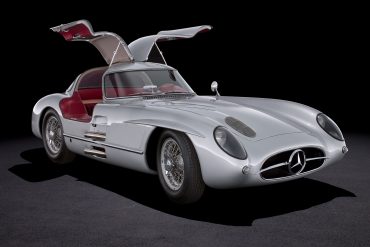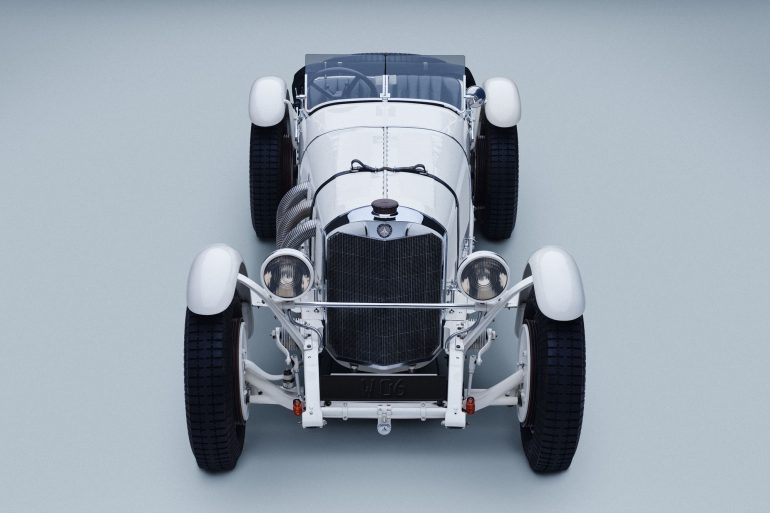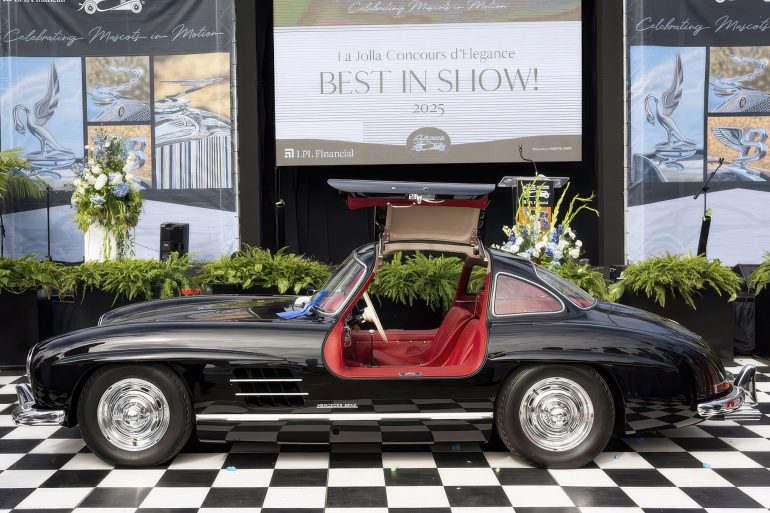
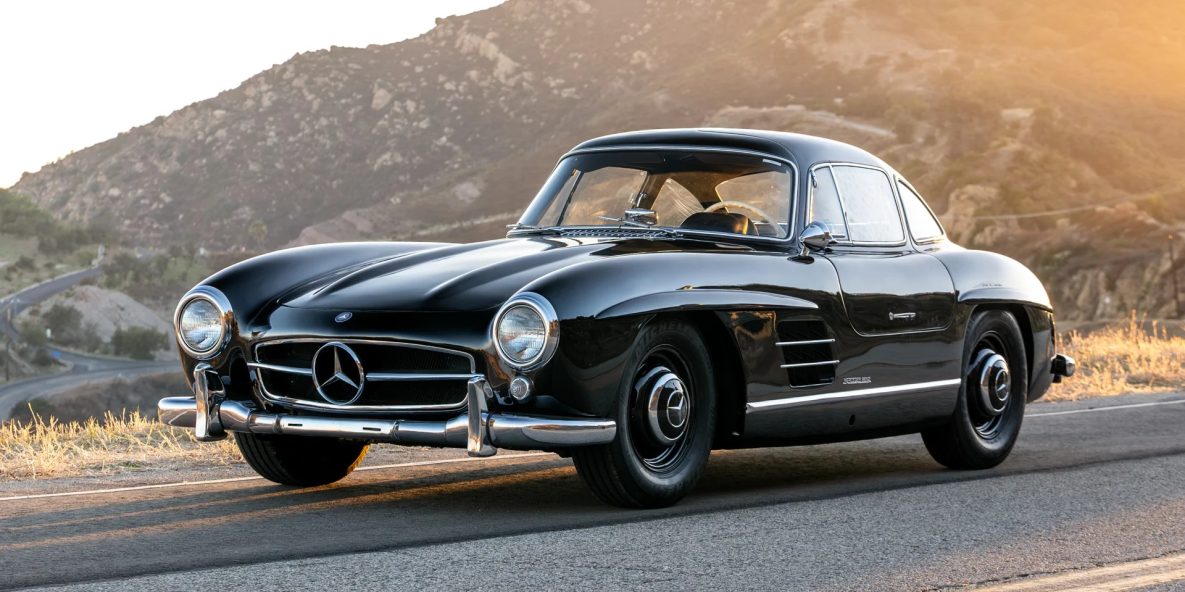
A landmark in postwar automotive engineering, this 1956 Mercedes-Benz 300 SL Gullwing is now offered through Broad Private Sales for $1,650,000. This example combines a highly unusual original factory specification,...

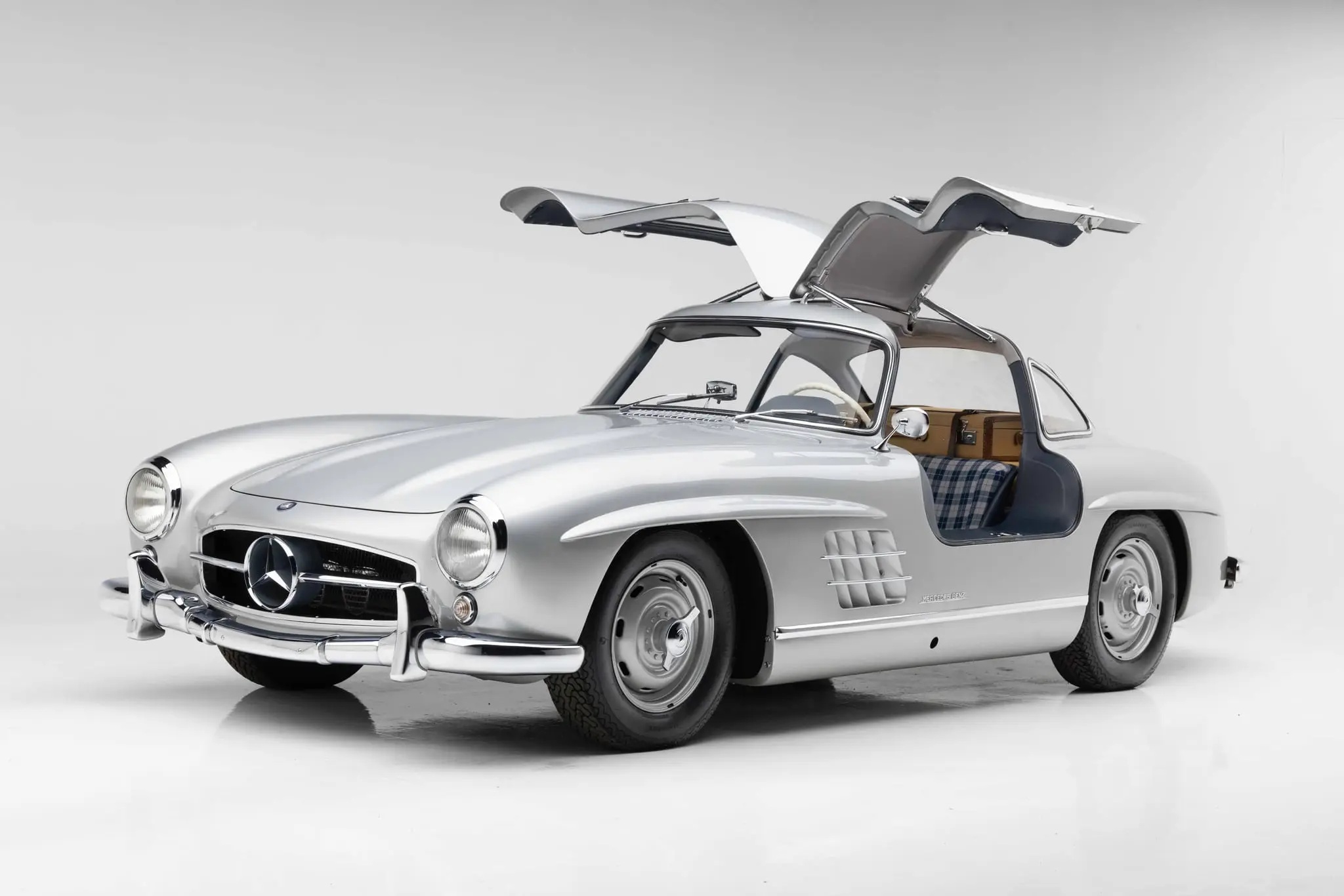
The doors open upwards because the chassis would not let them open any other way, and that accident of engineering made the Mercedes-Benz 300 SL the most recognisable sports car of the 1950s: a racing car of 1952 that won Le Mans and the Carrera Panamericana in its only season, turned into a road car in 1954 because a New York importer ordered a thousand of them, and became the first production car with fuel injection and the fastest you could buy. Fourteen hundred Gullwing coupés and 1,858 Roadsters were built to 1963; the Gullwing has never gone out of fashion and the alloy-bodied ones sell for seven million dollars. This page is the car: the W194 racer and its season, Max Hoffman and the W198, the Gullwing and the Roadster, the racing that followed, the 300 SLR and the Uhlenhaut coupé that share its name, the people, the market and the SL line it founded, with the archive's writing, Casey Annis in the 1952 racer and the 1960 Roadster, John Zimmermann's SL history and Robert Newman's Uhlenhaut portrait among it, threaded through. The marque is on the Mercedes-Benz page; the era around it is The Grand Touring Years.
The pieces to start with
Eight pieces on the car: the 1952 racer and the 1960 Roadster driven, the SL line's history, the SCCA championships, Uhlenhaut's life, the rebuilding of Mercedes after the war, John Fitch remembered and the 2025 gathering.
Fritz Nallinger said Mercedes was “just opening a little window on the motor racing scene”. With Formula One rules in limbo until 1954, Neubauer went to ask the CSI for a change, and the W194 became the way back.
Max Hoffman went to Stuttgart and told the Daimler-Benz board that a 180-based sports car would not sell in America, then promised to buy 500 road-going Gullwings. The committee did both. Casey Annis on the open car that followed.
Told in 1951 that money for racing was back, Mercedes waited on Grand Prix rules changing for 1954 and built a Le Mans car. John Zimmermann on Uhlenhaut’s 200-pound spaceframe and a 3-liter six canted at 50 degrees: the W194.
Paul O’Shea’s 1956 SCCA championship, confirmed on 28 December with 10,500 points in a works-backed 300 SL Gullwing, was a title the press awarded, not the club. He won again in 1957 in the 300 SLS.
Rudolf Uhlenhaut never owned a car. Made Mercedes-Benz racing’s technical director at 30 in 1936, he climbed into a 354-hp W25 at the Nürburgring and taught himself to match his professionals. Robert Newman on an engineer who could beat Fangio.
Mercedes-Benz’s post-war racing began in September 1950 with Karl Kling in a 170 S at the Nürburgring six-hour race, sprinting to his car “as if I was Jesse Owens” and finishing seventh in class. Alfred Neubauer’s rebuilt department followed.
More than 90 images of John Fitch, drawn from the GM and Daimler-Benz archives and his own collection, chosen by Art Evans, his friend and co-author of 50 years. Not a history, he says; there would never be enough pictures.
While many of North America’s collector car owners are starting to add Sta-bil to their fuel tanks and putting their cars on blocks, Southern Californian car enthusiasts have a different mindset.
The newest writing on the 300 SL, as it is published.
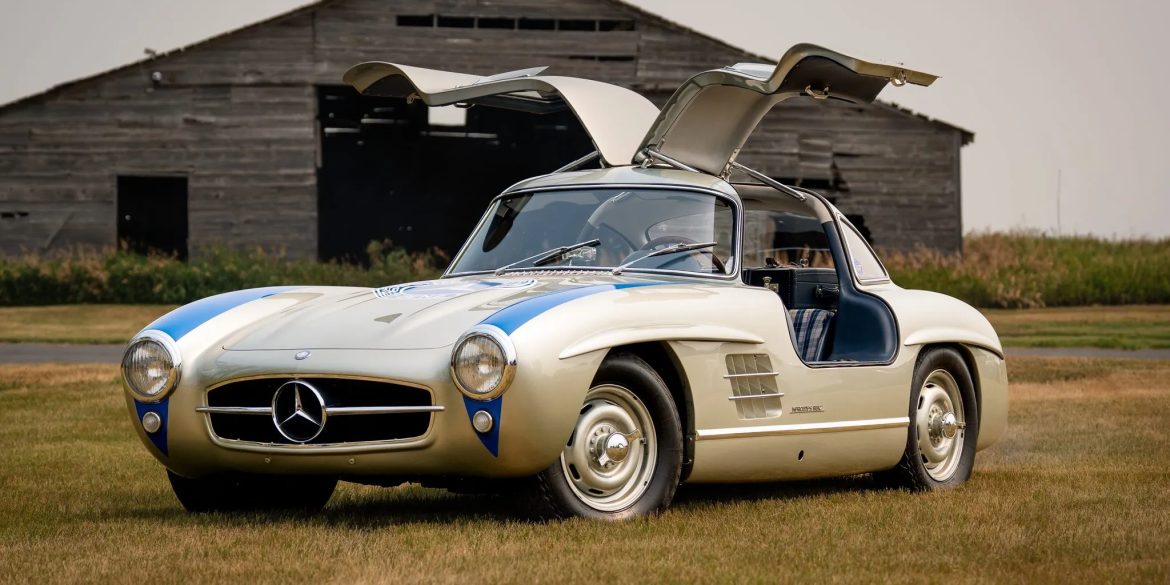
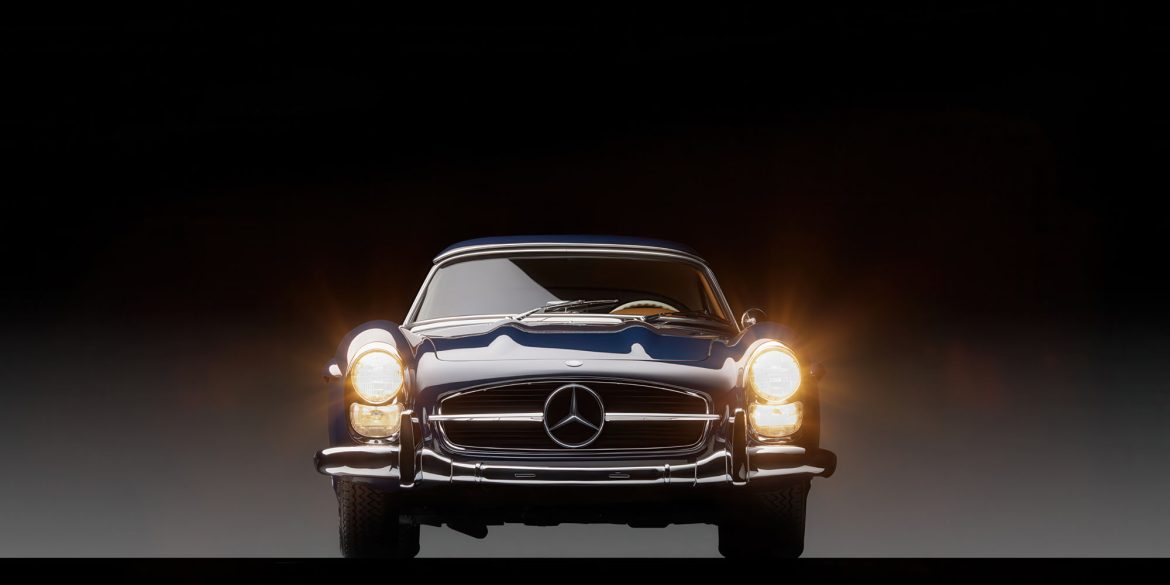
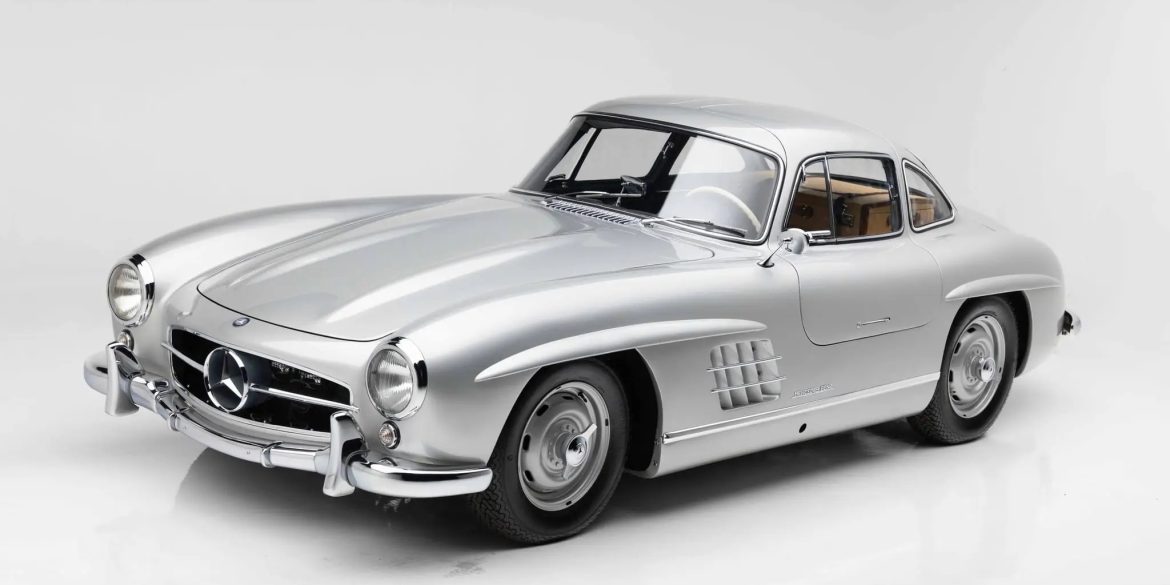
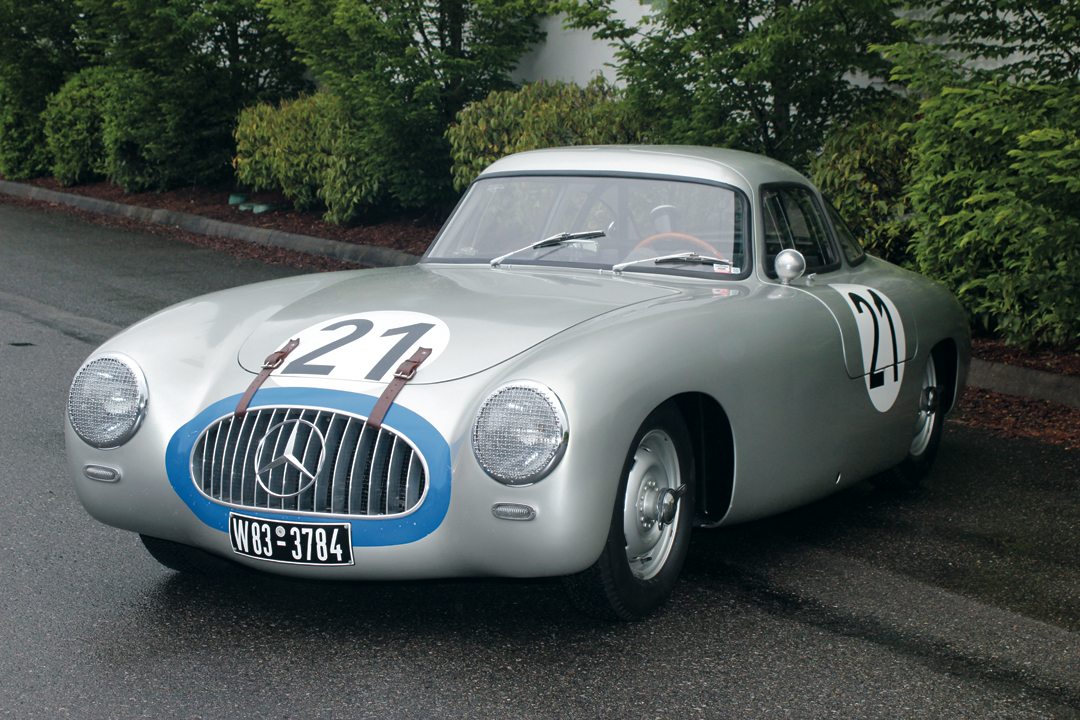
The Mercedes-Benz 300 SL is two cars with one name. The first, the W194 of 1952, was the sports-racing car Daimler-Benz built to return to international racing after the war, ten coupés and roadsters on a welded tubular spaceframe with the three-litre straight-six of the 300 saloon, which won the Le Mans 24 Hours, the Nürburgring sports-car race, the Bern Grand Prix and the Carrera Panamericana in its only season; "SL" stood for Sport Leicht, sport light. The second, the W198 of 1954–57, is the production Gullwing coupé Mercedes built after Max Hoffman, its American importer, guaranteed to sell a thousand: the same spaceframe, which rose so high at the sills that the doors had to hinge from the roof, the same engine with Bosch direct fuel injection, the first in a production car, giving 215 horsepower and 160 mph, and a body that Hoffman's customers, Clark Gable, Tony Curtis and Juan Perón among them, bought for $6,820 in New York, with 1,400 built, twenty-nine of them with aluminium bodies. The Roadster of 1957–63 replaced it, with conventional doors, a lower-pivot rear axle that cured the coupé's handling, disc brakes from 1961 and 1,858 built, and the 190 SL of 1955 was its four-cylinder understudy. The 300 SLR of 1955, the racing car of Moss's Mille Miglia and the Le Mans disaster, is a different machine with a Grand Prix engine, and the two 300 SLR coupés Rudolf Uhlenhaut built for himself include the most expensive car ever sold. The archive's 300 SL thread is one of its largest on a single model: the two W194 and Roadster drives, the SL history, the SCCA racing story, the Uhlenhaut pieces, the 2025 gathering of a record number of 300 SLs in California, and some two hundred sales.
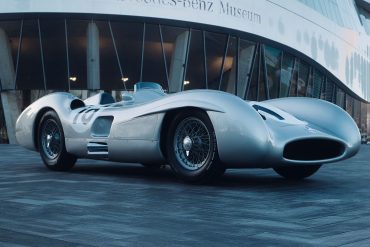
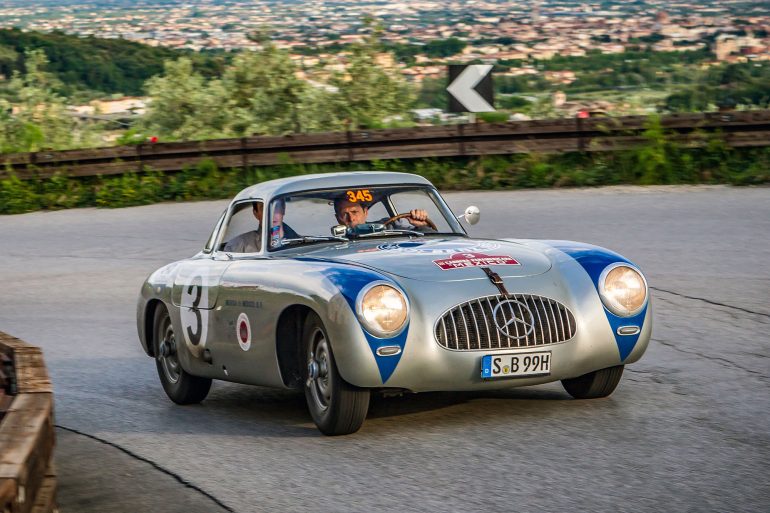
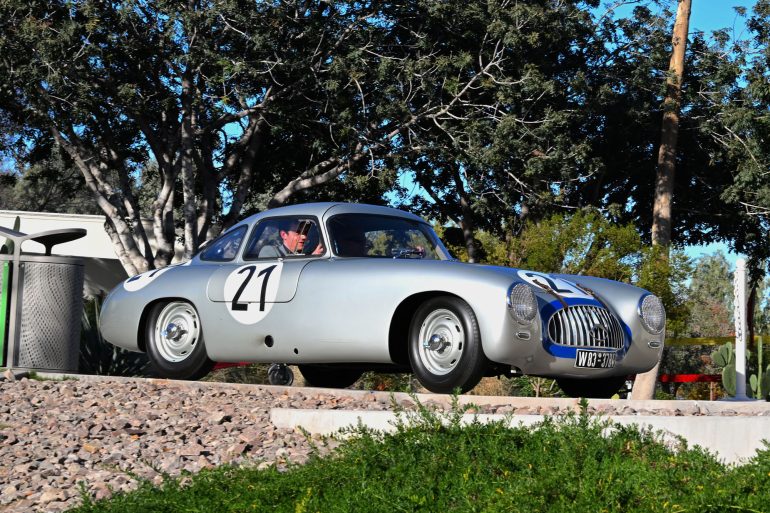
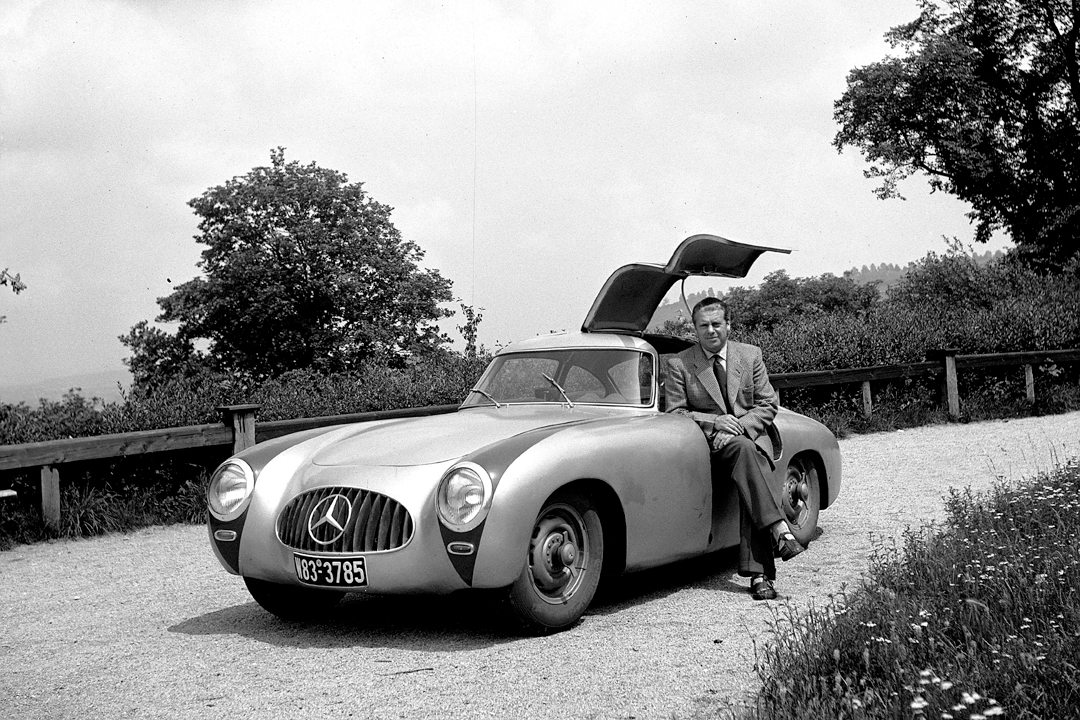
Daimler-Benz had the men but not the money for a Grand Prix return in 1951, and Fritz Nallinger, the technical director, suggested to Alfred Neubauer, the pre-war team manager, that a sports car built from the 300 saloon's parts could win Le Mans while the new Formula 1 rules for 1954 were awaited. Rudolf Uhlenhaut, who had designed the pre-war Silver Arrows and could drive them as fast as the drivers, laid out a spaceframe of thin steel tubes weighing fifty kilograms, so deep at the sides that a conventional door was impossible, which is where the gullwings came from; the 2,996 cc M186 engine, canted fifty degrees to lower the bonnet, gave about 170 horsepower on three Solex carburettors, far less than the Ferraris and Jaguars, and the car won on aerodynamics, reliability and Neubauer's organisation. Casey Annis drove one of the ten W194s in the rain in Seattle for the archive's "Wings of Change", and the season he describes is the one the table below sets out: second at the Mille Miglia on its first outing with Karl Kling, one-two-three at Bern, where Rudolf Caracciola crashed and ended his career, first and second at Le Mans with Hermann Lang and Fritz Riess after the Jaguars and Ferraris broke, one-two-three-four at the Nürburgring in open form, and first and second in the Carrera Panamericana in November with Kling and Hans Klenk, after the vulture came through the windscreen. The programme was closed at the end of the year, the 1953 car with fuel injection and a transaxle was built and never raced, and Mercedes went back to Grand Prix racing with the W196 in 1954. Zimmermann's "Building a Legend" and Rex McAfee's "Rebuilding Mercedes-Benz after WWII" in the archive are the context; the Carrera Panamericana and Le Mans pages have the races.
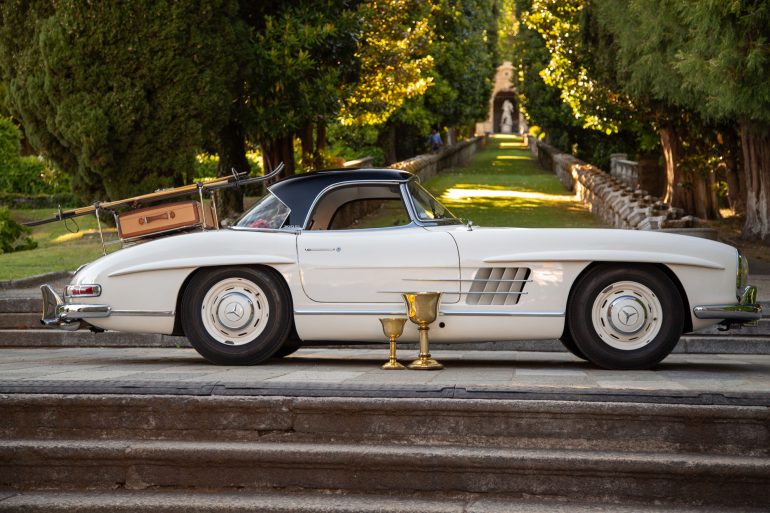
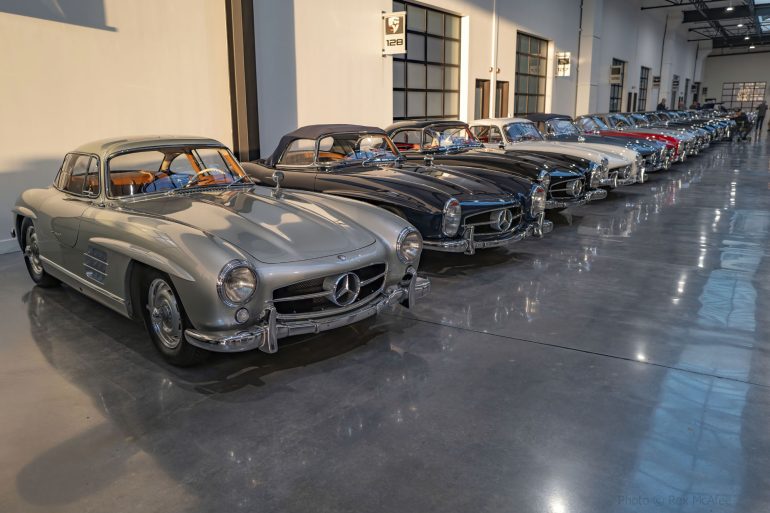
Max Hoffman, the Austrian who imported Mercedes, Porsche, Jaguar and BMW into New York from his Frank Lloyd Wright showroom on Park Avenue, went to Stuttgart in 1953 and told the board that a road-going W194 would sell in America; the board was doubtful, Hoffman ordered a thousand, and the W198 was shown not at Geneva or Frankfurt but at the International Motor Sports Show in New York on 6 February 1954, beside the 190 SL he had also asked for. The production car kept the spaceframe and the doors, added the eyebrows over the wheel arches, a bonnet with two power bulges, a proper interior with plaid cloth and the famous fold-down steering wheel, and gained Bosch mechanical direct injection, developed from the DB 601 aircraft engine's, which took the engine to 215 horsepower and the car to 260 km/h with the tallest axle ratio, the fastest production car in the world in 1954. It was expensive, $6,820 in America against the Corvette's $3,500, and difficult: the high-pivot swing axle would tuck a rear wheel under in a fast corner, the cabin was an oven, the doors made it impossible to get out in a tight garage, and none of that mattered, because nothing else looked like it. 1,400 coupés were built between August 1954 and May 1957, 29 of them with aluminium bodies for racing customers, and most went to America. Annis's "Wingless Gull" and the archive's Hoffman and Gullwing stories have the car's making; the 2025 Finish Line Auto Club gathering in Costa Mesa, which the archive attended, had more of them in one room than anyone had seen.
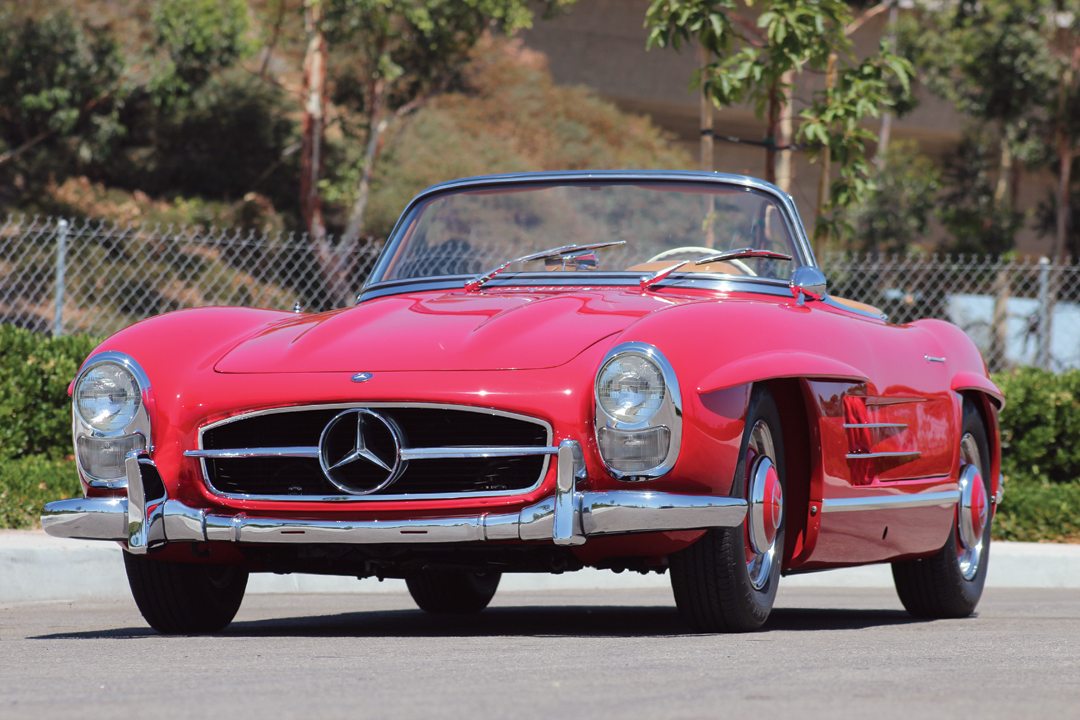
The Roadster shown at Geneva in March 1957 was the Gullwing fixed: a lower spaceframe that allowed conventional doors, the low-pivot single-joint swing axle with a compensating spring from the 220 that made the car predictable, a slightly softer tune, a folding hood and from 1958 a removable hardtop, with Dunlop disc brakes from March 1961 and an aluminium cylinder block on the last 209 cars from 1962. It was the better car and the less loved one for forty years, which is why the archive's Annis drove a 1960 example for "Wingless Gull" to make the case; 1,858 were built to February 1963, when the 230 SL Pagoda replaced it, and the Roadster has since come up to meet the coupé in the market. The 300 SLS, two lightened Roadsters built in 1957 for Paul O'Shea's SCCA campaign, are the rarest of the family.
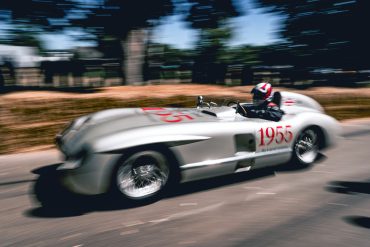
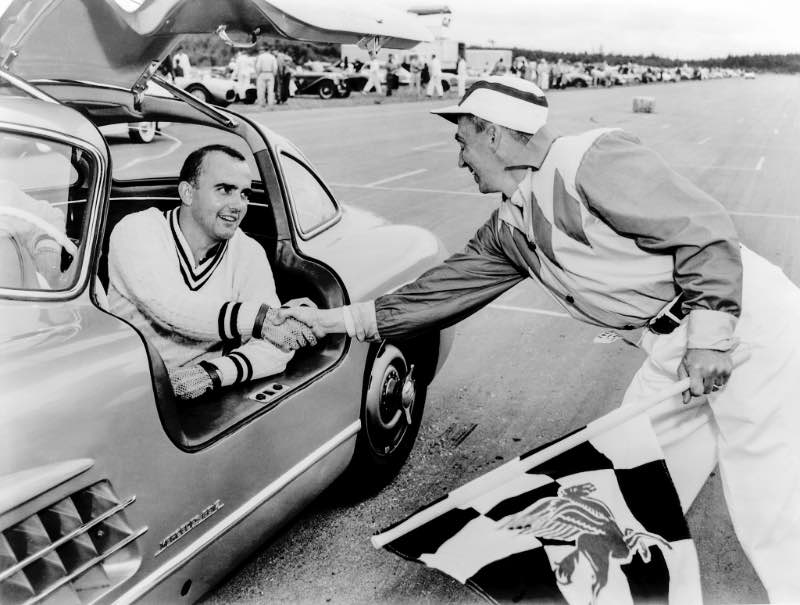
The production car raced from its first year. John Fitch, who had driven the W194 in the 1952 Carrera, won the production class of the 1955 Mille Miglia and finished fifth overall in a standard Gullwing, behind the three works 300 SLRs and a Ferrari, and the archive's Fitch tribute and pictorial remembrance have the drive; Olivier Gendebien won the Liège–Rome–Liège rally outright in a 300 SL the same year, Walter Schock the Acropolis Rally and the European Rally Championship in 1956, and the Gullwing won the Sestriere, the Tour de France and a dozen national events. In America Paul O'Shea, with works support, was the SCCA's national champion in D-Production in 1955 and 1956 in a Gullwing and in 1957 in the 300 SLS, three years running, which the archive's "When Mercedes-Benz Dominated SCCA Racing" tells; the alloy-bodied cars, with the competition camshaft, Rudge wheels and the NSL engine, were the ones built for the job, and the "African Alloy" car the archive followed to the Arizona Concours is one of them. The Mille Miglia page has 1955 in full.
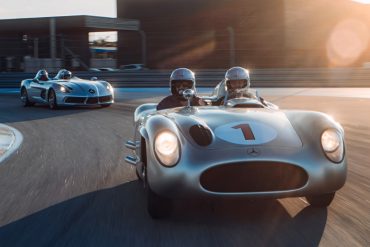
The 300 SLR (W196 S) of 1955 shares the name, the shape and little else: it is the W196 Grand Prix car with a three-litre straight-eight and a sports body, built for the World Sportscar Championship, which it won, with Stirling Moss and Denis Jenkinson's Mille Miglia at 97.96 mph, the Targa Florio and the Tourist Trophy, and the Le Mans from which Mercedes withdrew after Pierre Levegh's crash; ten were built. Uhlenhaut had two of them fitted with gullwing coupé bodies for the 1956 season that never came, kept one as his company car, the fastest road car in the world by a distance at 290 km/h, and the pair stayed in the Mercedes-Benz museum until May 2022, when one was sold privately at auction for €135 million, the most ever paid for a car, which the archive reported as it happened. Newman's "Superman" is Uhlenhaut's life; "Uhlenhaut's Drive" is the coupé on the road; the 300 SLR thread is in the feed below, and the Mercedes-Benz page has the 1955 season.
The 1955 racing car and the Uhlenhaut coupés, newest first.
The table below runs from the W194's first race in 1952 to the last Roadster in 1963, with the racing results, the production milestones and the cars linked to their archives; the 300 SLR's 1955 is included for the name's sake.
The W194's season, the production milestones and the racing that followed. People link to every story on the site about them.
| Year | Event | People | Car | The story |
|---|---|---|---|---|
| 1951 | The decision | Neubauer, Uhlenhaut, Nallinger | W194 design | A sports car from the 300 saloon's parts to fill the years before the 1954 Formula 1 return |
| 1952 | Mille Miglia, May | Kling / Klenk; Caracciola | W194 coupé | 2nd and 4th on the car's first outing |
| 1952 | Bern Grand Prix, May | Kling; Lang; Riess | W194 | 1-2-3; Caracciola crashes and ends his career |
| 1952 | Le Mans, June | Lang / Riess; Helfrich / Niedermayr | W194 coupé | 1st and 2nd after the Jaguars, Ferraris and Talbot break |
| 1952 | Nürburgring, August | Lang; Kling; Riess; Helfrich | W194 roadster | 1-2-3-4 in open form |
| 1952 | Carrera Panamericana, November | Kling / Klenk; Lang / Grupp | W194 coupé | 1st and 2nd over 1,933 miles; the vulture through Kling's windscreen |
| 1953 | The programme closed | Daimler-Benz | W194/11 prototype | The fuel-injected, transaxle 1953 car built and never raced; the W196 Grand Prix car takes priority |
| 1953 | Hoffman in Stuttgart | Hoffman | — | The American importer promises to sell a thousand road-going 300 SLs |
| 1954 | New York International Motor Sports Show, 6 February | Hoffman | W198 Gullwing | The production 300 SL and the 190 SL shown together; the first production car with direct fuel injection |
| 1954 | Production begins, August | Sindelfingen | W198 Gullwing | 215 bhp, 260 km/h; $6,820 in America |
| 1955 | Mille Miglia, May | Fitch / Gesell; Moss, Fangio, Kling, Herrmann in the SLRs | Gullwing; 300 SLR | Fitch wins the production class and is 5th overall; Moss's 97.96 mph record in the SLR |
| 1955 | Liège–Rome–Liège, August | Gendebien / Stasse | W198 Gullwing | Outright win on the Marathon de la Route |
| 1955 | SCCA national championship | O'Shea | W198 Gullwing | O'Shea's first title, with works support |
| 1956 | European Rally Championship | Walter Schock | W198 Gullwing | The Acropolis and Sestriere rallies and the title |
| 1956 | SCCA national championship | O'Shea | W198 Gullwing | Second title |
| 1957 | Geneva Motor Show, March | Daimler-Benz | W198 Roadster | The Roadster with conventional doors and the low-pivot axle; coupé production ends in May after 1,400 cars |
| 1957 | SCCA national championship | O'Shea | 300 SLS | Third title in the two lightened Roadsters |
| 1958 | Hardtop | Daimler-Benz | W198 Roadster | The removable hardtop offered |
| 1961 | Disc brakes, March | Daimler-Benz | W198 Roadster | Dunlop discs at all four wheels |
| 1962 | Alloy block | Daimler-Benz | W198 Roadster | The aluminium cylinder block on the last 209 cars |
| 1963 | Production ends, February | Daimler-Benz | W198 Roadster | 1,858 Roadsters built; the 230 SL Pagoda follows at Geneva in March |
| 2022 | Uhlenhaut coupé sold, May | Uhlenhaut | 300 SLR coupé | €135 million at the Mercedes-Benz museum, the most ever paid for a car |
The 300 SLR's 1955 is shown for the name's sake; it is a different car. Production figures are Daimler-Benz's.
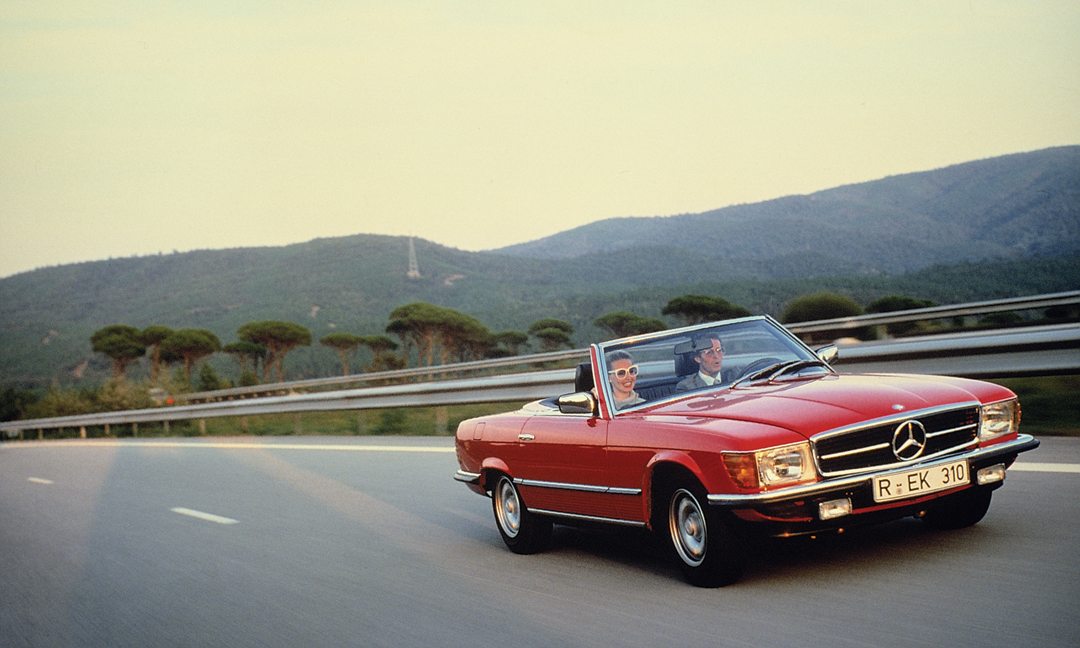
The W194 racers, ten built, survive almost all in the Mercedes-Benz collection, with the 1953 prototype among them; the Gullwing is the 1,400 steel coupés and the 29 aluminium ones, which weigh eighty kilograms less and sell for three to four times as much; the Roadster's 1,858 divide into drum-brake, disc-brake and alloy-block cars, the last the most valuable; the two 300 SLS are museum pieces; and around them the 190 SL, the 230, 250 and 280 SL Pagodas that followed and the SL line that has run unbroken to the present, the 300 SLR and the Uhlenhaut coupés. Famous chassis: the Le Mans winner and the Carrera winner in Stuttgart; Fitch's Mille Miglia car; O'Shea's SLS; the Gable, Curtis and Perón Gullwings; the alloy cars, one of which made $6.8 million at Monterey in 2022; and the 1963 Roadster that was the penultimate car built, offered in London in 2026. The cards below link nine of the family to their stories.
Nine cars from the archive, from the 1952 racer to the Pagoda; each links to every story on the site.
Rudolf Uhlenhaut designed the chassis and could out-drive the team; Alfred Neubauer ran it; Fritz Nallinger approved it; Friedrich Geiger drew the W198's body; Hans Scherenberg and Karl Wilfert engineered it; Max Hoffman made it exist and sold it, and Zimmermann's SL history and the archive's Hoffman piece explain how. The drivers: Hermann Lang and Fritz Riess, the Le Mans winners; Karl Kling and Hans Klenk, the Carrera winners; Caracciola, in his last race; Fitch, Gendebien, Schock, O'Shea, Prince Metternich, who raced a Gullwing in the 1955 Mille Miglia, and the Americans of the SCCA. The owners made it a legend as much as the drivers did: the archive's Pebble Beach, Amelia and Arizona reports show which cars the collectors bring.
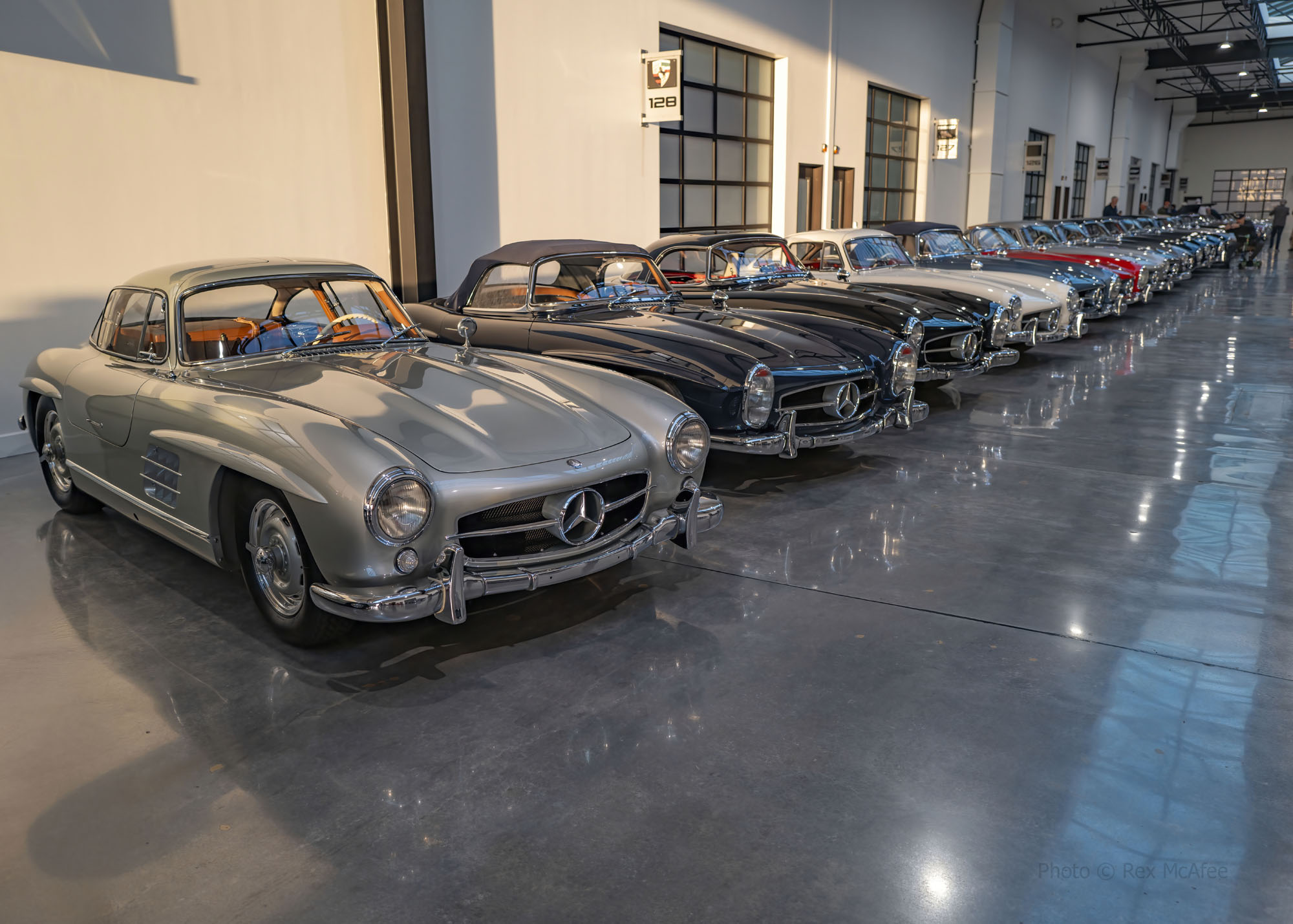
The Gullwing has been a blue-chip car since the 1980s and the market is deep and liquid: steel coupés sell between $1.3 and $2 million depending on history and colour, the alloy cars $5–7 million, Roadsters $1–2 million with the alloy-block disc-brake cars at the top, 190 SLs a tenth of that. The archive's auction reports and the marketplace listings, a dozen 300 SLs offered in 2026 alone, follow it month by month, and the 2025 Costa Mesa gathering is the collectors' world in one picture. The cars drive: the Mille Miglia regularity rally has a 300 SL class of its own, the Gullwing Group and the Mercedes-Benz Club run tours, and Mercedes-Benz Classic restores and certifies them in Fellbach. The feeds below carry the 300 SLR, 190 SL and Pagoda threads beside the 300 SL's own.
The smaller SL and the car that followed, newest first.
W194 (1952): 10 built; 2,996 cc M186 straight-six, three carburettors, about 170 bhp; spaceframe 50 kg; wins at Le Mans (Lang / Riess), Bern, the Nürburgring (Lang) and the Carrera Panamericana (Kling / Klenk); 2nd Mille Miglia (Kling). W198 Gullwing (1954–57): 1,400 built (29 alloy); 2,996 cc M198 with Bosch direct injection, 215 bhp at 5,800 rpm; 1,295 kg; 235–260 km/h by axle ratio; $6,820 in 1954. W198 Roadster (1957–63): 1,858 built; low-pivot swing axle; disc brakes from March 1961; alloy block on the last 209; 1,420 kg. 300 SLS: 2 built, 1957. 190 SL: 25,881 built, 1955–63. 300 SLR (W196 S): 10 built, 1955, two of them finished as the Uhlenhaut coupés. Racing: Le Mans and Carrera 1952; Mille Miglia production class 1955 (Fitch, 5th overall); Liège–Rome–Liège 1955 (Gendebien); European Rally Championship 1956 (Schock); SCCA national champion 1955, 1956 and 1957 (O'Shea). Firsts: the first production car with direct fuel injection; the fastest production car of 1954. Record prices: 300 SLR Uhlenhaut coupé, €135,000,000 (May 2022), the most ever paid for a car; alloy Gullwing, $6,825,000 (RM Sotheby's Monterey 2022). The archive: 384 300 SL stories; Wings of Change and Wingless Gull; Building a Legend; the SCCA story; Superman and Uhlenhaut's Drive; the Fitch tributes; the 2025 gathering; the sales.
Short answers, with the long ones above.
Because the racing car's tubular spaceframe runs high along the sides for stiffness and left no room for a conventional door; hinging the doors from the roof was the engineers' solution in 1952 and the production car of 1954 kept it. The Roadster of 1957 lowered the frame at the sills and got normal doors.
1,400 coupés between 1954 and 1957, 29 of them with aluminium bodies, after ten W194 racing cars in 1952; then 1,858 Roadsters from 1957 to 1963. About 80 per cent of the Gullwings were sold in the United States.
A steel Gullwing $1.3–2 million, an alloy Gullwing $5–7 million (one made $6.8 million in 2022), a Roadster $1–2 million with the late disc-brake and alloy-block cars at the top; the 300 SLR Uhlenhaut coupé's €135 million of 2022 is the record for any car.
The 300 SL is the production Gullwing and Roadster (and the 1952 racer they came from), with a three-litre six-cylinder engine; the 300 SLR of 1955 is a pure racing car built from the W196 Grand Prix car with a three-litre straight-eight, ten built, which won the 1955 World Sportscar Championship. They share only the name and the outline.
The first production car with direct petrol injection, yes: Bosch's mechanical system, derived from its wartime aircraft engines, replaced the racer's carburettors and lifted the engine to 215 horsepower. Earlier cars had used indirect injection in small numbers.
Between 235 and 260 km/h (146–161 mph) depending on the axle ratio fitted, 0–100 km/h in about nine seconds: the fastest production car in the world when it was launched in 1954.
The 1952 racing version did, first and second with Hermann Lang and Fritz Riess leading Theo Helfrich and Helmut Niedermayr, and won the Carrera Panamericana the same year. The production car won its class at the 1955 Mille Miglia and three SCCA championships but never raced at Le Mans as a works entry.
One of two 300 SLR racing cars fitted with gullwing coupé bodies in 1955 for a season that never happened; Rudolf Uhlenhaut used one as his company car. Mercedes-Benz sold one from its museum in May 2022 for €135 million, the most ever paid for a car; the other stays in Stuttgart.
The whole archive on one thread, newest first.