With the exciting announcement that the Mullin Automotive Museum re-opening to the public, we deemed it a great opportunity to take a glimpse of the spectacular vehicles on display at the museum. Sports Car Digest will spotlight one of their unique vehicles each week in a four-part series. This week’s focus will be placed on their 1937 Talbot-Lago Type 150-C SS.
1937 Talbot-Lago Type 150-C SS
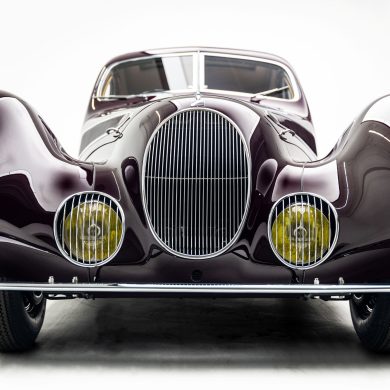
Upon popularizing the French curve, Joseph Figoni took the aerodynamic design to an art form when he showcased a mature teardrop style with the Type 150-C-S.

The 1937 French Grand Prix victory by the Talbot-Lago Type 150-C SS was instrumental in launching the marque to the international stardom. The public sensation surrounding these vehicles convinced coachbuilder Joseph Figoni to partner with the Talbot-Lago company in creating a touring version of the car that would be a standout at concours d’elegance.
These masterpieces were the peak of the Streamline Moderne movement of the 1930s, as they elegantly brought together the extraordinary power of the Lago’s impressive machine and the organic form of a teardrop.

In 1937, Figoni’s goutte d’eau, or teardrop, has never been seen before. The Talbot-Lago Teardrop was the embodiment of speed, elegance, and aerodynamic efficiency. Its form resembled raindrops as it falls to the earth – the perfect form for an object in motion.
Fourteen Type 150-C SS Figoni in total were produced, with thirteen of them still in existence today, demonstrating the love and care that their owners have given the examples over the years.
Many of the examples survived World War II because they were transported to the United States after being purchased by Hollywood glitterati.

Exulted custodians of the Talbot-Lago Type 150-C SS included French racecar driver Marcel Balsa, American car collector Tommy Steward Lee, Australian Olympic bobsledder Freddie McEvoy, and the Maharani Stella de Kapurthala, who relished having her car’s color scheme changed to match her outfits.
The Teardrops were made in two series. The first was the Jeancart series and was named after the original patron of the style. The first series were coupés that had a slight notchback design.
The second series, known as the New York, was introduced at the 1937 National Automotive Show in New York City. This series had an uninterrupted fastback profile.

Despite all the Teardrops being similar in nature, there are subtle differences in each car as they were handmade.
The Mullin Automotive Museum 1937 Talbot-Lago Type 150-C SS (chassis number 90106) has an aluminum alloy body, a sunroof, a foldout windscreen, and competition-style exhaust headers, among other features.
Owner History of the Mullin Automotive Museum Teardrop
The 1937 Talbot-Lago Type 150-C SS was originally owned by the chairman of Bentley Motors and Bentley aficionado, Woolf Barnato, where it resided two decades in England.
In the 1960s, it was sold to Otto Zipper, who transported it to the United States and presented it at the Briggs Cunningham Automotive Museum.

In the 1980s, it went through a succession of owners. First being acquired by Peter Giddings, then by John Calley, and followed by Pat Hatt, who carried out a multi-year restoration. In 1985, Peter Mullin acquired the vehicle, completing the restoration process.
Talbot-Lago Type 150-C SS Specifications
| Coachbuilder | Figoni and Falaschi |
| Chassis number | 90106 |
| Profile type | Touring |
| Body type | Coupé |
| Number made | 14 |
| Acceleration | 0 |
| Top Speed | Unavailable |
| Front brakes type | Cable-operated |
| Rear brakes type | Cable-operated |
| Length | 15’ 8” |
| Height (Ground line to highest roof) | 4’ 6” |
| Width | 5’ 6” |
| Engine Type | Inline |
| Number of cylinders | 6 |
| BHP at 4000 RPM | 140 |
| Gearbox | Wilson pre-selector |
| Number of gears | 4 |
| Overdrive | 0 |
To find more information about this stunning vehicle why not visit the Mullin Automotive Museum. The museum will now be open every weekend with the new hours – Friday to Sunday from 10 am to 3 pm.
[Source: Mullin Automotive Museum]