Grand Prix Cars

A List of the Iconic Grand Prix Cars

Pre-War Grand Prix Cars (The First Race Cars)

The Early 1900s. Motor racing started to take shape in France around 1884, quickly evolving from simple races from one village to another to sophisticated events. Before the outbreak of WW2, F1 was known purely as Grand Prix. It was an era of danger, dashing drivers and amazing cars.

When Edouard Sarazin, Daimler's patent agent in France, died in 1887 aged 47, his widow Louise concluded the deal herself: 12 per cent to Daimler, 8 to her, and Panhard et Levassor building Daimler engines in Paris from 1889.
A 12,781-cc four making 135 bhp at 1,400 rpm, chain drive, brakes on the rear wheels and Michelins pumped to 100 psi. The 1908 Grand Prix rules capped bore at 155 mm, and output first passed 10 hp per litre.
peugeot1
The Peugeot family made corset bones, coffee grinders and spectacle frames from 1810. Armand came back from Leeds convinced the horse was finished, took two Daimler engines from Panhard in 1890; Levassor's 1893 letter to Daimler compared the two cars.
Georges Richard's bicycles came with a lifetime guarantee and sold to the army, health service and the post office; the 708cc, 3.5 hp Pony voiturette followed from 1896. Charles-Henri Brasier, ex-Mors, arrived for a partnership that lasted under four years.
The 17.6-liter, 90 bhp Locomobile of 1906 became the first American-built car to win an international race, at the 1908 Vanderbilt Cup. Built in Bridgeport, Connecticut, by a firm that began with Stanley-style steamers needing water every 15 miles.
Mors's origins lie in an 1851 maker of artificial flowers with wire stems; the stem-wrapping machine led to insulated wire, railway signals and, by 1895, cars. Charles-Henri Brasier, hired as a 22-year-old draughtsman, designed the 9,236cc 60 HP of 1901.
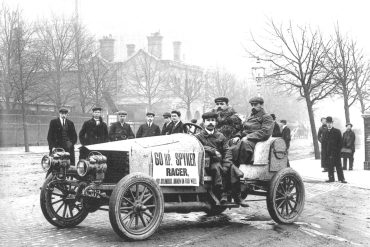
Joseph Laviolette's 1903 Spyker 60 HP was the first car with a six-cylinder engine, four-wheel drive and brakes on all four wheels. Built for Paris–Madrid, it missed the race and was shown in Paris that December.
D. Napier & Son was down to seven employees in 1895 before Montague Napier met Selwyn Edge at the Bath Road Club. Edge's company agreed to buy the firm's entire output; the 1902 30 HP had 6,435cc and 44.5 bhp.
Peugeot's twin-cam, four-valve Henry engines had won the 1912 and 1913 French Grands Prix, so Mercedes answered for 1914 with a single-cam aero-derived four of 4,483cc, steel cylinders welded to an aluminum crankcase, aiming at 3,500 rpm.
Emile Mors, an electrical engineer, built cars whose name a motorphobe MP said implied a licence to kill. Henri Brasier's 7.3-litre racer won Bordeaux-Périgueux-Bordeaux and Paris-Toulouse-Paris in 1900 with Levegh; by 1903 the works turned out two cars a day.
fiat130m
Fiat's 1907 Grand Prix car carried a 16,288cc four whose engine alone weighed over 2,000 pounds, each piston nearly ten, under a formula limiting fuel to 30 liters per 100 km. Its first outing was the Targa Florio, pistols advised.
Beaten at the 1910 Coupe des Voiturettes by Paul Zuccarelli's Hispano-Suiza, Peugeot drivers Boillot and Goux persuaded Robert Peugeot to hire the man who beat them. The result, backed on a lark, was the L76: 112 bhp and 116 mph.
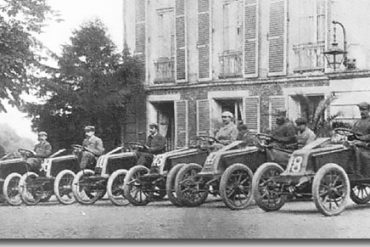
Le Mans, 26–27 June 1906: 32 starters from 12 makers, 12 laps of a 64-mile triangle over two days, 40 miles of barricades and a tunnel. Renault's 12,986cc four made 90 bhp at 1,200 rpm. The first Grand Prix.
Louis Renault, turned away by Panhard et Levassor as an amateur, built his own voiturette behind the family house at Billancourt and at Christmas 1898 drove it up the rue Lepic in Montmartre. He took 12 orders that evening.

Post-War Race Cars (The Pace Increases)

New road racing circuits were being built throughout Europe, riding mechanics were banned and the first World Championship was organized and included the French, Italian and Belgian Grand Prix and the Indianapolis 500. This championship was between manufactures rather than drivers. Alfa Romeo won that inaugural year and celebrated the victory by incorporating a laurel wreath into its badge. It was an era of rapid development and growth. We saw names like Bugatti, Mercedes and Ferrari, as well as the fearsome Silver Arrows from Germany. After 6 years of World War II, most of Europe lay in ruins including much of its automobile industry. Germany was still banned from racing when in September of 1945 the first race meeting were held. World War Two ended in Europe in May 1945 and by September the first postwar meeting was taking place.

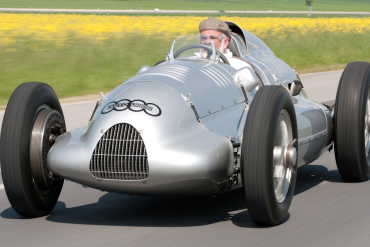
1932_AlfaRomeo_TipoBP31
Jano's P3 of 1932 was the first single-seater in Grand Prix racing: a 2,654 cc straight-eight from two four-cylinder blocks, each with its own Roots blower, twin driveshafts so the driver sat lower. It won first time out.
Auto Union Type D
Auto Union lost Ferdinand Porsche to an unrenewed contract and Bernd Rosemeyer to a record attempt, yet had a new 3-liter V12 car ready in 18 months for 1938, with De Dion rear suspension and old-fashioned friction dampers.
bimotore2
Bazzi and the 30-strong Scuderia Ferrari built the Alfa Romeo Bimotore in under four months in 1935: a lengthened P3 with one straight-eight ahead of the driver and one behind, 540 bhp and twin driveshafts, aimed at Tripoli and Avus.
Auto Union Type C
Laid off by Steyr after the 1929 crash, Ferdinand Porsche set up on his own with Adolf Rosenberger's money and Karl Rabe as chief designer, then in 1932 drew a racing engine with no customer. The 6-litre, 520 bhp V16.
Rudolf Uhlenhaut, 30, took over the Mercedes racing department after Auto Union's 1936 and decided he had to drive the cars himself, soon lapping the Nürburgring close to the drivers' times. The W125: 5,660 cc, 646 bhp, a redesigned chassis.
1923sunbeam4
Coatalen arrived at Sunbeam in 1909, built the Nautilus Brooklands racer within a year, copied a twin-cam Peugeot in 1914 and took a DOHC six to third at Indianapolis in 1916. The 1923 car: 1,988 cc, 102 bhp, 108 mph.
Ettore Bugatti told the press before the 1923 Grand Prix that the closer a car ran to the ground, the less its resistance. His Tank de Tours had a wing-shaped top and a flat floor and made lift at speed.
Wilhelm Kissel, a 38-year-old Benz man, ran Daimler-Benz from an office with room for a desk, chair and file cabinet, and never moved. He set Ferdinand Porsche on the line that ended in the 7-liter, 300 bhp SSKL.
Auto Union showed its P-Wagen in January 1934 and the press called it the German racing car before Daimler-Benz had shown anything. The W25 arrived for the 750 kg formula with a 450,000 Reichsmark subsidy that had to be shared.
Told in 1938 that the Tripoli Grand Prix would be run for 1.5-liter cars to guarantee an Italian win, Mercedes had eight months, not the usual 18, to build one. The 254 bhp W165 V12 was the result.
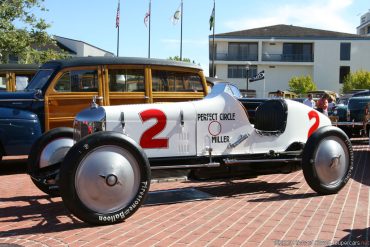
Harry Miller sketched, Leo Goossen drew the dimensions and Fred Offenhauser built them. Between 1922 and 1928, 83 percent of the Indianapolis field ran Miller engines or cars. The supercharged 1.5-litre 91 made 250 bhp at 8,000 rpm.
trop3
Edmund Rumpler, builder of the Taube warplane, showed a teardrop car in Berlin in 1921 that later tested at a drag coefficient of 0.28. Willy Walb talked Benz into a mid-engined Grand Prix version, the 90 hp Tropfenwagen of 1923.
488108
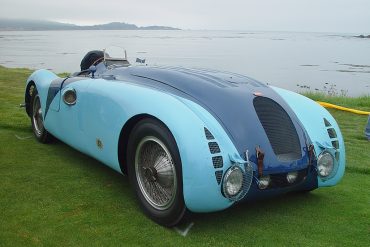
Jean Bugatti persuaded his father that the Type 57 he had designed could become a long-distance racer. The lowered 57S chassis under magnesium-alloy bodywork became the "Tank"; the 1937 Le Mans winner ran supercharged.
1921 Duesenberg Grand Prix
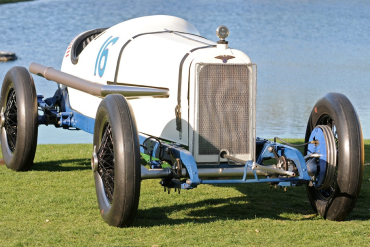
Fred and August Duesenberg built their first cars for Mason in 1907, then Maytag, before setting up alone in St Paul in 1913. The 2,980cc straight-eight 1921 Grand Prix car gave 115 bhp at 4,250 rpm.
The 1939 W163's two-stage supercharged V12 gave about 480 bhp on 86 per cent methanol laced with nitrobenzene, acetone and ether, at two miles per gallon from 105 gallons in two tanks, with mercury-filled exhaust valves.
Fiat 804
Giovanni Agnelli put in $400 in 1898; by 1922 Fiat's technical office under lawyer-turned-engineer Carlo Cavalli held Bazzi, Bertarione, Zerbi and a young Vittorio Jano. The 804 for the new 2-liter formula was their work.
Bugatti Type 35
Ettore Bugatti designed a gold-medal car at 19 and was Deutz's chief engineer by 25. The 1924 Type 35 followed: 1,991cc straight-eight, 135 bhp at 5,300 rpm, 1,433 lb, built on the back of Brescia's 1921 1-2-3-4.
era6
Raymond Mays, Humphrey Cook and Peter Berthon founded ERA at Bourne in November 1933 to restore British racing prestige in the 1.5-liter voiturette class. R2B 'Romulus': Riley-based straight-six, Roots blower, 166 bhp at 6,500 rpm.
1926_Delage_15S81
Louis Delage, born with one eye in Cognac in 1874, left Peugeot's test department to build his own cars in 1905. The 1926 15 S8 made 170 bhp at 8,000 rpm from 1,488cc with a Roots supercharger.
Alfa Romeo P2
Jano joined Alfa Romeo from Fiat in 1923 and the P2 won first time out in 1924: 1,987cc supercharged straight-eight, 155 bhp, more than 139 mph. Mechanic Guidotti swore no drawings left Fiat; the engine looked very like Fiat's Type 805.
361983
Piero Dusio, whose Cisitalia made sportswear, tennis rackets and bicycles, asked Fiat's Dante Giacosa to design a cheap single-seater to get Italy racing again in 1946. The D46: Fiat 1100 engine, 62 bhp, 771 lbs and a spaceframe.
Adolfo Orsi bought Maserati in 1937 and kept three of the brothers on ten-year contracts. Their 1938 8CTF used a fixed cylinder head, hence the name, with two Roots superchargers on a 2,991cc straight-eight for 350 bhp, later 365.
420416
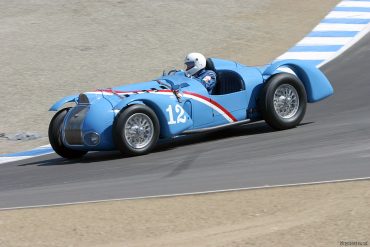
Lucy O'Reilly Schell, an American heiress, bought into Delahaye in 1934 and collected orders from twelve friends to make the 135 Compétition Spéciale happen. The 1937 145 Grand Prix car, a 245 bhp V12, followed with Popular Front encouragement.
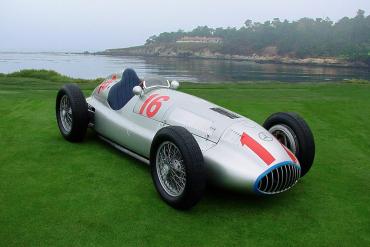
The 1938 Mercedes W154: a 60-degree V12 with 48 valves, twin Roots blowers and nine oil pumps, burning a liter of methyl alcohol, nitrobenzene and acetone every kilometer, with 400 liters aboard and the propshaft running beside the driver.

Formula 1 Race Cars

In 1950 a World Championship for drivers was introduced. The championship would be decided based on the results of seven races: the British, Swiss, Monaco, Belgium, French and Italian Grand Prix and the Indianapolis 500. The era of Formula 1 had begun. The cars that have defined racing since then were largely a result of the rapid change in technology and rules governing the sport. The cars we remember are the ones that pushed the limits and found ways to change the game.

Mercedes F1 W05 Hybrid
Mercedes' 2014 W05 was built around 100 kg of fuel per race and a 100 kg/hour flow limit: a 1.6-liter turbo V6 hybrid giving 800–850 hp and a 30 percent efficiency gain lost in arguments about spectacle. Dennis David's profile.
bt46g
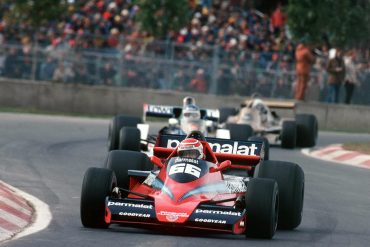
Gordon Murray's 1978 Brabham BT46 carried Alfa Romeo's flat-12, 50 bhp up on a Cosworth DFV but thirstier and 40 kg heavier, and tried to cool it with flat-plate heat exchangers on the bodywork. Dennis David's profile.
Lancia D50
Vincenzo Lancia chose not to race his own cars; his son Gianni commissioned Vittorio Jano's D50 for 1955: a 2,488 cc V8 as a stressed member, offset driveline and pannier fuel tanks between the wheels. Dennis David profiles it.
Connaught-b-2-4737
Rodney Clarke's Connaughts were built to details his rivals at Cooper and HWM never bothered with, which slowed development; he conceived a rear-engined GT in 1950 and a monocoque F1 car in 1955, and never got a competitive engine.
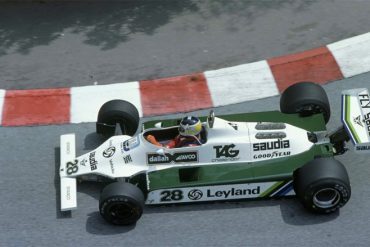
Williams put a model of what it took to be a Lotus 79 in the tunnel and thought the dials had broken: four or five times the downforce of its flat-bottomed car. Dennis David on Patrick Head's FW07B of 1980.
BRM Type 15
Raymond Mays and Peter Berthon persuaded 350 companies to fund a car to beat Italy and Germany: the Type 15, a supercharged 1,496cc V16, 525 bhp at 10,500 rpm. Twelve years of futility ended at East London in 1962.
Porsche's 1962 Formula One car had an air-cooled flat-eight, 1,494cc and 180 bhp at 9,200 rpm, with carburetors and steel wheels while Lotus moved to injection and alloys. Ferry Porsche was skeptical; Dan Gurney was the team's best weapon.
fer375g
The unblown 4.5-litre Talbot-Lagos needed fewer fuel and tyre stops in 1949, so Enzo Ferrari had new chief engineer Aurelio Lampredi build a big V12. The long-block 375 of 1950 gave 350 bhp, 380 at Monza in 1951.
Denis Jenkinson rode his motorcycle to Ken Tyrrell's garden in September 1975, saw the six-wheeler on the lawn and was struck speechless. Derek Gardner's answer to everyone having the same DFV, gearbox and Goodyears: four 10-inch front wheels.
312t1
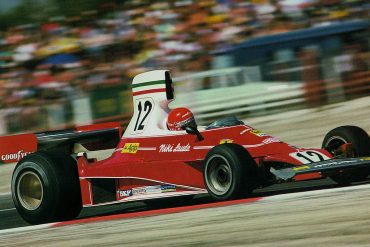
By the end of 1972 Ferrari was buying monocoques from England and the 312B3 managed one win in two seasons. Luca di Montezemolo brought back Forghieri, kept Lauda and ended the sports car program. The transverse-gearbox result arrived in 1975.
A monocoque ran at Indianapolis in 1915 and Voisin raced one in 1923, but Colin Chapman's 1962 Lotus 25, a tub wide enough for Jim Clark with rubber fuel bags in its box sections, changed Grand Prix design for good.
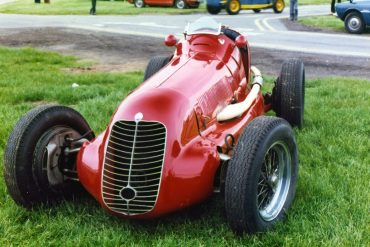
Ernesto Maserati's 4CL arrived in 1939 to take on the Alfa 158 and ERA in voiturette racing, and with Germany absent after the war it had the field to itself in 1947. The twin-supercharged 4CLT of 1948 gave 260 bhp.
The turbine 56B and four-wheel-drive 63 both failed, so the Type 49 soldiered on until Maurice Phillippe's wedge-shaped 72 arrived in 1970. Six seasons, 74 championship races, 20 wins, two drivers' and three constructors' titles followed.
Mercedes returned to Grand Prix racing in 1954 with a desmodromic-valve, fuel-injected straight eight, Uhlenhaut running the department, Neubauer the team and Fangio, Kling and Herrmann driving. The W196 came in three wheelbases, the shortest for Monaco.
Ferrari 500
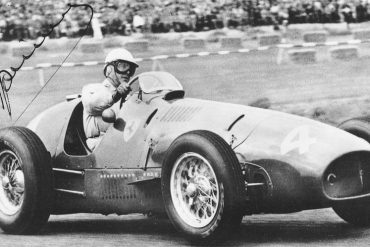
With Alfa Romeo gone and BRM hopeless, the 1952 World Championship was run to Formula 2 rules. Aurelio Lampredi's four-cylinder Tipo 500, 185 bhp in a welded ladder frame, had already won on debut at Modena in late 1951.
brabbt19a
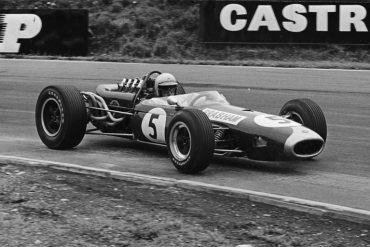
Jack Brabham and Ron Tauranac met the 3-liter formula of 1966 with a spaceframe and a Repco V8 built around an aluminum block Oldsmobile had abandoned. It gave 311 bhp to Ferrari's 360 and was easy to mend.
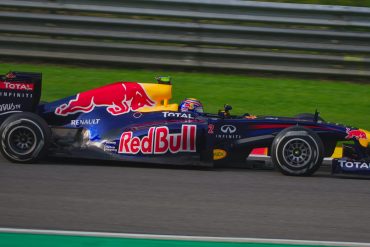
The RB7 of 2011 lost the double diffuser to the rules and got KERS back, which Adrian Newey called the season's big challenge. The blown diffuser he revived in 2010 went back to Renault in the early 1980s.
Gordon Murray's previous design, the low-line Brabham BT55, had failed. His MP4/4 put the drivers almost flat on their backs, cut frontal area by 10 per cent and won 15 of 16 races in 1988. Prost objected at first.
Honda RA273
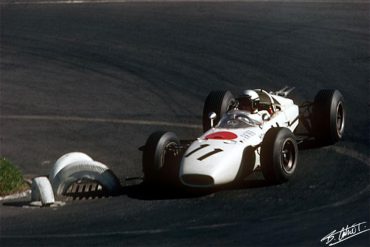
Soichiro Honda won the 1936 All-Japan Speed Rally in a car powered by an 8-litre Curtiss aircraft engine, then nearly died when it crashed. Thirty years later his company was in Formula 1 with the 400 bhp V12 RA273.
Tony Vandervell backed BRM's V16, tired of its committee and bought Ferraris to run as ThinWall Specials instead. The 2,490cc four-cylinder Vanwall of 1957 was where that road led, 285 bhp against the Italian red.
BRM P261
BRM published "Ambassador for Britain: The Story of Britain's Greatest Racing Car" before it had a car, broke both driveshafts on the line before the King in 1950 and drove Tony Vandervell out to found Vanwall. Then the P56.
Renault's 1.5-litre turbo began as the 2-litre iron-block Le Mans engine with a shorter stroke, and stayed the junior project until the A442 won in 1978. The 1979 RS11 brought Arnoux alongside Jabouille and KKK twin turbos.
1959_Cooper_Climax_T51_Goodwood,_2009
Rear engines had been tried in the 1923 Benz Tropfenwagen and the 500 bhp Auto Unions, which only handled once Eberan von Eberhorst fitted a De Dion axle in 1938. Cooper's 240 bhp T51 of 1959 made the idea stick.
Matra would not supply Tyrrell a 1970 chassis without its V12, so Ken Tyrrell bought a March 701 and paid Derek Gardner £22,500 from his own account to design a car in secret at Ockham. Tyrrell 002 was the result.
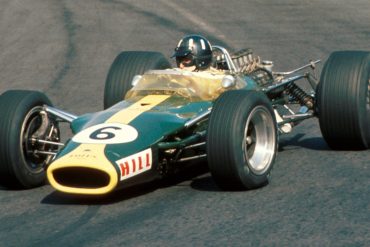
Keith Duckworth put the cost of designing, building and running five Grand Prix engines for a season at £100,000; Walter Hayes sold Ford on it. The Lotus 49 of 1967 hung the result off the back of the monocoque.
Gerlach Delissen
Lord Mosley told his son he would almost certainly go bankrupt but it would be good training. Four founders put in £2,500 each in 1969 and planned cars for F1, F2, F3, Formula Ford and Can-Am at once.
Ken Tyrrell made his fortune in timber for rebuilding bombed Britain, raced 500cc Coopers and hired Jackie Stewart in 1964. The Cosworth-powered Matra MS80 of 1969, drawn by Ducarouge and Boyer at a guided-missile firm, is where that led.
Penske went to Formula One from Poole in 1974 with the PC1 and Mark Donohue, who died after practice at Austria in 1975. The 1976 PC4, Cosworth DFV and 620 kg, was the car that followed with John Watson.
312b3
Mauro Forghieri's flat-12 sat low and left the air clear under the rear wing; a Pirelli coupling between crank and flywheel cured early failures. Ickx won three late 1970 races and lost the title to a broken fuel pipe at Watkins Glen.
Ferrari Dino 246 F1
The 1958 rules cut engines to 2.5 liters and banned alcohol fuel. Jano's 65-degree Dino V6, the first V6 in Formula One, was built for AvGas from the start, made 275 bhp on three Webers and still stopped on drums.
The Maserati brothers sold to Adolfo Orsi but stayed until 1947, having found refuge from the German teams in voiturettes and at Indianapolis, which a 3-liter 8CTF won in 1939 and 1940. The road to the 250F, 2,490cc and 270 bhp.
Ferrari 156
Carlo Chiti's 120-degree V6 was 30 lb lighter than the Coventry-Climax four and sat low enough to go behind the driver. The 1961 Sharknose won five of seven races, with a 1-2-3-4 at Spa, and Phil Hill the title.
Ferrari-F2002-111
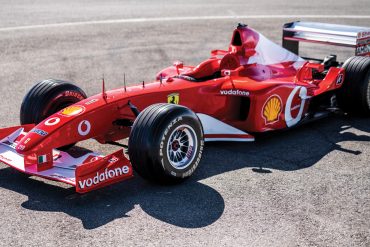
Fifteen wins from nineteen starts across 2002 and 2003. Rory Byrne's chassis, Paolo Martinelli's 835 hp 051 V10 at 17,800 rpm and Ross Brawn in charge; Martinelli explains what was kept from the 050 and what changed.
simon clay
The Williams FW14B of 1992 refined Patrick Head and Adrian Newey's FW14: active suspension perfected, semi-automatic gearbox, traction control, briefly anti-lock brakes, and a Renault V10 thought to hold 30 bhp over anything else on the grid.
Jim Clark crashed the only Lotus 33 while lapping a backmarker at Aintree in April 1964; straightened, it won at Solitude in July. Three retirements later he arrived at Mexico City behind Hill and Surtees with the title still open.
Bernoulli's equation applied to a Formula One car: shape the underside right and low pressure sucks it to the road. Tony Rudd tried it on BRM models in the late 1960s; Lotus made it work with the 78 and 79.
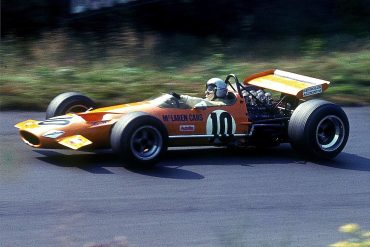
McLaren's first DFV car: Robin Herd drew the M7A around a three-quarter monocoque with the Cosworth as a stressed member, then left for Cosworth before it was finished, leaving Coppuck and Bruce McLaren to complete it. 415 bhp, 1,140 lbs.
Renault's 2006 Formula 1 car: the 2,398cc RS26 V8 giving 775 bhp at 20,500 rpm under the new engine rules, and a mass damper in the nose, a disc between two coil springs in an oil-filled cylinder. Specifications and explanation.
Antonio Lago bought the French branch of the collapsed Sunbeam-Talbot-Darracq combine in 1934. Postwar rules allowing 4.5-liter unblown engines suited his straight-six, which Carlo Marchetti enlarged and fitted with twin-spark ignition in 1948.
Gordon Coppuck borrowed the Lotus 72's chisel nose and side radiators for the M23, filled its deformable structure with foam and built thirteen cars over five and a half years. Fittipaldi's winter testing in 1974 added three inches of wheelbase.
eagle67a
Len Terry, fresh from the Indy-winning Lotus 38, drew the Eagle for Dan Gurney's All American Racers with symmetrical suspension so it could run Indianapolis and Europe. Aubrey Woods's 3-liter Weslake V12 gave 370 bhp at 9,500 rpm.