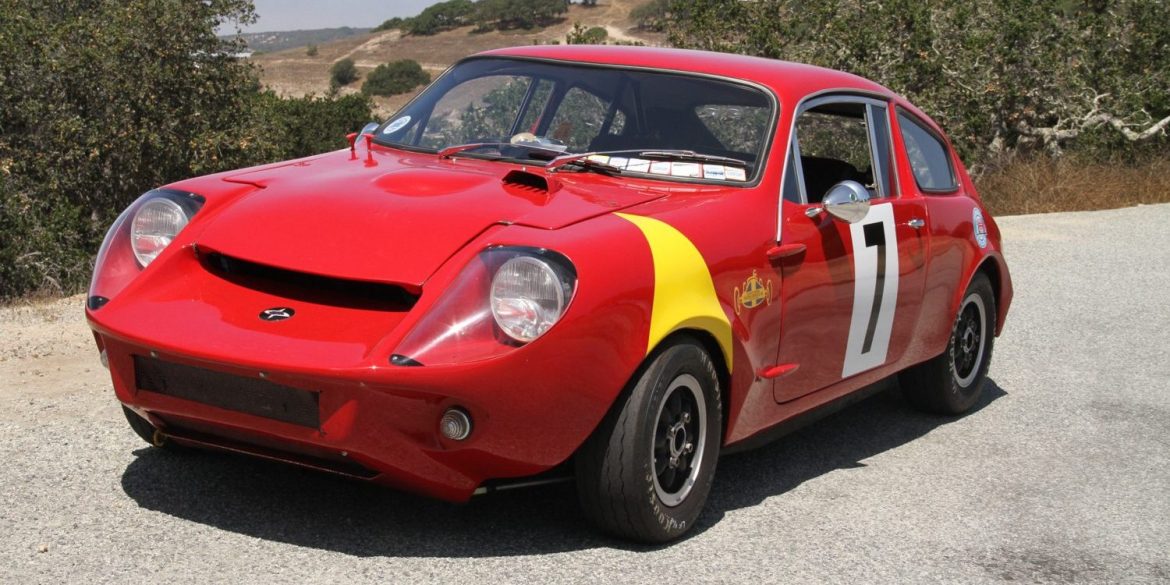
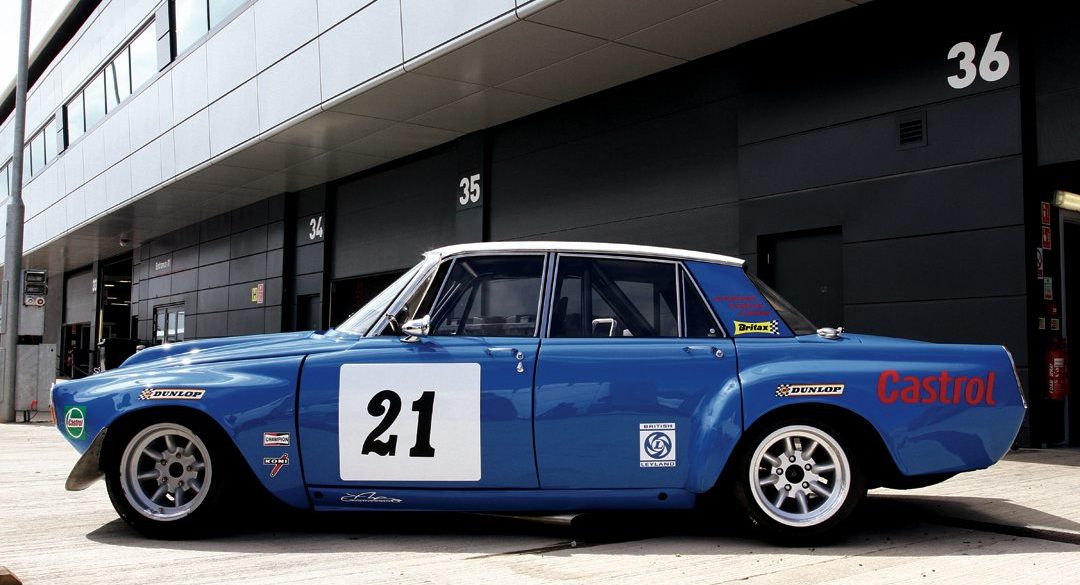
"What is that thing?" asked a Ferrari driver on the Monterey pre-grid. Steve Natale on the Mini Marcos, born of Jem Marsh and Frank Costin's 1959 partnership in North Wales and still racing 50 years on.

For ten seasons, from the first Ford GT40 in 1964 to the last Ferrari 312 PB in 1973, the fastest racing cars in the world were sports-prototypes: closed two-seaters with no production run to apologise for, built by the richest company in the industry, the most famous name in racing and a small firm in Stuttgart that outlasted them both. Ford spent a fortune to beat Ferrari at Le Mans and did it four times; Porsche built twenty-five 917s to satisfy a rule and won everything; Matra brought the era to a close with three Le Mans wins for France. This is the story of the prototype era, and every linked piece is a source.
The pieces to start with
Dixon's Route to '66, the 330 P4, Galanos on Daytona 1967 and 1970, Pace on the 917K, McDonough's Alfa 33/2, Forghieri in his own words and Annis's Sebring 910.
Ford won at Le Mans in 2016 fifty years after its first victory, and Raj Nair admitted corporate approval came late. The same layers nearly sank the original program, born when Enzo Ferrari walked away from Ford's 1963 takeover talks.
Ford's 1-2-3 at Le Mans in 1966 ended Ferrari's run, so Enzo sent his engineers back to the 330 P3. The P4 looked almost the same outside. The story starts with Ford's bid to buy Ferrari outright.
Ford beat Ferrari 1-2-3 at Daytona and Sebring in 1966 and took Le Mans too; Stirling Moss called it sad to see a true racing manufacturer beaten by a marketing decision. Louis Galanos on how Maranello answered in February 1967.
The FIA's 3-liter limit for 1968 was meant to suit Porsche, whose 2-liter 906s had followed the Fords home at Le Mans in 1966. Harold Pace on how the 917 came out of it, and the obstacle inside Porsche.
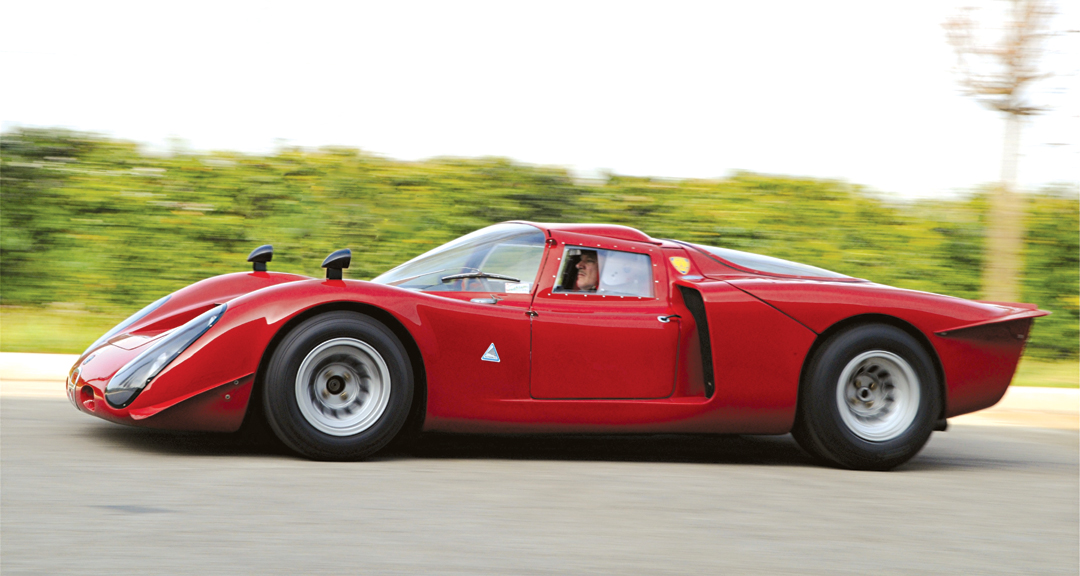
Ed McDonough watched chassis 75033.018 finish fifth at Le Mans in 1968 from Mike Salmon's signalling post at Mulsanne; it was the first Alfa model he built. Last year he raced the same car and talked to Mario Casoni.
Porsche had a ten-month head start on Ferrari with the 917, yet its own drivers refused the car as unstable and preferred the 908, until John Wyer's team sorted it. Louis Galanos on the first meeting of 917 and 512.
For 1970 Mauro Forghieri wanted a four-wheel-drive Ferrari, a hydraulic joint passing excess torque forward when the rears spun. Enzo Ferrari liked it; Forghieri talked him out of it to get the flat-12 312 B racing sooner. Robert Newman continues.
Porsche needed almost 20 years to win Le Mans outright, yet Casey Annis dates the turning point to 1963, when Butzi Porsche drew the 904 and his cousin Ferdinand Piëch joined the firm. The background to a 1967 Sebring 910.
The newest long-form writing on the prototype era, as it is published.
Sports-prototypes had existed since the 1950s, when the FIA allowed a manufacturer to race a car it intended to build before anybody had bought one, but until 1966 they were an annex to the grand touring championship: the GT cars scored the points, the prototypes won the races. In 1966 the FIA turned that around with the International Championship for Sports Prototypes, and in 1968, alarmed by seven-litre Fords and four-litre Ferraris doing 210 mph on the Mulsanne, it cut the prototypes to three litres and admitted five-litre "sports cars" provided fifty, later twenty-five, had been built. Porsche took the invitation literally and built the 917; Ferrari answered with the 512. For 1972 the five-litre cars were gone and the three-litre prototypes raced alone until the oil crisis and the Group 5 silhouette rules of 1976 ended the era. The GT cars that came before are on The GT Wars page; the Group C cars that followed are on Turbos and Group C. The races themselves — Le Mans, Sebring and the Targa Florio — each have a page of their own.
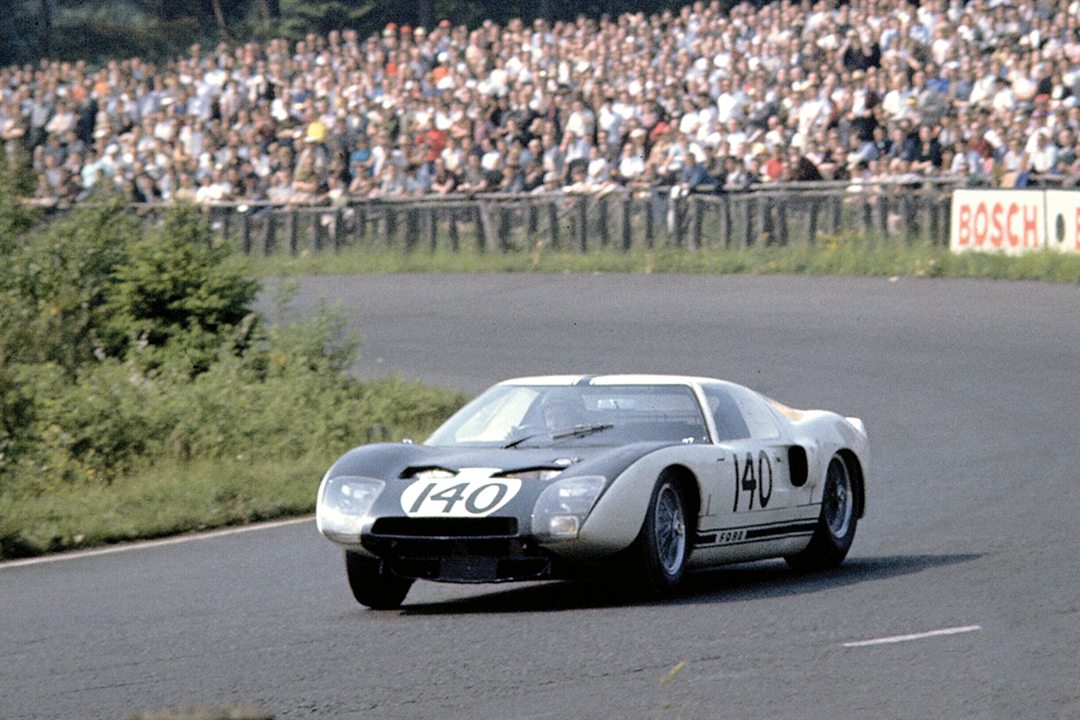
In May 1963 Henry Ford II's negotiators were in Maranello with a contract to buy Ferrari, and Enzo Ferrari, having read the clause that gave Detroit control of the racing team, walked out. Ford's response was to build a car to beat him. Roy Lunn's team bought Eric Broadley's mid-engined Lola GT as a starting point, set up Ford Advanced Vehicles at Slough under John Wyer, who had run Aston Martin's winning team in 1959, and in May 1964 the GT40 — forty inches high, 4.2-litre Fairlane V8 behind the driver — ran its first race at the Nürburgring 1000 Kilometres with Phil Hill and Bruce McLaren. It retired. All three retired at Le Mans in June, where Jean Guichet and Nino Vaccarella won in a Ferrari 275 P, the only chassis to win the race twice. Roger Dixon's two-part Route to '66 tells the story of that first miserable season and of the decision, at the end of it, to hand the cars to Carroll Shelby in California. Shelby American's engineers, Phil Remington, Ken Miles and Carroll Smith among them, sorted the car over the winter, and Miles and Lloyd Ruby gave the GT40 its first win in the Daytona 2000 Kilometres in February 1965. Le Mans 1965 was another rout, all six Fords out before dawn, the race won by Masten Gregory and Jochen Rindt in Luigi Chinetti's Ferrari 250 LM; Casey Annis tells the story in "Ford vs. Ferrari" the Sequel. But two of the cars that failed were the new Mk II, with the seven-litre NASCAR 427 in place of the small-block, and Ford had seen enough to know what would come next.
Ferrari had put the engine behind the driver in a sports car in 1961, and by 1963 the 250 P had won Le Mans and the Nürburgring. The 275 P and 330 P of 1964, the 275 P2 and 330 P2 of 1965 with Mauro Forghieri's new four-cam heads, and the 330 P3 of 1966 with Lucas fuel injection were the cars that kept Ford waiting; Robert Newman's two-part Ferrari, According to Forghieri is the engineer's own account of those years, and the archive's Forghieri profile covers the whole career. Alongside the works prototypes ran the 250 LM, the closed version of the 250 P that Ferrari tried to homologate as a GT car, failed, and raced as a prototype instead: it won Le Mans in 1965 and was still finishing in the top ten in 1968. The works team of the mid-1960s — John Surtees, Lorenzo Bandini, Ludovico Scarfiotti, Mike Parkes, Vaccarella — won the Nürburgring 1000 Kilometres in 1964 and 1965, the Targa Florio in 1965 and Monza and Spa in 1966, and the archive profiles Bandini, Scarfiotti and Surtees.
Ford went to Le Mans in June 1966 with eight Mk IIs, three run by Shelby American, three by Holman & Moody and two by Alan Mann Racing, after the Mk II had already won the first twenty-four-hour race at Daytona and the Sebring 12 Hours, both with Miles and Ruby. Ferrari brought the 330 P3s for Bandini and Guichet, Scarfiotti and Parkes, and a third P3 for Luigi Chinetti's Pedro Rodriguez and Richie Ginther. By dawn all the works Ferraris were out and the Fords were running 1-2-3. What followed is the most argued-over finish in the history of the race: Ford wanted a side-by-side photograph, Miles, who had won Daytona and Sebring and was leading, slowed to allow Bruce McLaren and Denny Hulme alongside, and the organisers ruled that McLaren and Chris Amon, who had started further back on the grid, had covered the greater distance and won. Ronnie Bucknum and Dick Hutcherson were third. Arthur Schening's 1966 24 Hours of Le Mans and the second part of Route to '66 cover the race, and the archive has Ken Miles, who was killed two months later testing the J-car at Riverside, remembered and revisited. Ford won the first prototype championship; Porsche's 906 won the Targa Florio and the two-litre class everywhere, and Jim Hall's Chaparral 2D won the Nürburgring for Phil Hill and Jo Bonnier.
The champion make and the winners of the four races that mattered most, 1964 to 1973.
| Year | Champion | Le Mans | Daytona | Sebring | Targa Florio | What happened |
|---|---|---|---|---|---|---|
| 1964 | Ferrari | Ferrari 275 P · Guichet / Vaccarella | Ferrari 250 GTO · Rodriguez / Hill | Ferrari 275 P · Parkes / Maglioli | Porsche 904 · Pucci / Davis | The GT40 races for the first time at the Nürburgring in May and retires everywhere; Ferrari's 275 P wins Le Mans |
| 1965 | Ferrari | Ferrari 250 LM · Gregory / Rindt | Ford GT40 · Miles / Ruby | Chaparral 2A · Hall / Sharp | Ferrari 275 P2 · Vaccarella / Bandini | Shelby takes over the Fords and Miles wins Daytona; Le Mans goes to Chinetti's 250 LM and the seven-litre Mk II appears |
| 1966 | Ford | Ford GT40 Mk II · McLaren / Amon | Ford Mk II · Miles / Ruby | Ford X-1 · Miles / Ruby | Porsche 906 · Mairesse / Müller | Daytona becomes a 24-hour race; Ford finishes 1-2-3 there and at Le Mans; the first prototype championship is Ford's; Miles is killed in August |
| 1967 | Ferrari | Ford Mk IV · Gurney / Foyt | Ferrari 330 P4 · Bandini / Amon | Ford Mk IV · McLaren / Andretti | Porsche 910 · Hawkins / Stommelen | Ferrari's P4s 1-2-3 at Daytona; Ford's Mk IV wins Sebring and Le Mans at 135 mph; the three-litre rule is announced in October |
| 1968 | Ford | Ford GT40 · Rodriguez / Bianchi | Porsche 907 · Elford / Neerpasch / Stommelen / Siffert / Herrmann | Porsche 907 · Siffert / Herrmann | Porsche 907 · Elford / Maglioli | Ford and Chaparral go home, Ferrari sits out; Porsche's 907 and Wyer's Gulf GT40s share the season; Le Mans is run in September |
| 1969 | Porsche | Ford GT40 · Ickx / Oliver | Lola T70 Mk3B · Donohue / Parsons | Ford GT40 · Ickx / Oliver | Porsche 908/2 · Mitter / Schütz | The 917 is shown at Geneva and homologated in April; Ickx beats Herrmann by 120 metres at Le Mans; Porsche's first title |
| 1970 | Porsche | Porsche 917K · Herrmann / Attwood | Porsche 917K · Rodriguez / Kinnunen | Ferrari 512 S · Andretti / Giunti / Vaccarella | Porsche 908/3 · Siffert / Redman | Gulf and Salzburg run the 917K, Ferrari the 512 S; Porsche wins nine of ten and its first Le Mans; McQueen films the race |
| 1971 | Porsche | Porsche 917K · Marko / van Lennep | Porsche 917K · Rodriguez / Oliver | Porsche 917K · Elford / Larrousse | Alfa Romeo Tipo 33/3 · Vaccarella / Hezemans | Martini replaces Salzburg; Spa at 154.8 mph, Le Mans at 138 mph; Rodriguez and Siffert are killed; the five-litre cars are banned |
| 1972 | Ferrari | Matra MS670 · Pescarolo / G. Hill | Ferrari 312 PB · Andretti / Ickx (6 hours) | Ferrari 312 PB · Andretti / Ickx | Ferrari 312 PB · Merzario / Munari | Ferrari's 312 PB wins all ten rounds it enters and skips Le Mans, which Matra wins; Graham Hill completes the triple crown |
| 1973 | Matra | Matra MS670B · Pescarolo / Larrousse | Porsche Carrera RSR · Gregg / Haywood | Porsche Carrera RSR · Gregg / Haywood / Helmick | Porsche Carrera RSR · Müller / van Lennep | Matra beats Ferrari to the title and wins Le Mans again; Ferrari closes its sports-car department at the end of the year |
Car names link to every story on the site about that car. Daytona was a 2000 km race in 1964–65, 24 hours from 1966 and six hours in 1972; the 1964 and 1965 champions are the makers' prototype trophy.
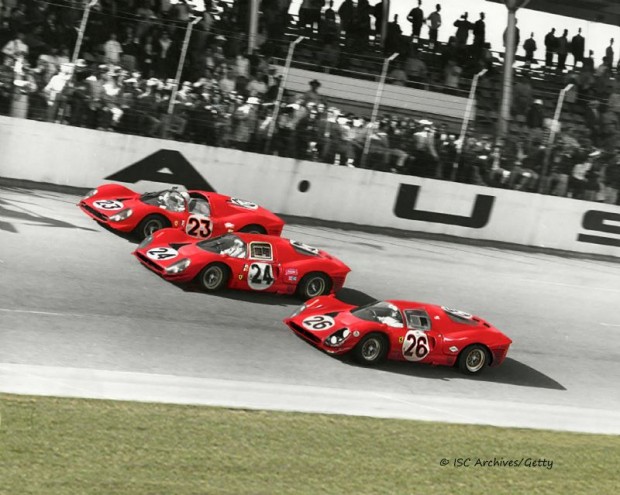
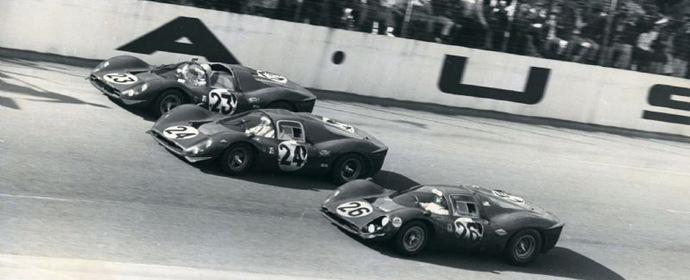
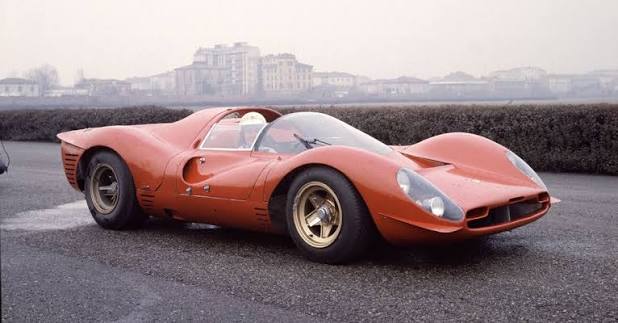
Ferrari's answer to Le Mans 1966 was the 330 P4, Forghieri's four-litre V12 with three-valve heads and 450 horsepower in a car that is still, by common consent, the most beautiful sports-racer ever built. Three were made, plus a P3 brought up to the specification, and in February 1967 they finished 1-2-3 at Daytona, Bandini and Amon leading Parkes and Scarfiotti across the line side by side in a deliberate echo of Le Mans; the archive's 1967 Daytona 24 Hours race profile runs to nine thousand words and the P4 profile tells the car's story. Ford's answer to the answer was the Mk IV, Lunn's honeycomb-aluminium J-car chassis with a new body and the 427, which won Sebring on its debut for McLaren and Mario Andretti. At Le Mans in June Dan Gurney and A. J. Foyt — a pairing the press expected to break the car — drove it steadily for twenty-four hours and won by four laps from the P4 of Scarfiotti and Parkes, covering 3,251 miles at 135.5 mph, a distance no one bettered until 1971. On the podium Gurney shook the magnum and sprayed the crowd, and a tradition was born. Jim Hall's winged Chaparral 2F led the race and retired, as it did everywhere except Brands Hatch, where Phil Hill and Mike Spence won the BOAC 500 in it; Karl Ludvigsen's piece on the 2E explains where the wing came from. Ferrari took the championship by two points from Porsche, whose 910s had won the Targa Florio and the Nürburgring; Casey Annis's Sebring Climber follows one 910 through that season.
In October 1967 the CSI announced that from 1968 prototypes would be limited to three litres, and that five-litre cars would be admitted only if fifty had been built. Ford and Chaparral went home; Ferrari, furious, sat out 1968. The championship fell to Porsche's 907 and 908 and to John Wyer's Gulf-sponsored GT40s, which qualified as five-litre sports cars because more than fifty had been made. Porsche finished 1-2-3 at Daytona in February 1968 and won Sebring, the Targa Florio, where Vic Elford lost eighteen minutes changing a wheel and still won, and the Nürburgring; Wyer's team, with Jacky Ickx and Brian Redman, won Brands Hatch, Monza, Spa and Watkins Glen, and in September, at a Le Mans postponed by the events of May, Rodriguez and Lucien Bianchi won in GT40 chassis 1075. Ed McDonough's Daytona Rising follows Alfa Romeo's new Tipo 33/2, fifth, sixth and seventh at Daytona and the class winner everywhere, and Michael Oliver's The Jet Set covers the turbine cars, the Howmet TX that ran against them among them. In 1969 the 908 was almost unbeatable — Jo Siffert and Redman won Brands Hatch, Monza, Spa and the Nürburgring — but at Le Mans Ickx, who had walked to his car in protest at the running start that would be abolished the next year, took 1075 to its second win, beating Hans Herrmann's 908 by about a hundred and twenty metres after four hours of wheel-to-wheel racing. Porsche won the title anyway; its first, and the price of it was already sitting in the paddock. Ferrari had come back with the three-litre 312 P, second at Sebring for Amon and Andretti, and the archive has Ickx, Redman, Herrmann and Elford.
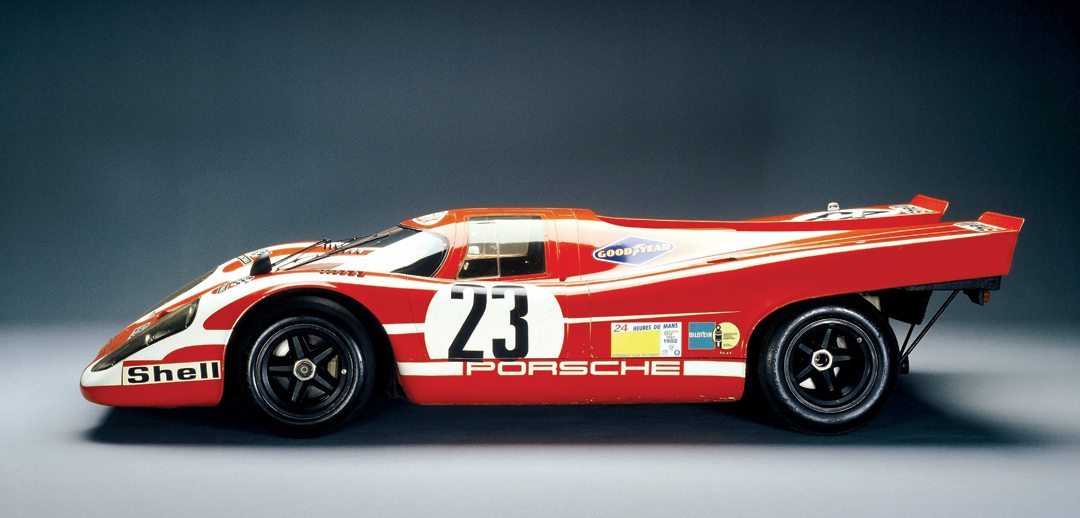
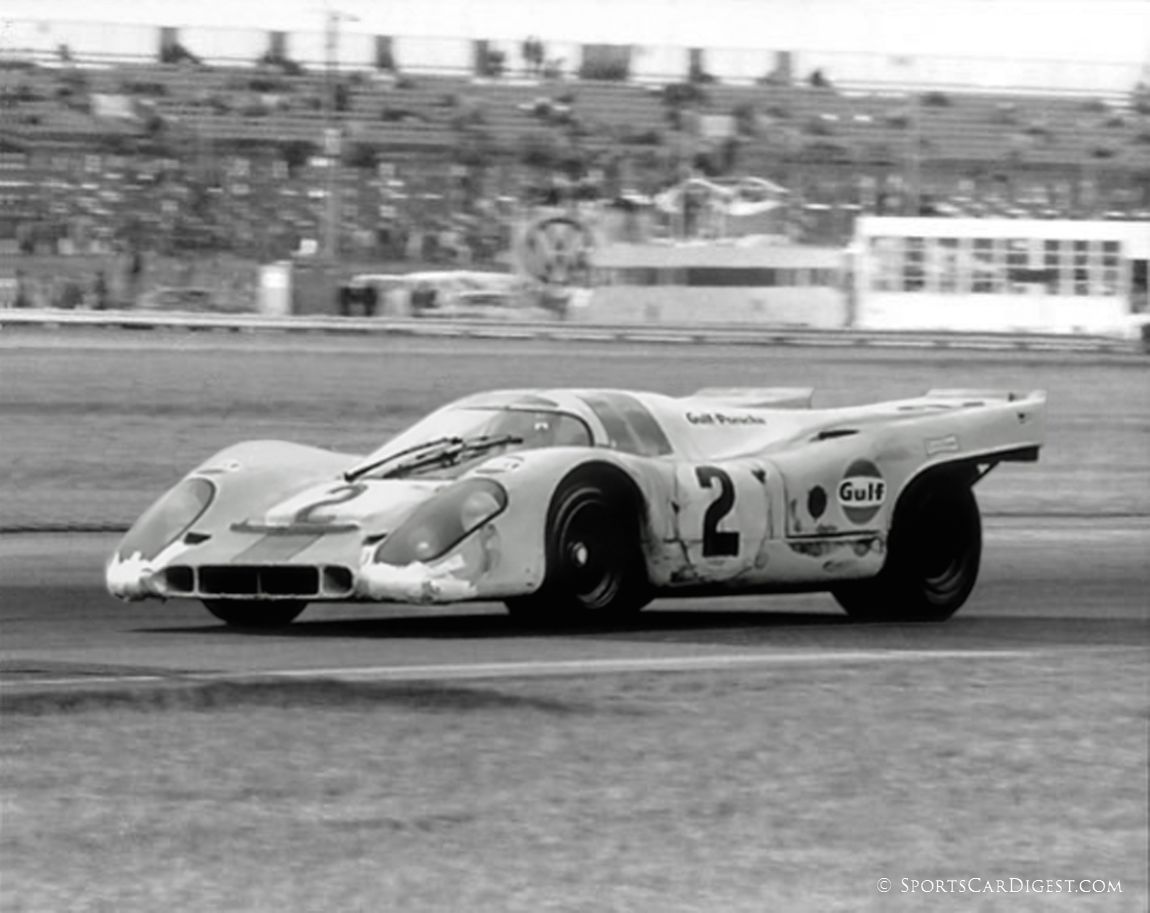
In April 1968 the CSI cut the sports-car minimum to twenty-five cars, and Ferdinand Piëch decided Porsche would build them. The 917, shown at Geneva in March 1969 with Hans Mezger's air-cooled 4.5-litre flat-twelve, 560 horsepower and a spaceframe that weighed ninety-three pounds, was lined up twenty-five strong in the Zuffenhausen courtyard for the inspectors on April 20th, and nobody at Porsche knew how to make it go round corners. It killed John Woolfe on the first lap at Le Mans in 1969, it won its first race at Zeltweg that August, and in October, at a test at the same circuit, John Wyer's engineer John Horsman taped a new short tail onto it and the 917K was born; Harold Pace's The Le Mans Breakthrough and the archive's history of chassis 004/017 tell the story. Ferrari built its twenty-five 512 S for 1970 — five-litre V12, 550 horsepower, coupé and spyder — and Enzo sold most of them to privateers to pay for the works cars. The 512 won Sebring in 1970, when Andretti, Ignazio Giunti and Vaccarella beat the Porsche 908 of Peter Revson and Steve McQueen by twenty-three seconds, and it won nothing else of consequence; the 917 won the rest, and Roger Penske's Sunoco 512M of 1971, driven by Mark Donohue and David Hobbs, was the only Ferrari that could stay with it. The archive has McQueen and the 917, Donohue and Hobbs.
Each links to every story on the site about that car; the model pages come next.
Porsche never ran the 917 itself. For 1970 the works cars went to Wyer's JW Automotive in Gulf's pale blue and orange, with Siffert and Redman, Rodriguez and Leo Kinnunen, and to Porsche Salzburg, the Piëch family's Austrian distributor, with Elford, Kurt Ahrens, Herrmann and Richard Attwood. Rodriguez's drive through the rain at Brands Hatch in April 1970, lapping the field, is the one everybody remembers; Siffert and Redman won Spa at 149 mph; the 908/3, built for the Targa Florio and the Nürburgring where the 917 could not go, won both. At Le Mans the Gulf cars broke and the Salzburg 917K of Herrmann and Attwood won Porsche's first Le Mans, with the Martini 917 Langheck of Gérard Larrousse and Willi Kauhsen second; the archive has Attwood, Herrmann interviewed, The 1970 Le Mans Race in paintings and Lou Galanos's 1970 Daytona 24 Hours race profile, where the era's greatest driver won his first race in the car. Porsche won nine of the ten rounds. In 1971 Martini took over from Salzburg, Rodriguez and Jackie Oliver won Daytona, Monza and Spa, the last at 154.8 mph, the fastest road race ever run, and Helmut Marko and Gijs van Lennep won Le Mans in a Martini 917K at 138.1 mph, 3,315 miles, a record that stood for thirty-nine years. Pedro Rodriguez was killed at the Norisring in July 1971 in a Ferrari 512M, Siffert at Brands Hatch in October in a BRM, and the five-litre cars were banned at the end of the year; Siffert and the 1971 Martini 917LH are in the archive, and the 1971 Sebring race profile and Elford at Sebring '71 cover the Martini team's American win.
The championship of the prototype era ran to ten or eleven rounds a year, and the archive covers most of them. Daytona's twenty-four-hour race began in 1966 for the Fords and the archive has Lou Galanos's long race profiles for 1967, 1969, when Penske's Lola T70 beat the Porsches, 1970, 1971 and 1973, plus his 1972 six-hour. Sebring, the second American round, is profiled for 1965, when the rains came and Chaparral won, 1966, 1967, 1970 and 1971, and the Sebring page has the rest. The Targa Florio, forty-five miles of Sicilian road, belonged to Porsche from 1966 to 1970 and to the small cars built for it — the 906, 910, 907, 908/2 and the 908/3 that Ed McDonough drove for Ring Wraith — until Alfa Romeo's 33/3 won in 1971 and Ferrari's 312 PB in 1972; the Targa Florio page has the winners and Targa Tipo the Alfa. The Nürburgring 1000 Kilometres went to Porsche five years running from 1967 and to Ferrari in 1972 and 1973; the archive has the 1970 race and the 1971 Spa 1000 Kilometres in pictures, and the 1967 BOAC 500, the Chaparral's day. Monza, Spa, Brands Hatch, Watkins Glen and Zeltweg filled the calendar, and from 1970 the Buenos Aires 1000 Kilometres opened it.
Race profiles and racing stories from the prototype era, newest first.
The GT40 was built in a hundred or so examples in Mk I, Mk II and Mk III form, with a dozen J-car chassis, the Mk IVs among them, on top; the archive has the design evolution, a 1965 Mk I and a recreated Mk IV. Ferrari built the P cars in handfuls — four P4s, two 412 Ps for customers, one of which is profiled here — and twenty-five 512 S, most converted to 512 M. Porsche built the 906 in sixty-five, the 910 in about thirty, the 907 in about twenty, the 908 in about thirty in long-tail, short-tail, spyder and 908/3 form, and the 917 in sixty-five chassis of every kind: K, LH, the Pink Pig 917/20 that was anything but, and the Can-Am spyders. Lola's T70, the privateers' car, is in the archive as Mike Jiggle's Free Spirit, Casey Annis's Sun Rise and the Greatest Racecar? series; Alfa Romeo's Tipo 33 as Tipo 33 and the 1968 Daytona car; Ford's Gulf-sponsored Mirage as J. Michael Hemsley's Abandoned Potential on the M2-BRM and McDonough's Magnificent Mirage on the M6. The small prototypes that filled the grids — Chevron's B8, Lola's T290, the Austin-Healey Sprite prototype that ran at Le Mans in 1968, the L-88 Corvette that did the same — have their own stories. Every car named here links to its tag archive in the table and cards below, and the model pages come next.
Single-car stories: GT40s, P cars, 906s to 917s, T70s, Tipo 33s, 512s, 312 PBs and Matras.
The era belongs to its drivers. Pedro Rodriguez, the Mexican who won Le Mans in 1968 and became the 917's master in the wet, is photographed at the 1967 French Grand Prix; Jo Siffert, the Swiss garage-owner's son who shared the winning Porsche at Daytona in 1968, won Sebring and the Nürburgring that year and partnered Redman through 1969 and 1970, is profiled; Jacky Ickx, who won Le Mans in 1969 and would win it five more times, is here; Vic Elford, the only man to win the Monte Carlo Rally, the Daytona 24 Hours and the Targa Florio in the same year, is remembered; Brian Redman gave the magazine a long interview in two parts, as did David Hobbs, Richard Attwood, Hans Herrmann and Dan Gurney. Bruce McLaren, Chris Amon, Mark Donohue, Jo Bonnier, killed at Le Mans in 1972, and Nino Vaccarella, the Sicilian schoolmaster who won his Targa three times, are all here. Behind them stood the engineers and the team owners: Forghieri at Ferrari, Hans Mezger and Ferdinand Piëch at Porsche, Carroll Shelby, whose Shelby American story covers the Ford years, Jim Hall of Chaparral, honoured by the RRDC, Luigi Chinetti, whose NART Ferraris were at Le Mans every year of the era and still there in 1973, and John Wyer, who won Le Mans with Aston Martin and Ford, ran Porsche's works 917s, and whose Gulf colours are the era's.
Drivers, engineers and team owners of the prototype years.
With the five-litre cars gone, 1972 belonged to Ferrari. The 312 PB, a flat-twelve Formula One engine in a spyder weighing 650 kilograms, won all ten rounds it entered — Ickx and Andretti, Clay Regazzoni and Redman, Ronnie Peterson and Tim Schenken, Arturo Merzario and Sandro Munari on the Targa — and Ferrari skipped Le Mans rather than risk the engine for twenty-four hours. Matra, who had been building sports-prototypes since 1966 and had never won anything with them, went to Le Mans with four MS670s and won it with Henri Pescarolo and Graham Hill, who became the first man to win the Monaco Grand Prix, the Indianapolis 500 and Le Mans; Pescarolo's own Greatest Racecar? is about the car, and Ickx's 312 PB test about the other. In 1973 the two met head-on. Ferrari won Monza and the Nürburgring, Matra won Vallelunga, Dijon, Le Mans again with Pescarolo and Larrousse, the Österreichring and Watkins Glen, and took the title; Porsche's Carrera RSR, a GT car, won Daytona and the Targa Florio when the prototypes broke, and Ed McDonough's Rennmeister and Targa Tourer cover it. Enzo Ferrari closed his sports-car department at the end of the year to concentrate on Formula One, and never raced a works prototype again. Matra won once more in 1974, Alfa Romeo in 1975, and then the oil crisis and the Group 5 silhouette rules of 1976 pushed the three-litre prototype to the margins. Casey Annis's A Long Tail of Evolution traces what the changes of the late 1960s did to Le Mans, and Porsche at Le Mans, 1969 to 1973 the five years that made Porsche the race's great name.
Ford's Mk IV covered 3,251 miles at Le Mans in 1967, a record that stood for four years; Porsche's 917K covered 3,315 miles in 1971, 138.1 mph for twenty-four hours, a record that stood until 2010. A 917 LH was timed at 240 mph on the Mulsanne in 1971. Rodriguez and Oliver's 1971 Spa 1000 Kilometres averaged 154.8 mph, which remains the fastest road race in the history of the championship, and Siffert's fastest lap there was over 162 mph. The 917 won fifteen of the twenty championship rounds of 1970 and 1971 and Le Mans twice; the Ferrari 312 PB won ten of ten in 1972; the GT40 won Le Mans four years running, 1966 to 1969, the last two with the same chassis, 1075. Ford's programme cost, by the most-quoted estimate, something over 25 million dollars; a 917 sold, new, for 140,000 Deutschmarks. The twenty-five 917s inspected on April 20th 1969 became sixty-five chassis by 1973, and the 1,100-horsepower 917/30 of that year, the last of them, is the most powerful sports-racer ever to win a championship. Three drivers who won Le Mans in the era were killed in it — Bianchi in 1969, Rodriguez and Siffert in 1971 — and the organisers abolished the running start after 1969 because of what Ickx had done to protest it.
Short answers, with the long ones above.
Racing sports cars with no minimum production: a manufacturer could build one and race it. From 1966 they had their own world championship, from 1968 they were limited to three litres, and from 1972 the three-litre prototypes raced alone.
To beat Ferrari at Le Mans, after Enzo Ferrari walked out of the sale of his company to Ford in May 1963. Ford won Le Mans in 1966, 1967, 1968 and 1969.
Bruce McLaren and Chris Amon in a Ford GT40 Mk II, after Ken Miles, who was leading, slowed for a staged side-by-side finish and lost the race on a technicality.
A 4.5-, later 4.9- and five-litre, flat-twelve sports car of which Porsche built twenty-five in 1969 to qualify under the FIA's sports-car rules. It won Le Mans in 1970 and 1971 and the world championship both years.
Speed. The 917 and the Ferrari 512 were lapping Le Mans at over 150 mph and reaching 240 mph on the straight, and the FIA limited the championship to three-litre prototypes from 1972.
The 275 P and 330 P2 in 1964 and 1965, the 330 P3 in 1966 and the 330 P4 in 1967. Ferrari then withdrew for 1968 and returned with the three-litre 312 P in 1969 and the five-litre 512 S in 1970.
Ferrari in 1964, 1965, 1967 and 1972; Ford in 1966 and 1968; Porsche in 1969, 1970 and 1971; Matra in 1973.
Around a hundred across the Mk I, Mk II and Mk III, plus a dozen J-car chassis that include the Mk IVs. Chassis 1075 won Le Mans twice, in 1968 and 1969.
The whole thread, newest first.