In 1926 Italy had 170,000 cars, roads of compacted earth, and Milan and Turin had only just agreed to drive on the right. Robert Newman on the four men from Brescia who invented the Mille Miglia that year.
The Mille Miglia Race
The Greatest Drivers, Cars, Races & More
The Mille Miglia was an open-road, motorsport endurance race established in 1927 by the young Counts Francesco Mazzotti and Aymo Maggi, which took place in Italy twenty-four times from 1927 to 1957 (thirteen before World War II, eleven from 1947). The Mille Miglia roared into life in 1927, when Counts Aymo Maggi and Franco Mazzotti — with a little help from sports manager Renzo Castagneto, motoring journalist Giovanni Canestrini and a host of wealthy investors — held the first of their nationwide figure-of-eight endurance races. The course sped from Brescia to Rome and back, with 77 all-Italian competitors racing to cover just over 1,000 miles in the fastest time. Since 1977, the "Mille Miglia" has been reborn as a regularity race for classic and vintage cars. Participation is limited to cars, produced no later than 1957, which had attended (or were registered to) the original race. The route (Brescia–Rome round trip) is similar to that of the original race, maintaining the point of departure/arrival in Viale Venezia in Brescia. It is now known as the 1000 Miglia.

Mille Miglia
The most beautiful race in the world
Mille Miglia - The Races
An in-depth review of the early years of the Mille Miglia races. Year by year coverage including race winners and all the important moments.
Stirling Moss did not take Denis Jenkinson in 1955 for publicity; he wanted a passenger with proven nerve. Jenks had been 1949 world sidecar co-champion. Pete Lyons on the writer whose account shaped how everyone feels about the Mille Miglia.
Ed McDonough can date the moment racing entered his life: a three-month-old Motor Trend account of the 1953 Mille Miglia, Fangio driving the last 200 miles of his Alfa Disco Volante with one wheel steering. He ran the race himself.
The Mille Miglia Storica's organizers named Vintage Racecar Journal "Historic Racing Magazine of the Mille Miglia", so Casey Annis gives the May issue to Brescia: Pete Lyons on Denis Jenkinson, Tim Considine on John Fitch, and the race's history.
Robert Newman puts questions to Aymo Maggi, Enzo Ferrari, Nuvolari, Biondetti, Fangio, Moss, Ascari and Federico Fellini, and answers them with the men's own recorded words. A Mille Miglia interview spanning 1926 to the last fatal race of 1957.
Egyptologists have it easy, says Ed McDonough; try deciding which car won the 1950 Mille Miglia. The story of Ferrari 195S chassis 0060M, the muddled 166/195 model line, and why historians now hesitate to print details of early Ferraris.
Alfredo Brioschi bought chassis 412006 "new" on 4 December 1936, a month after it sat on Alfa's Paris Show stand. He did not know it already had hard miles on it. Ed McDonough untangles four or five lives.
525 races, five wheels off, seven or eight brake failures, steering sheared twice. Stirling Moss still picks the 1955 Mille Miglia as his best: start time 7:22 am, hence number 722, and perhaps 60 competent drivers among 700-odd entries.
Brescia's answer to losing the Italian Grand Prix to Monza: Count Aymo Maggi, Giovanni Canestrini, Franco Mazzotti and Renzo Castagneto devise a 1,000-mile race on open roads. Dennis David's history of the event Enzo Ferrari said created the GT car.
Four days on the Mille Miglia, 15–18 May 2008, between Rome and Brescia and back on the roads of the Italian retrospective. Event gallery from the August 2008 issue of the magazine.
BMW and the Mille Miglia are united by a shared history that goes back a long way. The triumphs of the BMW 328 are as inseparably linked with this 1,000-mile race as the winning appearance of the BMW…
Brescia to Rome and back, 13–17 May 2009: the Brescia Auto Club's Mille Miglia, five days of historic cars on the roads of the original race, covered in a photo report from the route.
BMW has a long and distinguished history at the Mille Miglia, culminating in 1940 when Fritz Huschke von Hanstein and Walter Bäumer drove to a historic victory in their BMW 328 Mille Miglia Coupé with a Touring body.
Fangio finished fifth in the 1956 Mille Miglia in a works Ferrari 290MM, slowed by carburetion trouble and cold, persistent rain. Neil Podbery's monochrome oil took more than 200 hours; the 27 by 14 inch original is offered at £3,750.
BMW showed the 328 to selected customers in late 1935 and kept the press in the dark until motorcycle record-holder Ernst Henne drove it at the Eifelrennen on 14 June 1936. Will Silk on the road to the 1940 Mille Miglia win.
Seventy-seven cars left Brescia for the first Mille Miglia on 26 March 1927, some crews carrying overnight bags; 25,000 soldiers lined the route and traffic laws applied. Minoia and Morandi won at 48.27 mph.
Mussolini's verdict on the first race was 'It is to be repeated'. In 1928 Bugatti sent three Type 43s for Nuvolari, Bordino and Brilli-Peri; 241-lb Giuseppe Campari won for Alfa Romeo in a supercharged 1500 at 52.58 mph.
The 1929 Mille Miglia clashed with Monaco's first Grand Prix and drew few foreign entries, but Campari and Ramponi won again for Alfa Romeo at 56.05 mph while Fiat 509 owners used the race as a weekend of their own.
The entry nearly doubled to 135 in 1930, as Italy divided between the dapper Varzi of Galliate and Nuvolari of Mantua in his yellow jersey. Nuvolari and Guidotti won at 62.78 mph, the first time over 100 km/h.
Daimler-Benz quit racing in November 1930, so Alfred Neubauer arranged a private contract for Caracciola and a works-supported SSKL. Alfa Romeo released him from its own claim, and he and Sebastian won the 1931 race at 63.21 mph.
In 1932 Alfa Romeo supplied 40 per cent of the field. Varzi's Bugatti holed its tank on a rock, Nuvolari broke his nose, Campari's co-driver hit a wall, Caracciola's Alfa cracked, and Borzacchini and Bignami won at 68.67 mph.
Three MG K3 Magnettes entered the 1933 Mille Miglia at the invitation of the King and Mussolini, backed by a Mercedes service car full of MG spares. The class win was theirs; Nuvolari and Compagnoni won outright at 67.85 mph.
Varzi in a Scuderia Ferrari Alfa 8C bored to nearly 2.6 liters against Nuvolari in a Scuderia Siena 8C with the latest Memini carburettor, through Venice for the first time in the rain. Varzi and Bignami won at 71.44 mph in 1934.
Varzi left Ferrari for a 150-mph supercharged Maserati in 1935 and Nuvolari stayed home rather than face it. Pintacuda, who had told Ferrari a P3 adapted with two seats would win the Mille Miglia, proved himself right at 71.72 mph.
League of Nations sanctions left Italy short of fuel in 1936, so the Mille Miglia offered prizes for cars running on wood and charcoal; the fastest finished 18 hours after the winner. Brivio and Ongaro won at 76.01 mph.
Works Delahayes and Talbots came from France in 1937, and Mussolini's chauffeur drove a Touring-bodied Alfa 2300B. In a deluge Pintacuda averaged 107 mph to Bologna, led at Rome against all precedent and won at 71.71 mph.
Alfa Corse took the team in-house for 1938 and Jano was pushed out. Delahaye brought 4.5-liter V12s with magnesium blocks, BMW four 328s, and 39-year-old Sardinian Clemente Biondetti won in an 8C 2900B at 84.61 mph.
With the Mille Miglia banned after ten spectators died in 1938, the 1940 Gran Premio di Brescia ran nine laps of a 104-mile triangle. Enzo Ferrari, barred from using his name, entered the Fiat-based Auto Avio Costruzioni 815.
The Mille Miglia Drivers
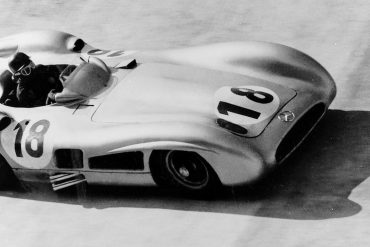
Enzo Ferrari said it best: "No driver could ever say that he had achieved his victor's laurels if he had not won at Brescia". Perhaps that is why Mille Miglia drew the best drivers from across the globe. Below, we tell you their stories. Perhaps the best known driver was Sterling Moss. His victory in 1954 became a defining moment in motorsports history: With the Mercedes-Benz SLR, the Englishman set a speed record that remains unsurpassed to this day. Moss became a driving hero and was granted knighthood by Prince Charles himself.
John and Julie Herlihy won the 2019 Mille Miglia WarmUp in their 1953 Jaguar XK120 roadster and went back for the real thing. John began racing a Ferrari 360 Challenge car because he never got to drive his road Ferraris.
Caracciola and Sebastian's 1931 Mille Miglia win in the SSKL, the first by non-Italians; Heyer and Schickentanz second overall at Spa in 1971 in the first 300 SEL 6.8 AMG. Mercedes marks Fangio at 110 and Uhlenhaut at 115.
At 17 Stirling Moss secretly ordered an MG and signed for it in his father's place. In 1948 his Cooper-JAP 500 won 12 of 15 Formula 3 races. He died on Easter Sunday at his Mayfair home, aged 90.
Robert Blakemore sat in his father's pre-war Aston Martin MkII as a boy, not touching the switches, flew airliners, then took voluntary redundancy to buy into Ecurie Bertelli, the firm that sold his father the car. Mike Jiggle asks how.
Rich Taylor's mother drove her Model A from Peekskill to Mexico City and back in 1929 for fun; his father designed steam locomotives and thought cars flimsy. The racer, rallymaster and former Car and Driver editor on how it began.
A Daimler-Benz salesman from Dresden, allowed to race within driving distance of the agency, Caracciola stalled at the start of the German Grand Prix at Avus, was push-started from 44th and last, and led in the rain. Dennis David's biography.
Cindy Banzer was an Oregon state representative and Keith Martin ran a Portland ballet company before he started curbstoning cars to Europe and Japan. The Sports Car Market co-founder and Alfa Owners Club president on how that became a business.
In 2009 Sports Car Digest toured the Mario Righini Collection, one of the more exceptional private car collections in Italy, if not the world.
Stirling Moss was meant to be a dentist like his father Alfred, one of London's leading odontologists. He drove at six on the family farm, held a licence at 15 on a permit and turns 85 still working for Mercedes-Benz.
Dan Radowicz grew up a block from Woodward Avenue, son of a GM prototype builder and a leadfoot mother, and had his first speeding ticket at 14. The California Mille organizer tells Casey Annis how the disease took hold.
Two books, The Immortal 2.9 and a three-volume study of the 8C 2300, make Simon Moore the last word on pre-war Alfa Romeos. He has spent his adult life tracing all 43 2.9s built between 1936 and 1939.
Hans Herrmann turns 85 on 23 February 2013. He began in a 356 in 1952, took a class win at Le Mans in 1953, joined Neubauer's Mercedes team at 26 and gave Porsche its first Le Mans win in 1970.
More than 90 images of John Fitch, drawn from the GM and Daimler-Benz archives and his own collection, chosen by Art Evans, his friend and co-author of 50 years. Not a history, he says; there would never be enough pictures.
Two broken legs in practice at the Monza motorcycle Grand Prix, casts on both, and Nuvolari had himself tied to his Bianchi the next day, held upright at the start and caught at the finish. He won.
Martin Swig, the only American at the first Mille Miglia Retrospettiva in 1982 and creator of the California Mille, died on 3 July after a stroke. Michael Lynch on a dealer who said nobody wanted Alfas until they were old.
Martin Swig and his Palo Alto friends learned to drive at 12, copying their parents' car keys at the key shop and taking the Cadillacs out when the adults went to dinner. His first was a $125 '37 Pontiac.
Jon Shirley left MIT for a small electronics chain called Radio Shack, ran Microsoft as president from 1983 to 1990 and buys one-off Ferrari 375MMs. Dennis Gray and Jamie Doyle ask about the Ferraris, Alfas and 1950s sports racers.
Chuck Jones grew up on a cattle ranch, read George Monkhouse's book on the 1937 Mercedes season and set out for Formula 1. It took 25 years, via USRRC and F5000, to reach Ensign in 1975. Will Silk asks.
Martin Swig's mother bribed him to Sunday school at three with a stop to press his nose against a Cord showroom window. Dennis Gray talks to the San Francisco dealer and California Mille founder before the 2011 event.
The Schlumpf Collection in Mulhouse, France has been described as the most prestigious automobile collection in the world. Without doubt, no other collection in the world has a history more filled with intrigue.
Ascari, who died at his father's age on the same day of the month; Biondetti, with four Mille Miglia wins between 1938 and 1949. A roll call of the drivers who made the Brescia race what it was.
Ferdinando Minoia won the first Mille Miglia in 1927 in an OM 665 Superba, with his child's sandals tied to the front springs for luck. In 1923 he raced the mid-engined Benz Tropfenwagen at Monza.
Enzo Ferrari wanted Luigi Villoresi in a Barchetta for the 1951 Mille Miglia. Villoresi insisted on the 340 Coupé he had just won with at Monza, got his way, and won in the wet.
Count Gaetano Marzotto's son entered his father's Lancia Aprilia in the Giro di Sicilia at 20. In 1950 he and three brothers ran the Mille Miglia in Ferraris; for 1951 he designed his own car by "optical intuition".
Piero Taruffi won 22 of 41 motorcycle races and 44 of 136 car races, set 38 world records on Gileras, held a doctorate in engineering and closed his career by winning the 1957 Mille Miglia.
Carlo Pintacuda first held a steering wheel at 13, in his father's 30 hp Darracq. His first race, at Livorno in 1925, ended with the Lancia Lambda towed home by two horses.
Eugenio Castellotti lent Alberto Ascari his helmet for a few laps in the unpainted Ferrari 750 Monza at Monza in 1955. Three laps later Ascari was dead at the Vialone curve.
Giuseppe Campari gave Alfa Romeo its first major win at Mugello in 1920, won the Mille Miglia twice and trained as a baritone, hoping to sing at La Scala. Monza, September 1933, was his last race.
The Mille Miglia Cars
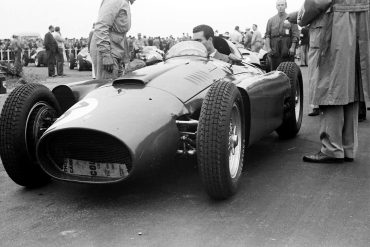
For 20 years (1927 to 1947), the race cars from Alfa Romeo were virtually invincible. With a total of 11 victories, they dominated the Mille Miglia. Afterwards however, Alfa Romeo temporarily withdrew from the motorsport scene. This is when Enzo Ferrari stepped up and took over: He won a total of 8 victories with his own sports cars. Mercedes-Benz was the only other team that managed to beat Alfa Romeo twice during the early decades. The heroic Rudolf Caracciola managed to defeat the then superior Alfa Romeos in 1932. Meanwhile, Stirling Moss dominated the Ferraris in 1954. Every Mille Miglia fan should know about the incredible story about the race with Stirling Moss behind the wheel of a Mercedes-Benz SLR at the 1955 Mille Miglia. The racing team Moss and Jenkinson mastered the 992-mile circuit in just 10 hours, 7 minutes and 48 seconds, which corresponds to an average speed of little less than 160 km/ h. With their victory, history had been written.
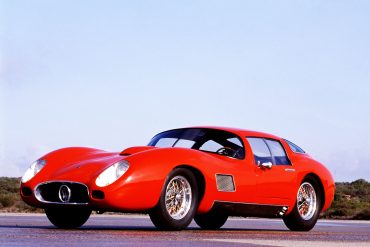
Parravano, Los Angeles property developer with 13 Maseratis and as many Ferraris, commissioned a 4.2-litre V8 for Indianapolis in 1954 and never went. Karl Ludvigsen on the 450S that grew from it, the most powerful Maserati since the 8CTF.
Mercedes-Benz's post-war racing began in September 1950 with Karl Kling in a 170 S at the Nürburgring six-hour race, sprinting to his car "as if I was Jesse Owens" and finishing seventh in class. Alfred Neubauer's rebuilt department followed.
Vincenzo Lancia, a soup canner's son, joined Ceirano in 1898, became FIAT's test driver and racer after the takeover, won the 1904 Coppa Florio at a record 72 mph, and quit in 1906 to build his own cars.
Joe Ballengee's 1965 Flavia Sport Zagato draws shouts from the curb; one car person called it "rare as rocking horse poo". Vincenzo Lancia was meant to be the accountant for his father's soup-canning business. How both came about.
Preston Lerner calls the 250 GT/L "one of the most beautiful cars ever built" and the writer disputes only the "one of". Pinin Farina, tenth of eleven, apprenticed to his brother in 1905. The Lusso and the house behind it.
Lampredi told Enzo Ferrari a 2-liter four would beat Colombo's V12 on torque, weight, moving parts and friction, and was allowed to prove it during Formula One's lame-duck years before 1954. Casey Annis drives the resulting 500 Mondial.
Fritz Nallinger said Mercedes was "just opening a little window on the motor racing scene". With Formula One rules in limbo until 1954, Neubauer went to ask the CSI for a change, and the W194 became the way back.
The Italian Air Force display team over Brescia's Viale Venezia, 417 cars, 2,200 kilometers over five days, up from the original day and 1,000 miles. Pictures from Ferrara's cobbles, Siena's Piazza del Campo and Milan's Piazza del Duomo at dusk.
Four days, four countries, 13 Alpine passes and more than 1,000 kilometers, from scrutineering at Brescia's Mille Miglia Museum to the 2,149-meter Fuorn Pass, led off by a 1927 Bugatti T37A. Photographs from the third Coppa delle Alpi.
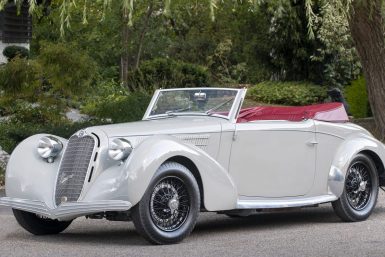
Alfa Romeo built 107 6C 2300 Bs to Mille Miglia specification; chassis 815045, the only one with "MM" against its engine number, is the sole survivor of four Graber convertibles. It heads the pre-war open class at Salon Privé.
Ferrari's Type 130 V12, 3,491 cc, was designed under Andrea Fraschetti after Lampredi left for Fiat, with Bellentani from Maserati and a 65-year-old Vittorio Jano in the room. Karl Ludvigsen on the four-cam that beat Maserati's V8 in 1957.
A Carrozzeria Touring publicity photograph of the newly built BMW328 MM Coupe that would go on to finish 5th at Le Mans in 1939 and won the war marred 1940 Mille Miglia outright.
When the 1938 Grand Prix formula made Alfa Romeo's 4.5-liter V12s redundant, two went into racing speedboats and about four, unblown, into 8C 2900A frames as the Tipo 412 sports cars that finished 1–2 at Antwerp in May 1939.
'Who do you think you are, Stirling Moss?' The policeman's question is on the outrider's motorcycle in 'The Last Blast', Mercedes-Benz Classic's short film of 300 SLR '722' driven through London in September 2021 before retiring to the Stuttgart museum.
John Fitch and Kurt Gesell won the GT class and finished fifth overall in a Mercedes-Benz 300 SL at the 1955 Mille Miglia. Arthur Schening's print of the car, 19 by 13 inches on uncoated cover stock, costs $35.
It’s usually the other way around. A roadcar becomes a racecar. This 1956 Austin-Healey 100 was rescued from a certain fate of returning to the earth as it sat and rusted after an apparent career as a racecar.
Orazio Satta's 1900 arrived in late 1950 as a unit-body sedan with a 1,884 cc engine; the Super Sprint coupés became privateers' class winners in touring and GT racing. This 1955 1900C SS carries a Zagato berlinetta body.
Caracciola and Sebastian's 1931 Mille Miglia win in the SSKL, the first by non-Italians; Heyer and Schickentanz second overall at Spa in 1971 in the first 300 SEL 6.8 AMG. Mercedes marks Fangio at 110 and Uhlenhaut at 115.
Emilio Giletti and Guerino Bertocchi brought this Maserati A6GCS home sixth in the 1953 Mille Miglia, from 490 starters and 283 finishers. Arthur Schening's print of it, 19 by 13 inches, costs $35.
Ernst Henne won on the BMW 328's debut at the Nürburgring in June 1936, and the 1,971 cc car and its M328 engine went on racing for more than two decades, fathering a flock of specials into the 1950s.
Jaguar planned 200 XK120s and built more than 12,000, many for export dollars. The 3.4-liter twin-cam six with its alloy head made 160 bhp; the engine was planned by Lyons, Heynes, Hassan and Baily on wartime fire-watching duty.
The Tour de France ran five or six days over open French roads, hillclimbs and circuits, and gave Ferrari's 250 GT LWB Berlinetta its name. The Scaglietti-bodied forerunner of the SWB and GTO, with a 1958 example in focus.
Lake Garda, 13 April 1930, 5 am: Nuvolari and Guidotti at 93 mph, headlights off to surprise Varzi. The 6C 1750 won the Mille Miglia at a first 100 km/h average and filled eight of the top eleven places.
Twenty-two cars in two classes, 1927–1957 eligibles and post-1957 sports and supercars, ran the second 1000 Miglia Warm Up around Washington, DC, 23–26 October 2019: three days of rallying after a training day, finishing at the ambassador's Villa Firenze.
Mille Miglia & 1000 Miglia Updates
Since its relaunch as a classic car rally in 1977, the “Mille Miglia storica” has been held annually with special stages since its tragic end in 1957. Today, showcasing unique race cars means more than speed at one of the most important and beautiful stages in the history of motorsports. 'La corsa più bella del mondo‘ – the most beautiful race in the world – takes place every year around mid-May and attracts celebrities as well as gear heads from all over the world. Below, we take you through the highlights of the recent 1000 Miglia vintage races as well as share some special features on the epic races of yesteryear.
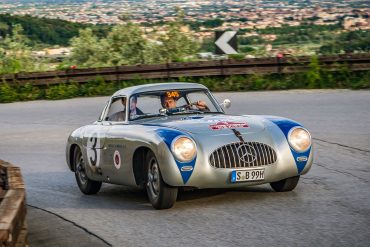
Four 300 SLs carry Mercedes-Benz's 140th anniversary through the 2026 1000 Miglia, June 9–13, among them one of the ten W 194 racing cars, the one Rudolf Caracciola and Paul Kurrle drove in 1952. Seven customers join the works team.
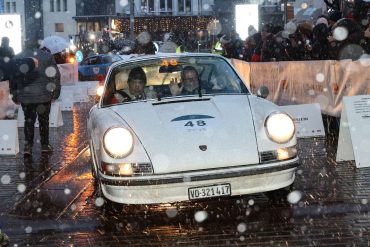
Aliverti and Carrara won the 1000 Miglia winter race in a 1937 Fiat 508 C with 617.87 penalty points, matching Aliverti's record, over three legs from 12 March through Celerina's bobsled run, Bormio, Livigno's ice rink and final-day snowfall.
Parravano, Los Angeles property developer with 13 Maseratis and as many Ferraris, commissioned a 4.2-litre V8 for Indianapolis in 1954 and never went. Karl Ludvigsen on the 450S that grew from it, the most powerful Maserati since the 8CTF.
Vesco and Salvinelli won the 43rd 1000 Miglia in a 1929 Alfa Romeo 6C 1750 Super Sport, with a 6C 1500 SS and a 6C 1750 GS Spider Zagato completing an all-Alfa podium. The 33 Stradale ran in support.
An imposing number: The "722" stands out immediately. The large, red number shines on the front, sides and rear of the Mercedes-Benz 300 SLR racing sports car at the Mercedes-Benz Museum.
Throughout the course of its action-packed two-day Amelia Island sale on Thursday, March 6 and Friday, March 7, Gooding Christie’s concluded its first official auction as the automotive leg of global luxury leader Christie’s, with results indicating a…
Seventy cars ran the first 1000 Miglia Experience Florida from the Biltmore in Coral Gables through Naples, Venice, Tampa, Cape Canaveral and West Palm Beach to a finish on Ocean Drive, Miami Beach, over three days from 23 February 2025.
When the Italian Grand Prix left Brescia for Monza in 1922, four locals, Aymo Maggi, Franco Mazzotti, Renzo Castagneto and Giovanni Canestrini, set out to restore the city's pride. Glen Smale visits the museum in the Monastery of St Euphemia.
RMD Classic Competition Cars is now offering this 1953 OSCA MT4 for sale. Key Features One of just 3 Frua bodied OSCA MT4 1453cc twin-cam engine #1403 from Cunningham owned Sebring 12h winning OSCA Mid-80ies Blakeney Motorsport restoration…
Mercedes-Benz's post-war racing began in September 1950 with Karl Kling in a 170 S at the Nürburgring six-hour race, sprinting to his car "as if I was Jesse Owens" and finishing seventh in class. Alfred Neubauer's rebuilt department followed.
In Italy, a country that’s home to numerous small, specialized companies making exotic sports and racing cars, few can compete with SVA in their combination of obscurity with exotic engineering.
Vincenzo Lancia, a soup canner's son, joined Ceirano in 1898, became FIAT's test driver and racer after the takeover, won the 1904 Coppa Florio at a record 72 mph, and quit in 1906 to build his own cars.
Joe Ballengee's 1965 Flavia Sport Zagato draws shouts from the curb; one car person called it "rare as rocking horse poo". Vincenzo Lancia was meant to be the accountant for his father's soup-canning business. How both came about.
Preston Lerner calls the 250 GT/L "one of the most beautiful cars ever built" and the writer disputes only the "one of". Pinin Farina, tenth of eleven, apprenticed to his brother in 1905. The Lusso and the house behind it.
The 2200-kilometre tour de force of the 1000 Miglia 2024 has ended. The 421 competing crews, with their vintage jewels built between 1927 and 1957, traveled the classic route from Brescia to Rome and back in an anti-clockwise…
Lampredi told Enzo Ferrari a 2-liter four would beat Colombo's V12 on torque, weight, moving parts and friction, and was allowed to prove it during Formula One's lame-duck years before 1954. Casey Annis drives the resulting 500 Mondial.
Fritz Nallinger said Mercedes was "just opening a little window on the motor racing scene". With Formula One rules in limbo until 1954, Neubauer went to ask the CSI for a change, and the W194 became the way back.
So, you want to drive in the Mille Miglia ? OK...you need a car. A model built between 1927 and 1957 (when the MM was an open-road race).
Ettore Bugatti's grandfather was an architect, his father Carlo a furniture and jewelry designer, his brother Rembrandt a sculptor. Peter Mullin's museum in Oxnard holds more than 75 pieces of Carlo's furniture and many of Rembrandt's sculptures alongside the cars.
Every year, the 1000 Miglia has some surprises in store. The passage through Genoa, with a view of the port and a parade along the seafront, will be the absolute novelty of the coming edition.
It's been more than 40 years since Jochen Mass and Jacky Ickx raced for their respective Formula 1 teams. Their competitive fires may have dimmed, but their love for the sport still burns.
The Italian Air Force display team over Brescia's Viale Venezia, 417 cars, 2,200 kilometers over five days, up from the original day and 1,000 miles. Pictures from Ferrara's cobbles, Siena's Piazza del Campo and Milan's Piazza del Duomo at dusk.
From our friends at Broad Arrow Auctions comes one of the holy grails of post-war sports cars; the 1956 A6G/54 with a “Double-Bubble” Zagato roof.
The longest edition in the history of the 1000 Miglia has come to an end as the crews criss-crossed Italy covering a total of 2200 kilometers over the five days of the race.
Sixty-seven cars built before the last Italian Mille Miglia of 1957 covered 1,000 miles of Central and Northern California over five days for the 2023 California Mille. Chopard made a 30-piece watch and prizes for the three award winners.
Four days, four countries, 13 Alpine passes and more than 1,000 kilometers, from scrutineering at Brescia's Mille Miglia Museum to the 2,149-meter Fuorn Pass, led off by a 1927 Bugatti T37A. Photographs from the third Coppa delle Alpi.
Some new and surprising events await the participants of the 1000 Miglia 2023. 405 cars have already been admitted to participate in the upcoming race that will be held from June 13 to 17, and it will start…
Organizers of the 2023 1000 Miglia 2023 have announced that the venerable event has been expanded to now cover 5 days of rallying from June 13 to 17 and this year will see 405 cars admitted to the…
For the Platinum Jubilee, Salon Privé gathered 16 platinum and silver cars at Blenheim: McLaren F1 chassis 064 and 065, a Porsche 959, the only factory Testarossa Spider and Hubert Hahne's Miura SV Jota, the last built. Matty White reports.
A 1956 Ferrari 250 GT TdF Berlinetta by Zagato has been awarded Best of Show at this year’s Salon Privé Concours d’Elégance presented by Aviva.
David and Ginny Sydorick's chassis 0515GT, one of five long-wheelbase 250 GTs bodied by Zagato with double-bubble roof, took Best of Show at Blenheim. Built for Vladimiro Galluzzi and raced through 1956, it beat the Graber Alfa 6C 2300 B.
Alfa Romeo built 107 6C 2300 Bs to Mille Miglia specification; chassis 815045, the only one with "MM" against its engine number, is the sole survivor of four Graber convertibles. It heads the pre-war open class at Salon Privé.
The 1000 Miglia, that traverses Italy each year, has been hailed as “the most beautiful auto race in the world.” The event now holds a United States edition, the 1000 Miglia Warm Up USA, which will return this…
Ferrari's Type 130 V12, 3,491 cc, was designed under Andrea Fraschetti after Lampredi left for Fiat, with Bellentani from Maserati and a 65-year-old Vittorio Jano in the room. Karl Ludvigsen on the four-cam that beat Maserati's V8 in 1957.
Andrea Vesco and Fabio Salvinelli have won the 2022 Miglia Miglia. Crew number 46, aboard a 1929 Alfa Romeo 6C 1750 SS Zagato, repeated the success achieved in the 2021 edition.
A Carrozzeria Touring publicity photograph of the newly built BMW328 MM Coupe that would go on to finish 5th at Le Mans in 1939 and won the war marred 1940 Mille Miglia outright.
The Mille Miglia permitted the birth of GT, or grand touring cars, which are now sold all over the world. The Mille Miglia proved that by racing over open roads for 1,000 miles, there were great technical lessons to be learned by the petrol and oil companies and by brake, clutch, transmission, electrical and lighting component manufacturers, fully justifying the old adage that motor racing improves the breed.
COMMENDATORE ENZO FERRARI