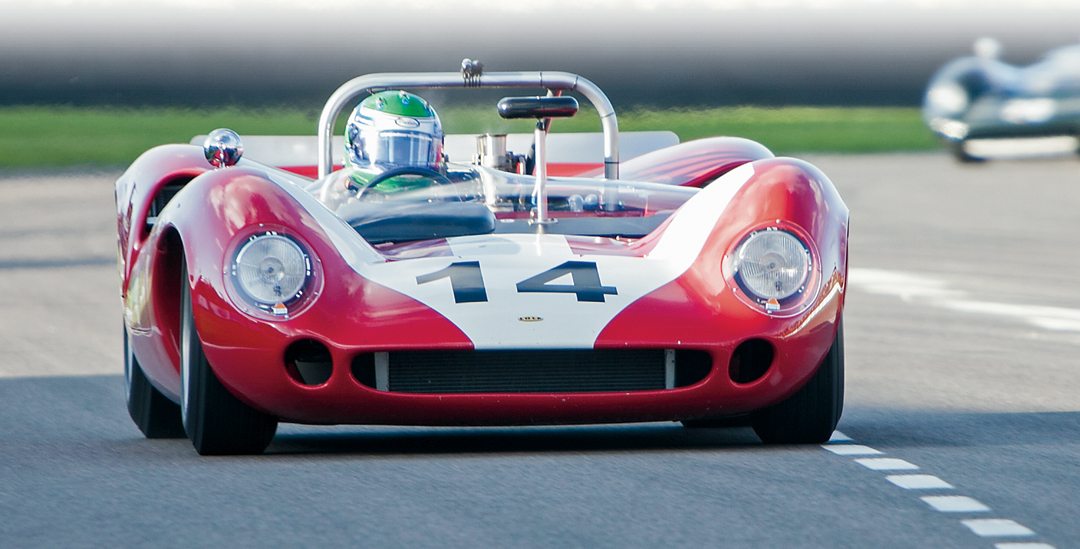
Proper warming up of components and attention paid to maintaining balance with the handling were the keys to enjoying the performance available from Lola’s first venture into Group 7 competition. Photo: Roger Dixon
If there was a racing car that most of the great and the good of both professional and amateur motor racing have competed in it would have to be one form or another of the Lola T70—not only in the UK, but in all corners of the world. It came from the pen of Eric Broadley after a number of political decisions, or indecisions, were made. In the first instance, Ford was “hell bent” on winning the 24 Hours of Le Mans, a crown to that point held by international drivers, but the sole prize of European manufacturers and marques. During 1963, in an audacious move to achieve this, the “Blue Oval” hierarchy made representation to none other than Enzo Ferrari with a view to purchasing his self-built empire. However, as history has shown, the notion that a precious Italian jewel could be pried away by an American conglomerate was simply a bridge too far for Il Commendatore. Ferrari, at this time, although rich in motor racing accolades, was relatively cash poor, as building and selling high-end roadcars was their only income—consuming much time and cash. Enzo had valued his company at around $18 million, but the account books told a much different story, and after a much lower offer was made by the boys from Dearborn, the deal was off. So, Ford had to look elsewhere.
The sturdy aluminum spoiler addition to the T70’s rear deck does little to detract from the lines that made the T70 one of the most beautiful sports racing cars ever created. Photo: Pete Austin
Grand Prix racing in the 1930s had been dominated by Germany, in the early to mid-1950s it had been Italy, but in the early 1960s it was the UK ruling the waves of success on many motor racing circuits. At this time, the UK was becoming the focal point for motor racing, more nimble rear-engined machines were replacing the big front-engined cars—thanks mainly to Cooper and Lotus. Over the years, the 750 Motor Club had spawned many great names of our sport, including Colin Chapman, Mike Costin, Brian Hart and Eric Broadley. Initially, Broadley trod the same path as Frank Lloyd Wright in the world of architecture, but the motor racing bug bit and he was hooked when his own design of car began to become successful. So, Broadley’s straight lines of buildings turned to the curved lines of car design. Like Cooper and Lotus, drivers of his Lola cars were regularly gaining podium places.
We bring you all the latest from the world of vintage and classic cars each week. News, auctions, events, vintage racing and more.
Members only$29 / year
Keep going. This is where it gets good.
Sports Car Digest Membership is for people who'd rather spend an hour with one chassis number than skim ten headlines. The rest of this story — and every other one like it — is a few seconds away.
5,000+ members-only stories
Concours, auctions, race history, driven classics and the full archive.
No ads. None.
The whole site reads like a magazine, on every device.
The market, every week
Auction results and classic-car values from the people who were there.
30% off the shop
Every Sports Car Digest shirt and piece of merch, all year.
$29 a year. Cancel anytime, no hoops. Already a member? Sign in
BY CAR PEOPLE, NOT A NAMELESS MEDIA COMPANY. Your membership keeps a small independent team of historians, photojournalists and racing drivers doing this.