Jeremy Cottingham and James Littlejohn won the two-hour Pall Mall Cup in a Shelby Daytona Cobra from a 36-car field, Connor Kay's Lotus Elan 26R holding off Lukas Halusa's Low Drag E-Type by under half a second for second.


Built for one race and the one straight in it, the Jaguar D-Type won Le Mans three years running, 1955, 1956 and 1957, the last time with five cars in the first six, and did it with an aircraft-style monocoque, disc brakes and a shape drawn by an aerodynamicist when its rivals still had ladder frames and drum brakes. Seventy-one were built between 1954 and 1956, sixteen more became the XKSS road car, and the Ecurie Ecosse car that won in 1956 is the most expensive British car ever sold at auction. This page is the car: how Malcolm Sayer and Bill Heynes built it, the three Le Mans wins and the 1955 disaster, the works and the privateers, the XKSS and the Browns Lane fire, the chassis and what they fetch, with the archive's D-Type stories, Ed McDonough's drive in the 1955 winner among them, threaded through it. The marque's whole story is on the Jaguar page; the race's on Le Mans.
The pieces to start with
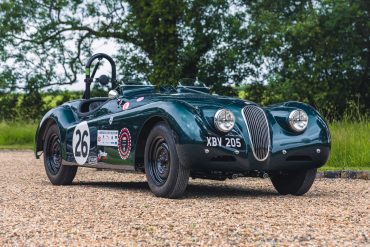
Eight pieces on the car: the 1955 winner driven, the 1956 Ecurie Ecosse winner, Jaguar at Le Mans, the red XKD 518, the C-Type before it, the American privateers and the continuation cars.
XKD 505 won Le Mans in 1955 with Hawthorn and Bueb, a race remembered for the accident rather than the Hawthorn–Fangio duel that preceded it. Norman Dewis, on the pit counter that night, now teaches Ed McDonough to drive it.
28 July 1956 – the 24 Hours of Le Mans starts at 4 o’clock in the afternoon and it’s raining in France. An inauspicious start to an already exceptionally dangerous motor race!
Jaguar’s first Le Mans entries in 1950 were three works-prepared XK120s run under private names in case of embarrassment; Johnson and Hadley ran second before the clutch failed. John Zimmermann on 60 years at La Sarthe.
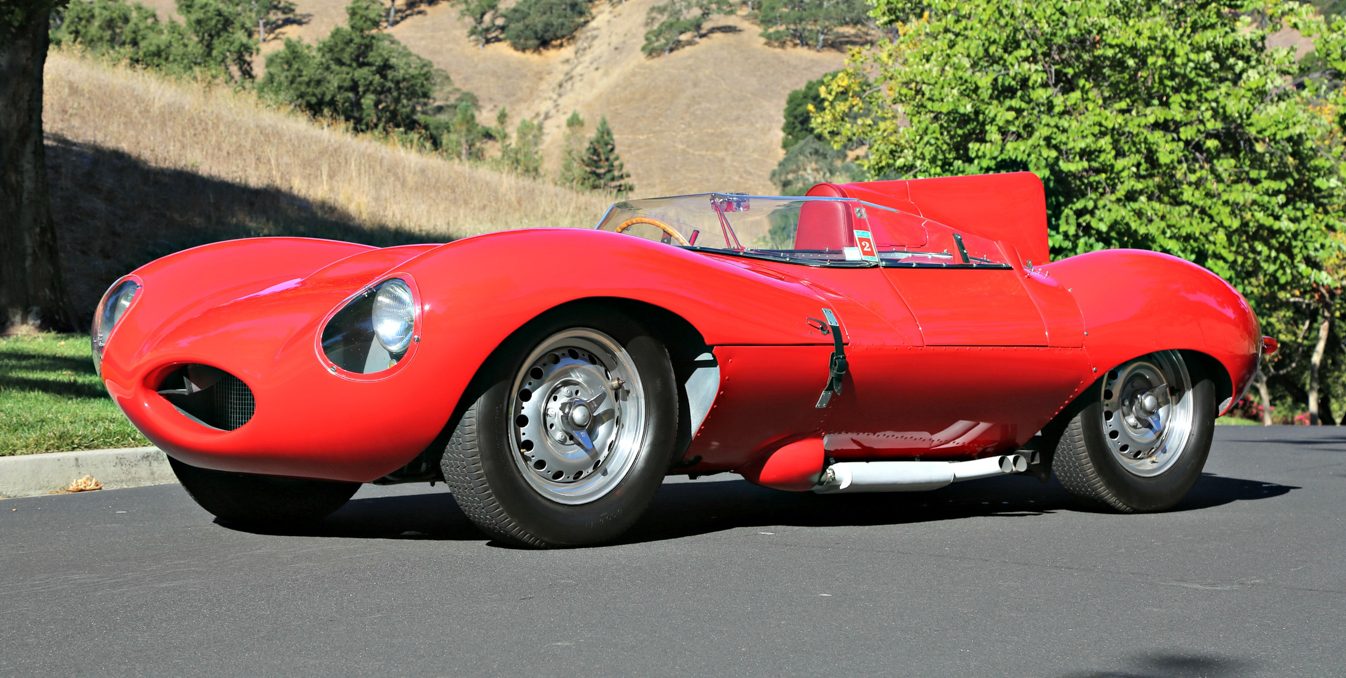
Jaguar built just two D-Types in bright red with red seats, and nobody knows why; one theory is an intended Italian sale. Steve Natale drives XKD 518, the 1956 car that was “born that way.”
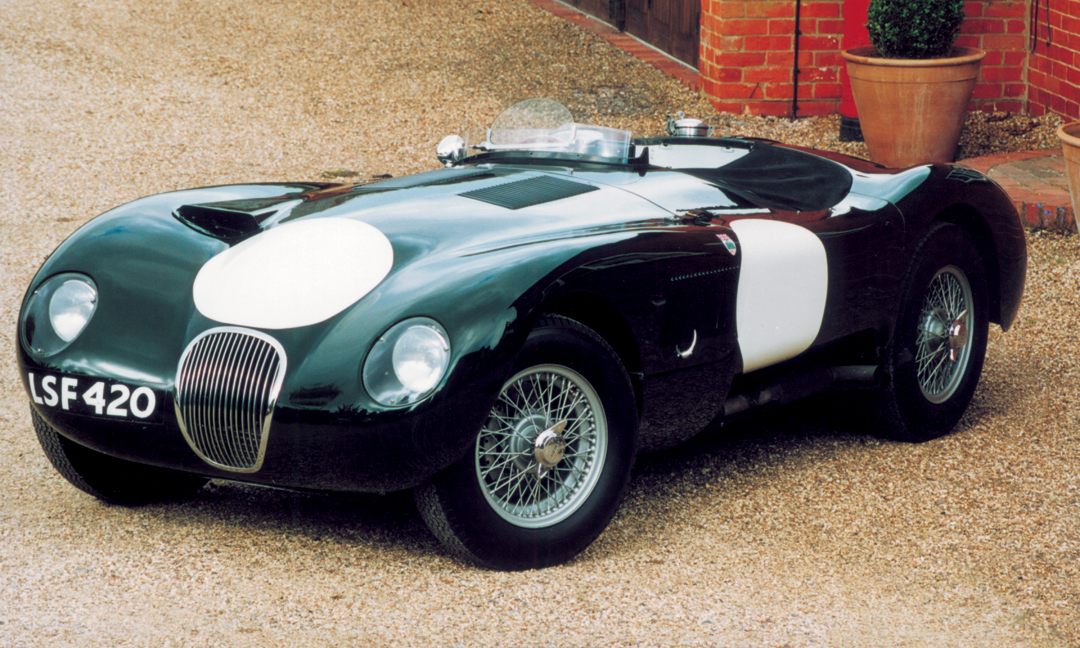
Chassis XKC 051 did exactly what Jaguar hoped: it won Le Mans, with Duncan Hamilton and Tony Rolt. Ed McDonough on the C-Type’s production-based ethos, in a year when Bentley and MG returned to the Sarthe in name only.
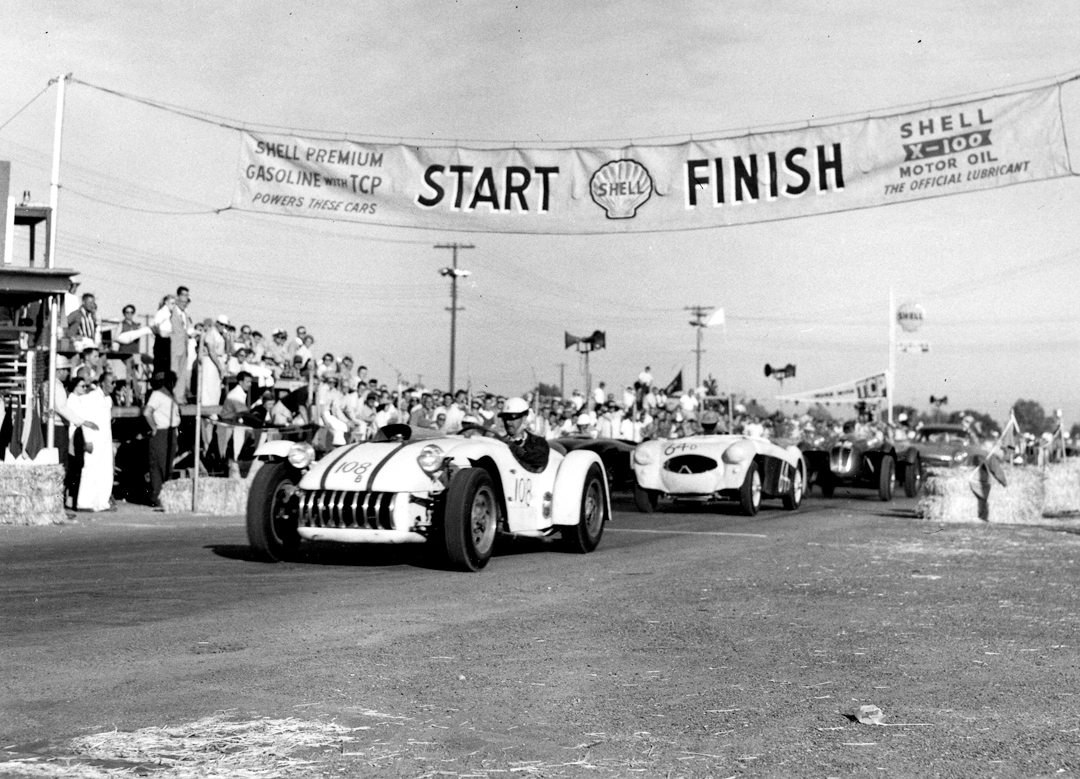
Lou Brero, born in Nice in 1909, ran tow trucks and log haulers out of Monte Rio on the Russian River. In his forties he went West Coast sports car racing, burned bright, and died in a racing accident.
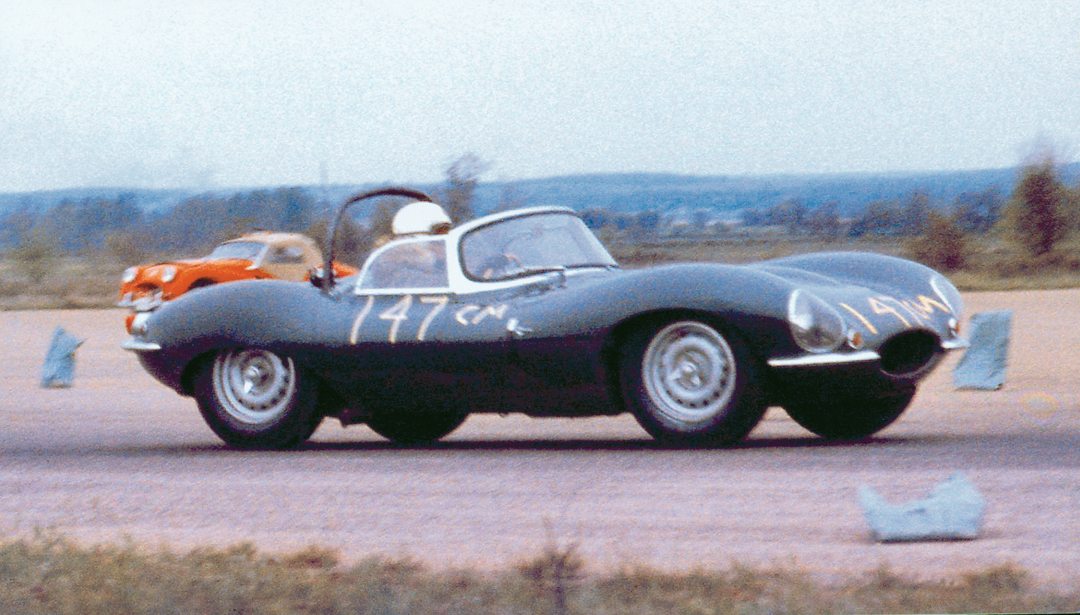
Sixteen D-types were unsold at the end of 1956, so Jaguar turned them into XK-SS cars with windscreens, bumpers and luggage racks. XKD 555 became XKSS 701, went to the New York show and drew no offers, headed for Texas.
Neither original nor replica, a continuation car is built by the firm that made the period car, to its specification, and sits in a limbo of its own in the market. Lorenzo Baer on why manufacturers keep building them.
The newest writing on the D-Type, as it is published.
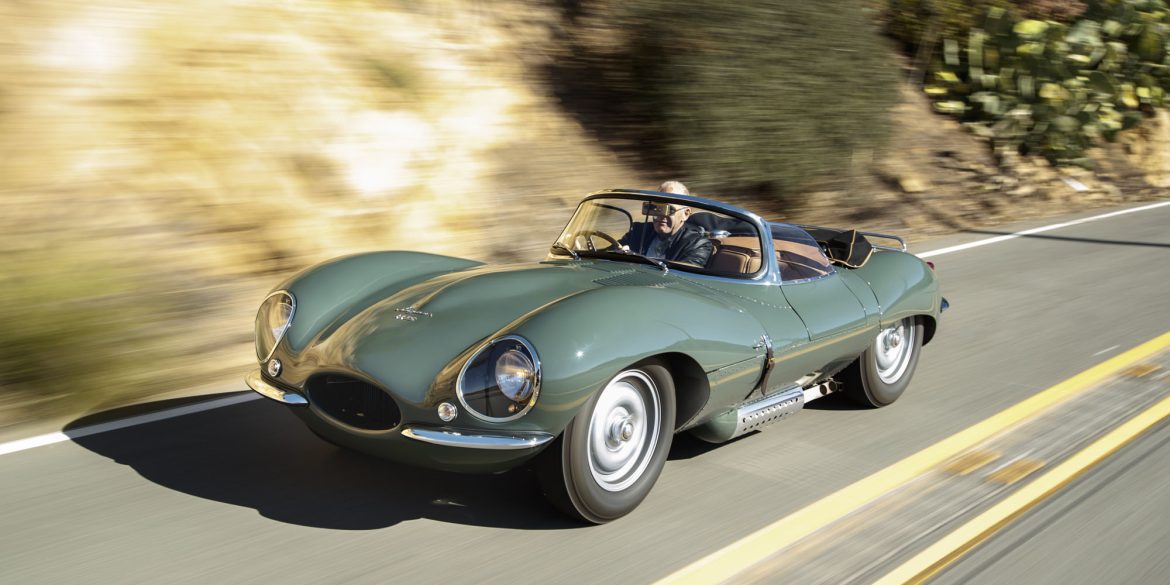
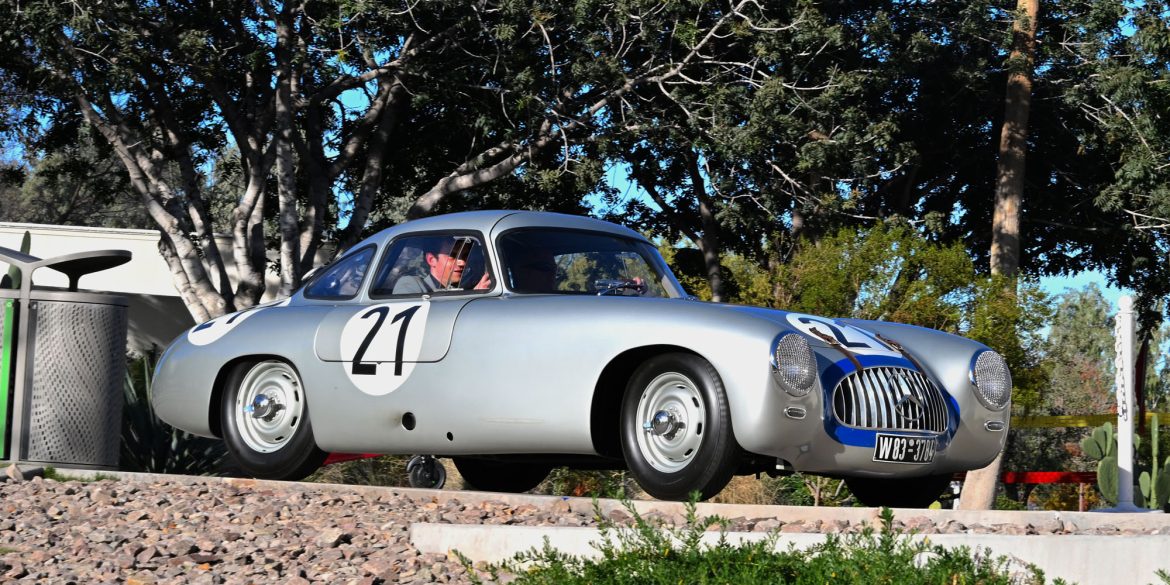
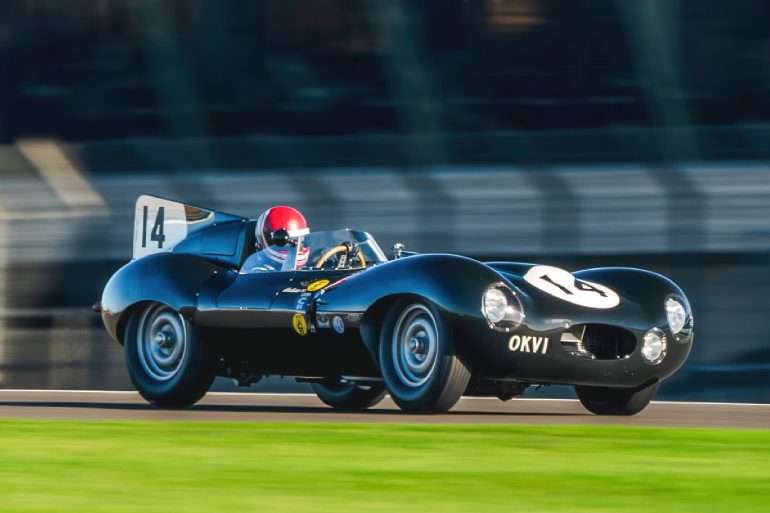
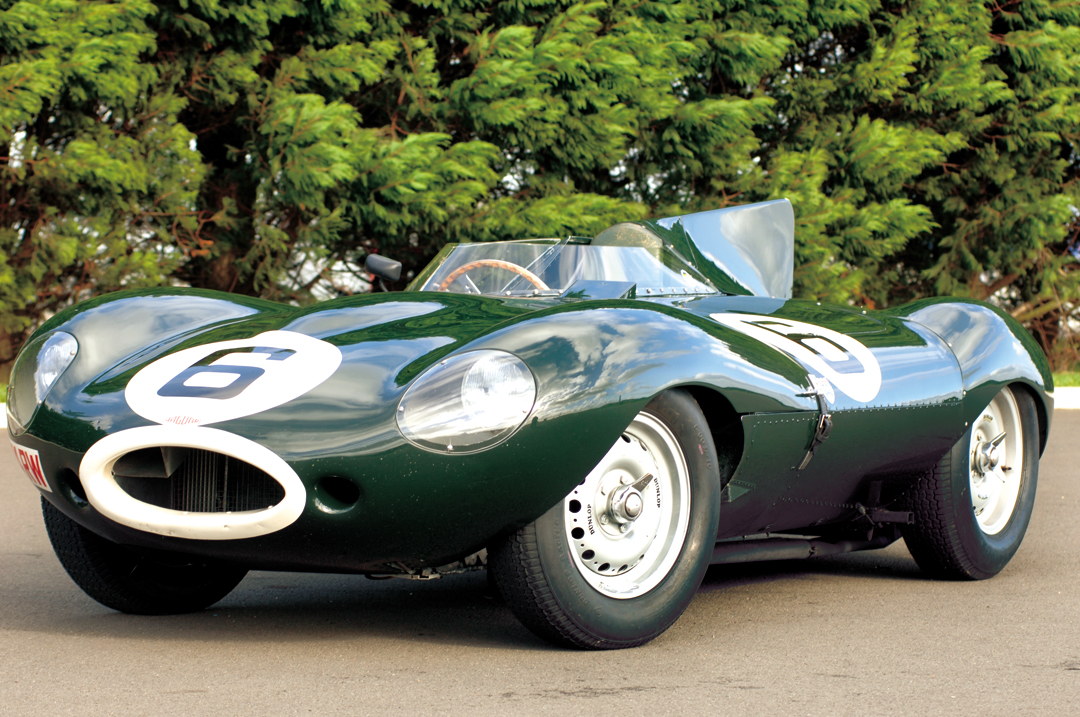
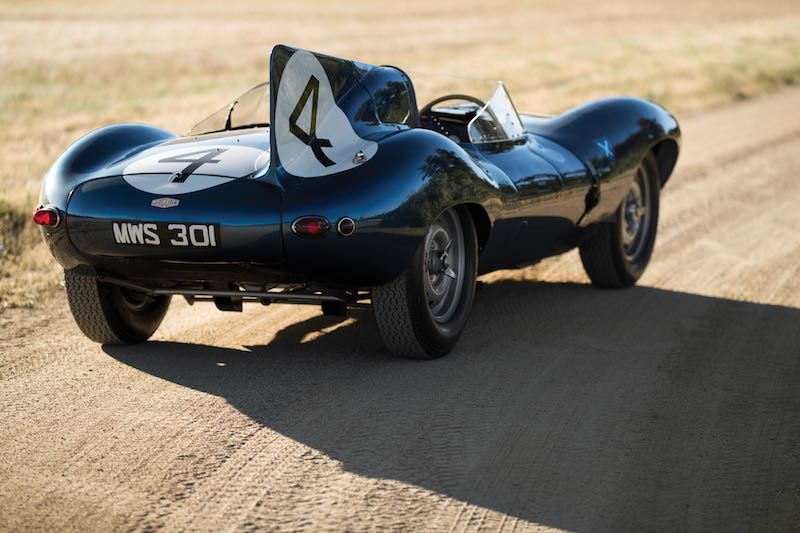
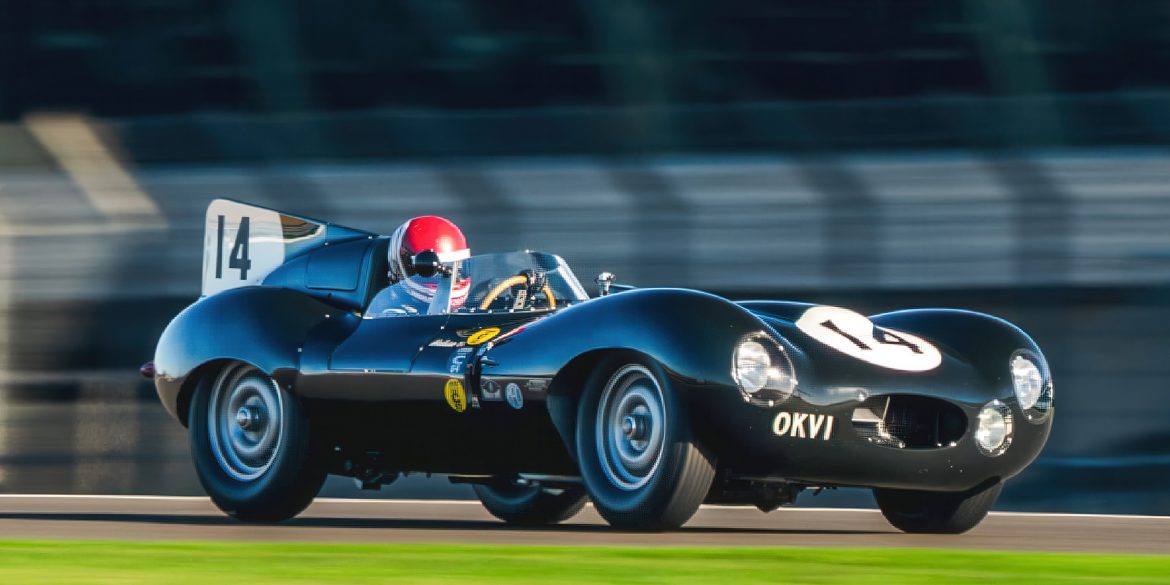
The Jaguar D-Type is the sports-racing car Jaguar built at Browns Lane, Coventry, from 1954 to 1956 to win the 24 Hours of Le Mans, which it did in 1955 with the works team and in 1956 and 1957 with the Scottish privateer Ecurie Ecosse. It succeeded the C-Type, Jaguar's Le Mans winner of 1951 and 1953, and shared its 3.4-litre twin-cam XK straight-six and Dunlop disc brakes, but nothing else: where the C-Type was a tubular spaceframe under an alloy skin, the D-Type was a riveted magnesium-alloy monocoque tub, the first in sports-car racing, with a tubular subframe carrying the engine and front suspension, a dry-sump engine canted to lower the bonnet, and a body shaped by Malcolm Sayer, who had come from Bristol's aircraft division, with the tail fin behind the driver's head that made it the most recognisable racing car of the 1950s. It was designed for the Mulsanne straight, where it reached 172 mph in 1954 when the Ferraris were doing 160, and it was less happy on tighter circuits, which is why its record away from Le Mans and Reims is thinner than its reputation. Seventy-one were built: eighteen works cars and fifty-three for customers, in short-nose (1954–55) and long-nose (1955 on) forms, with the final twenty-five unsold chassis converted into the XKSS road car in 1957, of which nine were destroyed in the factory fire of 12 February. The archive's D-Type thread runs from McDonough's drive in XKD 505 and the chassis histories to the Ecurie Ecosse car's $21.78 million sale in 2016 and Jaguar's continuation cars.
William Lyons had sent the XK120 to Le Mans in 1950 to build a competition pedigree and the C-Type had won in 1951 and 1953, but by 1953 Bill Heynes, Jaguar's chief engineer, knew the spaceframe car had reached its limit against the four- and five-litre Ferraris, and the replacement was drawn around two ideas: a structure borrowed from aircraft practice and a body shaped for speed rather than looks. Sayer, who had worked on Bristol's aircraft and had drawn the C-Type, designed the D-Type's body mathematically, by calculation and wind-tunnel test rather than by eye; the central monocoque, in magnesium alloy on the early cars, was riveted up like a fuselage, with the fuel in rubber bag tanks inside it, the front subframe welded to it on the 1954 cars and bolted on from 1955 so that a crashed nose could be replaced, and the whole car sat lower than the C-Type because the engine was dry-sumped and tilted eight degrees. The 3.4-litre XK engine gave about 245 horsepower with triple Webers, rising to 270 and more with the wide-angle cylinder head of 1955, Lucas fuel injection on the works cars of 1956 and the 3.8-litre engine Ecurie Ecosse ran in 1957; the Dunlop disc brakes, which the C-Type had introduced to Le Mans in 1953, let the D-Type brake from 170 mph at the end of Mulsanne lap after lap when the Ferraris' drums faded. The prototype, XKC 401, ran at the Le Mans test weekend in May 1954 and Tony Rolt lapped well under the record; the long-nose car of 1955, seven and a half inches longer with the fin faired into a longer tail, is the shape most people picture. Norman Dewis, who tested every one, told McDonough fifty years later how the car was meant to be driven, and the archive's XKD 518 piece has the engineering in detail.
The D-Type's first Le Mans, in June 1954, was lost by a mile and three quarters. Rolt and Duncan Hamilton, the 1953 winners, chased the 4.9-litre Ferrari 375 Plus of Froilán González and Maurice Trintignant through twenty-four hours of rain, delayed early by fuel filters clogged with sediment from the fuel and later by a misfire, and finished 105 seconds behind after Hamilton had closed to within a lap while the Ferrari sat in its pit refusing to restart; in the dry, most of the Jaguar team believed, the D-Type would have won by an hour. A month later Peter Whitehead and Ken Wharton won the Reims 12 Hours outright, the D-Type's first victory, on the other circuit with a straight long enough for it, and the works ran three cars in the Dundrod Tourist Trophy in September, where the handicap formula and the twisting Ulster road suited them less. John Zimmermann's "Building a Legend at Le Mans" in the archive has the 1954 race in Jaguar's own account.
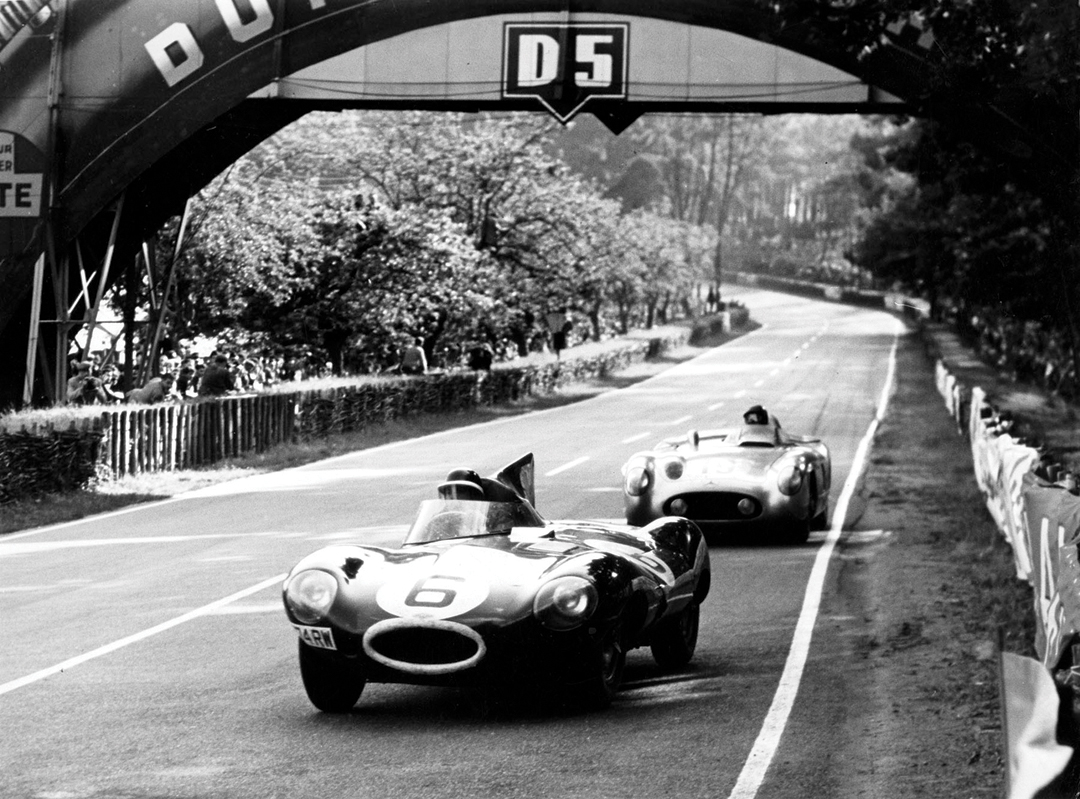
The 1955 Le Mans should be remembered for the duel between Mike Hawthorn's long-nose D-Type and Juan Manuel Fangio's Mercedes-Benz 300 SLR, two hours of lap records traded at 120 mph averages, and is instead remembered for what happened at 6.28 in the evening, when Hawthorn pulled across to his pit, Lance Macklin's Austin-Healey swerved, and Pierre Levegh's Mercedes launched off it into the crowd opposite, killing Levegh and more than eighty spectators. Mercedes withdrew its cars at two in the morning while leading; the race went on; and Hawthorn and Ivor Bueb won in XKD 505 by five laps from the Aston Martin of Peter Collins and Paul Frère, with the Belgian Ecurie Francorchamps D-Type third. The inquiry cleared Hawthorn, the argument has never ended, and the car itself, which McDonough drove at Goodwood with Dewis coaching him from the pit wall, is the subject of his "Cat du Mans" in the archive. Earlier that year Hawthorn and Phil Walters had won the Sebring 12 Hours in Briggs Cunningham's white-and-blue D-Type, XKD 406, the first of Cunningham's cars and the first Jaguar win in America's big race; at Dundrod in September the Hawthorn/Desmond Titterington car led the Tourist Trophy until its engine broke on the last lap. The Sebring and Tourist Trophy pages have both races in full.
Jaguar's 1956 was a year of near-misses saved by a privateer. At Sebring in March the Hawthorn/Titterington D-Type led or ran second for ten hours and set the lap record before retiring with ninety minutes left; at Le Mans in July the works team lost two of its three cars on the second lap, Frère and Jack Fairman crashing in the rain at the Esses, and Hawthorn's fuel-injected car spent twenty laps in the pits with a misfire before climbing back to sixth. The race was won by the dark-blue D-Type of Ecurie Ecosse, David Murray's Edinburgh team, driven by Ron Flockhart and Ninian Sanderson, a lap ahead of the Aston Martin of Moss and Collins; XKD 501 was a 1955 works car bought second-hand, and the archive's account of the race and the car is the long read. The Reims 12 Hours that month went to Hamilton and Bueb, Hamilton's last drive for the works after he ignored team orders to slow, and in October, with three Le Mans wins in six years, Jaguar announced its withdrawal from racing to concentrate on the road cars. The remaining D-Types were sold to customers; Ecurie Ecosse, Cunningham, Equipe Nationale Belge and the Australian and American privateers raced them for another four seasons.
With the works gone, Le Mans 1957 was the D-Type's greatest race. Ecurie Ecosse brought two cars with 3.8-litre engines prepared by the factory, and Flockhart and Bueb won in XKD 606 at a record 113.85 mph, eight laps clear of their team-mates Sanderson and John Lawrence; the Belgian car of Jean Lucas and "Mary" was third, Frère and Freddy Rousselle's fourth, and Hamilton and Masten Gregory's sixth, five D-Types in the first six and Jaguar's fifth Le Mans win in seven years, matching Bentley's five. The same summer Ecurie Ecosse took its D-Types to Monza for the Race of Two Worlds against the Indianapolis roadsters, Fairman finishing fourth, and in America Walt Hansgen won the SCCA C-Modified championship for Cunningham in a D-Type for the second year running. The three-litre limit of 1958 ended the car's front-line career: the sleeved-down XK engines broke, Hamilton crashed while second at Le Mans in the rain, and by 1959 the D-Type was a club racer and the Lister-Jaguar, with the same engine in a lighter frame, had taken its place. The Le Mans page has the full results of all three wins.
The table below has the D-Type's principal results, from the Le Mans trials of 1954 to the last works-supported entries, with the drivers linked to every story on the site about them. Three Le Mans wins, Reims twice, Sebring once and the 1957 sweep are the headlines; the retirements at Sebring and Dundrod show the car's limits as clearly as its wins show its strength.
The principal results, with the chassis that scored them. Drivers link to every story on the site about them.
| Year | Race | Drivers | Chassis / entrant | The story |
|---|---|---|---|---|
| 1954 | Le Mans trials, May | Rolt | XKC 401, works | The prototype's first laps at the Sarthe, well under the lap record |
| 1954 | Le Mans, June | Rolt / Hamilton | XKC 402, works | 2nd by 105 seconds to the Ferrari 375 Plus after a wet race and clogged fuel filters |
| 1954 | Le Mans, June | Moss / Peter Walker | XKC 403, works | Retired, brakes |
| 1954 | Reims 12 Hours, July | Whitehead / Wharton | Works | The D-Type's first win |
| 1954 | Tourist Trophy, Dundrod, September | Works, three cars | XKC works cars | Beaten by the handicap and the Ulster road |
| 1955 | Sebring 12 Hours, March | Hawthorn / Walters | XKD 406, Briggs Cunningham | 1st, Jaguar's first Sebring and Cunningham's first D-Type |
| 1955 | Le Mans, June | Hawthorn / Bueb | XKD 505, works | 1st by five laps in the long-nose car after the duel with Fangio and the disaster; Ecurie Francorchamps 3rd |
| 1955 | Le Mans, June | Dewis / Beauman | XKD 508, works | Retired; Dewis's only Le Mans drive |
| 1955 | Tourist Trophy, Dundrod, September | Hawthorn / Titterington | Works | Led until the engine broke on the last lap |
| 1956 | Sebring 12 Hours, March | Hawthorn / Titterington | Works | Led or ran 2nd for ten hours, set the lap record, retired with 90 minutes left |
| 1956 | Reims 12 Hours, July | Hamilton / Bueb | Works | 1st; Hamilton's last works drive after ignoring team orders |
| 1956 | Le Mans, July | Flockhart / Sanderson | XKD 501, Ecurie Ecosse | 1st by a lap from the Moss / Collins Aston Martin; the works cars crashed on lap two |
| 1956 | Le Mans, July | Hawthorn / Bueb | XKD 605, works | 6th after twenty laps in the pits with the fuel injection |
| 1957 | Sebring 12 Hours, March | Ecurie Ecosse and privateers | Various | D-Types in the field; Maserati's 450S wins |
| 1957 | Le Mans, June | Flockhart / Bueb | XKD 606, Ecurie Ecosse, 3.8 | 1st at 113.85 mph, the race record; D-Types 2nd (Sanderson / Lawrence), 3rd, 4th and 6th |
| 1957 | Le Mans, June | Hamilton / Gregory | XKD 601, Hamilton | 6th, the last of the five |
| 1957 | Race of Two Worlds, Monza, June | Fairman, Flockhart, Sanderson | Ecurie Ecosse | The D-Types against the Indianapolis roadsters on the banking; Fairman 4th |
| 1956–57 | SCCA C-Modified, USA | Walt Hansgen | Cunningham | Champion two years running in the Cunningham D-Type |
| 1958 | Le Mans, June | Hamilton / Bueb | XKD 601, 3-litre | The three-litre engines; Hamilton crashed in the rain while 2nd |
| 1959–60 | Le Mans and the clubs | Privateers | Various | The D-Type's last front-line years; the Lister-Jaguar takes its place |
The works team raced 1954–56; Ecurie Ecosse, Briggs Cunningham, Equipe Nationale Belge and the privateers carried on to 1960. Reims and Le Mans, the two circuits with straights long enough for it, account for most of the wins.
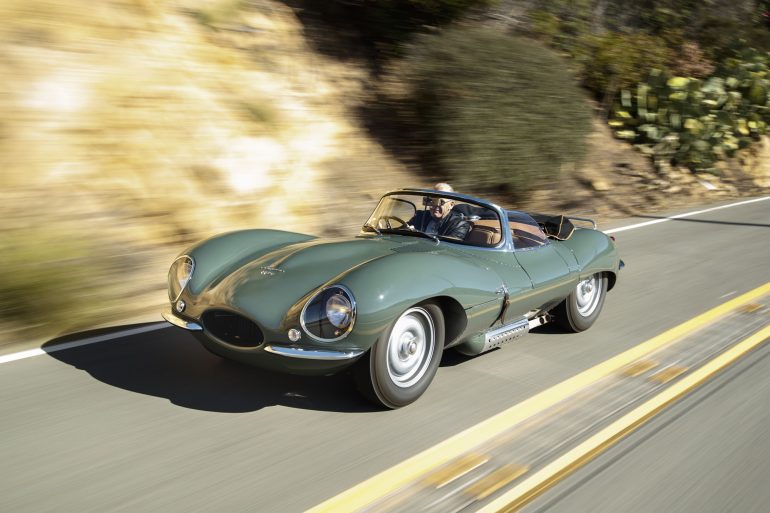
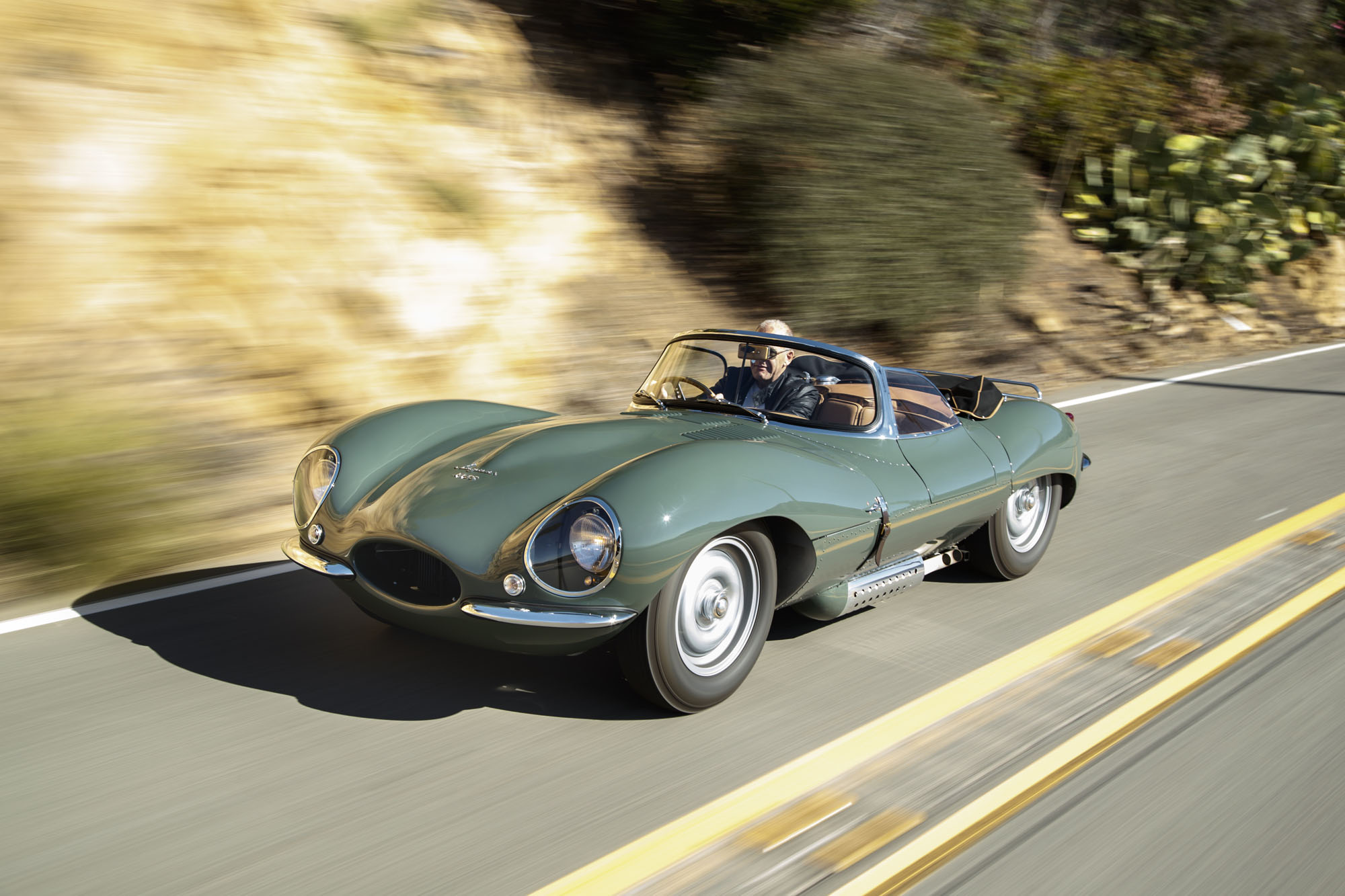
By the end of 1956 Jaguar had twenty-five D-Type chassis unsold, and in January 1957 it announced the XKSS: the same car with a full-width windscreen, a passenger door, bumpers, a folding hood, a luggage rack on the tail and the fin and the divider between the seats removed, aimed at the American market where the SCCA had changed its rules against the D-Type as a sports car. Sixteen had been built when, on the evening of 12 February 1957, fire swept through the Browns Lane factory and destroyed nine chassis in work, with the tooling; the sixteen survivors went mostly to America, Steve McQueen's green one the most famous, and two more D-Types were converted later. The Texas XKSS of Dave Tallaksen, raced at Eagle Mountain in 1957, is in Willem Oosthoek's "Wildest Cat in Texas" in the archive. In 2016 Jaguar Classic built the nine lost XKSS as continuation cars to the original drawings, and in 2018 announced twenty-five continuation D-Types to complete the hundred the factory had planned; the archive's piece on continuation cars sets out what they are and what they are not.
The road-going D-Type, newest first.
The 1954 works cars were numbered XKC 401 to 405, the 1955 long-nose works cars XKD 501 to 508, the 1956 cars XKD 601 to 606, and the customer cars XKD 509 to 573. The famous ones: XKD 505, the 1955 winner, kept by Jaguar; XKD 501, the Ecurie Ecosse car that won in 1956 and sold at Monterey in August 2016 for $21,780,000, the most ever paid for a British car and for a Jaguar; XKD 606, the 1957 winner; XKD 406, Cunningham's Sebring winner; XKD 518, one of two factory cars finished in red, which the archive's Steve Natale drove; and the cars that went to the American West Coast privateers, Lou Brero's among them, whose story Gary Horstkorta tells in "Shooting Star". The cards below link nine of the family, the C-Type before it and the XKSS and Lister-Jaguar after it, to the archive's stories; the feed has every D-Type piece on the site.
Nine cars from the archive, the car before it and the cars that came from it; each links to every story on the site.
The D-Type's drivers were the last of the gentlemen and the first of the professionals: Hawthorn, who won Le Mans in it at twenty-six and the World Championship three years later; Hamilton and Rolt, the 1953 winners who nearly won again in 1954; Bueb, who won Le Mans twice in a D-Type; Flockhart, Sanderson and Lawrence, the Scots of Ecurie Ecosse; Whitehead, Wharton, Titterington, Fairman, Frère; Dewis, the development driver who co-drove at Le Mans in 1955 and tested every car; Moss, who drove the works cars in 1954 and always said the D-Type was built for one circuit; Walters and Hansgen for Cunningham in America. Behind them Lyons, Heynes, Sayer and "Lofty" England, the team manager; David Murray and "Wilkie" Wilkinson at Ecurie Ecosse; Briggs Cunningham, whose team made the D-Type an American car. The archive's Hawthorn, Moss, Cunningham and Dewis stories and Robert Newman's portraits are the people of the car.
D-Types race at the Goodwood Revival, where the Sussex Trophy has had grids of them since 1998, at Le Mans Classic in the 1949–56 and 1957–61 grids, at the Monterey Reunion and the Silverstone Classic, and the Jaguar Heritage and Ecurie Ecosse cars still appear in the colours they wore. The market: Ecurie Ecosse's XKD 501 at $21.78 million in 2016 remains the benchmark; customer cars with period racing history bring $5–8 million; XKSSs more; the archive's Jaguars-at-auction reviews and the RM Monterey reports have the sales year by year. The feeds below carry the C-Type and XKSS threads beside the D-Type's own.
The car before: Le Mans 1951 and 1953, newest first.
The archive's galleries of D-Types at Goodwood, Le Mans Classic and the American historics are in the Everything feed; the Model tag collects them.
Built: 1954–56, 71 cars (18 works, 53 customer); 16 XKSS from the unsold chassis in 1957 (9 more destroyed in the fire); 25 continuation D-Types announced 2018, 9 continuation XKSS 2016. Engine: 3,442 cc XK straight-six, dry sump, triple Weber 45 DCO3, about 245 bhp (1954), 270–285 bhp with the wide-angle head (1955–56), Lucas fuel injection on the 1956 works cars; 3,781 cc for Ecurie Ecosse in 1957, about 306 bhp. Chassis: magnesium-alloy (later aluminium) monocoque tub, tubular front subframe, torsion-bar front and live-axle rear suspension, Dunlop disc brakes all round, Dunlop alloy wheels; about 860 kg. Speed: 172.97 mph on the Mulsanne straight, 1954; 113.85 mph race average at Le Mans 1957, the record until 1961. Le Mans: 2nd 1954; 1st 1955 (Hawthorn/Bueb), 1956 (Flockhart/Sanderson), 1957 (Flockhart/Bueb, with D-Types 2nd, 3rd, 4th and 6th). Other wins: Reims 12 Hours 1954 and 1956; Sebring 12 Hours 1955; SCCA C-Modified championships 1956–57 (Hansgen). Record price: XKD 501, $21,780,000, RM Sotheby's Monterey, 20 August 2016. The archive: 170 D-Type stories; McDonough's XKD 505 drive; the 1956 Le Mans account; Natale's XKD 518; the Cunningham, Brero and Tallaksen stories; the Jaguar auction reviews.
Short answers, with the long ones above.
Seventy-one between 1954 and 1956, eighteen for the works team and fifty-three for customers, plus sixteen XKSS road cars converted from unsold chassis in 1957; nine more XKSS were destroyed in the Browns Lane fire before completion. Jaguar Classic has since built nine continuation XKSS and is building twenty-five continuation D-Types.
The 1956 Le Mans-winning Ecurie Ecosse car sold for $21.78 million in 2016, the record for a British car at auction; customer D-Types with racing history have sold for $5–8 million and an XKSS for more; continuation cars were priced at around £1 million new.
Three times in a row: 1955 with Mike Hawthorn and Ivor Bueb for the works, 1956 with Ron Flockhart and Ninian Sanderson for Ecurie Ecosse, and 1957 with Flockhart and Bueb for Ecurie Ecosse, when D-Types also finished second, third, fourth and sixth. It was second in 1954 by 105 seconds.
The C-Type (1951–53) is a tubular spaceframe under an alloy body, the D-Type (1954–56) a riveted monocoque with a front subframe, lower, lighter in structure and far faster in a straight line; both use the 3.4-litre XK engine and the C-Type introduced the disc brakes the D-Type made famous.
A road-going D-Type: the last twenty-five chassis, fitted with a windscreen, a passenger door, bumpers and a hood in 1957 for the American market; sixteen were finished before the factory fire. Steve McQueen's is the best known.
Malcolm Sayer's tail fin behind the driver's headrest gave the car directional stability at 170 mph on the Mulsanne straight; the 1955 long-nose cars faired it into a longer tail. It was a functional aerodynamic device, not styling, and the XKSS did without it.
172.97 mph was recorded on the Mulsanne straight in 1954, and the 1957 Le Mans winner averaged 113.85 mph over twenty-four hours, a record that stood until 1961; the 3.4-litre engine gave about 250 horsepower, the 1957 3.8 about 300.
The British Motor Museum at Gaydon and Jaguar's own collection hold works cars; the Goodwood Revival, Le Mans Classic and the Rolex Monterey Motorsports Reunion run them in anger every year, and the Pebble Beach and Amelia Island concours show them.
The whole archive on one thread, newest first.