 Daytona is a name that has long been part of the speed racing history as early American-based land speed record attempts were undertaken on the beaches within a 20-minute drive of today’s Daytona International Speedway. As stated in Speed on Sand, written by William Tuthill, and published by the Daytona Beach Museum of Speed in 1969, “This area, encompassing Ormond and Daytona Beach, is the acknowledged speed capital of the world. Carried on today at Daytona International Speedway, that tradition was established over a period of six decades when the eyes of the world were focused on the stretch of sand extending from Ormond Beach to the Inlet.”
This stretch of sand became internationally renowned as perfect record-breaking territory, and every effort made to break previous land speed records at the beginning of the 20th century was seen as big news both in the USA and abroad. The automobile was in its infancy and was yet untested in this era. Drivers were true daredevils; no one could imagine the effect that such speeds would have on the human body as no one had ever driven that fast before.
From 1903-1935, the sands of Ormond-Daytona were home to most of the USA-set land speed records. It was in 1904 that W.K. Vanderbilt first set the world record in the area: 92.30 mph (148.54 km/h). This launched Daytona Beach into the international spotlight as the public was eager to follow, and the media ready to cover, the newest developments as each man attempted to better the last. There were the famous few, men like Ralph DePalma and his 12-cyclindar Packard, Sir Henry Segrave, the first to reach 200 mph (321.87 km/h) in an automobile and who introduced driver helmets to the USA, and the great Sir Malcolm Campbell and his world-famous Bluebird. It was a time when the automobile was new and the spirit of competition ran deep in the men who drove these great machines.
After a few trial years and initial records set by DePalma and Seagave, it was Sir Malcolm Campbell who elevated the world speed standard to 245.73 mph (395.46 km/h) in 1931, and in 1932 he raised the bar yet again to 253.97 mph (408.73 km/h). At a farewell party that year Campbell made a stunning announcement: he would return the following year with the new goal of reaching 300 mph (482.80 km/h) and thus 1933 -1935 became known as “the Campbell years.”
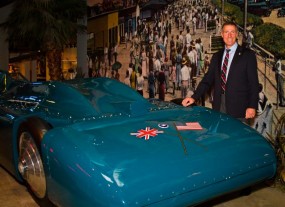
The 1933 version of his Bluebird proved incapable of harnessing the true power of its Rolls-Royce engine. While Campbell did add another 20 miles an hour to his existing record, the smallest bump in the sand proved to have disastrous results, resulting in a flying leap of over 30 feet and $1,800 tires that were completely destroyed with every run. It took two more years to complete the new Bluebird, which housed many design features well ahead of the times and which required aircraft mechanics to maintain and repair.
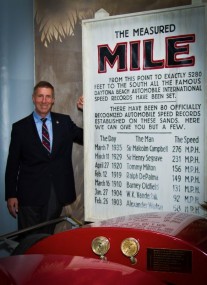 Although the Bluebird could not clock a multiple-run record time of over 300 mph, Campbell did clock in at 330 mph on one run, making him the first to break the 300 mph barrier and giving him the combined Land Speed Record time of 276.82 mph (445.50 km/h), a record that still stands as the fastest mile ever driven on Daytona Beach. This record moment also marks Rolex’s first involvement in early motorsport, as Campbell was wearing a Rolex timepiece during his 1935 landmark speed record attempt.
Although later land speed records would move to the Utah Salt Flats, Daytona remains the original “world centre of speed” thanks to the hard-packed sands that were ideal for early record-setting trials. Daytona continued on in the spirit of this tradition by inviting Andy Green to be the Grand Marshal for the 2011 Rolex 24 at Daytona. Andy Green, also known as “the world’s fastest man,” is the current land speed record holder. On October 15, 1997, the Royal Air Force Wing Commander drove the Thrust SSC in the Nevada desert to a supersonic speed of 763.035 mph (1228 km/h) – breaking the sound barrier.
To quote William Tuthill once again, “as each speed barrier is broken something new is discovered – better metals, better tires, better manufacturing techniques. History proves that engineering development based on speed has also determined the fate of nations and made possible the successful landing on the moon. It’s a fascinating history and it all started here.”
[Source: Rolex Motorsports]
Speed Capital of the World – Record Days at Daytona Beach